US Dollar does not see much change after Powell's speech
- The US Dollar flat for a second day in a row this week.
- Fed Chairman Jerome Powell says to lawmakers no rush to change rates.
- The US Dollar Index (DXY) is not ging anywhere and is residing above 108.00 wh.ile looking for direction
The US Dollar Index (DXY), which tracks the performance of the US Dollar against six major currencies, is holding steady at 108.00 after Federal Reserve (Fed) Chaiman Jerome Powell told lawmakers at Capitol Hill the Fed is in no rush or condition to change its monetary policy rate. Meanwhile, the Greenback looks to be immune to US President Donald Trump's tariff talks. While China silently slapped some minor tariffs on US goods in a tit-for-tat move on Monday, Trump introduced a 15% levy on steel and aluminum for all countries importing that will come into effect on March 12.
The economic calendar this Tuesday is being taken over by the Federal Reserve (Fed). Besides Fed Chairman Jerome Powell testifying before Congress, three Fed speakers are due to make an appearance. Traders will want to hear if the central bank has plans for any changes in its monetary policy soon. Meanwhile head of the Department of Government Efficiency (DOGE), Elon Musk, has mentioned the Fed is the next sucject for audit.
Daily digest market movers: No change ahead
- Elon Musk on Sunday said that the Fed could face scrutiny as the Department of Government Efficiency (DOGE) continues to audit federal agencies and spending. Musk wrote on X in response to a user's post about the billionaire's support for an audit of the Fed that the central bank isn't above scrutiny from DOGE, Reuters reports.
- At 11:00 GMT, The National Federation of Independent Business (NFIB) has released its Business Optimism Index for January. The number came in at 102.8, below the 104.6 estimate and down from 105.1 in the December reading.
- Fed Chairman Jerome Powell did not tell much new. Chairman Powell reiterated that the current Fed policy is ready for risks or uncertainty and that there is no rush to change its stance for now.
- More Fed speakers are lined out to speak throughout the day:
- At 13:50 GMT, President of the Federal Reserve Bank of Cleveland Beth Hammack has held a speech at the 2025 Economic Outlook Conference at the Central Bank Center. Fed's Hammack said to wait and see for incoming data, to be sure inflation is on the right path for another rate cut.
- At 20:30 GMT, Federal Reserve Governor Michelle Bowman speaks at the Iowa Bankers Association Bank Management and Policy Conference in Des Moines.
- At 20:30 GMT, Federal Reserve Bank of New York President John Williams also delivers keynote remarks at the CBIA Economic Summit and Outlook 2025, organized by the Connecticut Business and Industry Association (CBIA) in Connecticut.
- Equities are turning flat after a not-so-hawkish Fed speech from Fed Chairman Jerome Powell.
- The CME FedWatch tool projects a 93.5% chance that the Fed will keep interest rates unchanged at its next meeting on March 19.
- The US 10-year yield is trading around 4.54%, ticking up further for a second day in a row and recovering further from its fresh yearly low of 4.40% printed last week.
US Dollar Index Technical Analysis: Not what was expected
The US Dollar Index (DXY) is really turning into a snooze fest this week. No real movement in the Greenback as of yet, despite plenty of headlines. Though US yields are the asset to monitor, with Powell’s testimony ahead, things might start to move from now.
On the upside, the first barrier at 109.30 (July 14, 2022, high and rising trendline) was briefly surpassed but did not hold last week. Once that level is reclaimed, the next level to hit before advancing further remains at 110.79 (September 7, 2022, high).
On the downside, 107.35 (October 3, 2023, high) is still acting as strong support after several tests last week. In case more downside occurs, look for 106.52 (April 16, 2024, high), 106.14 (100-day Simple Moving Average), or even 105.89 (resistance in June 2024) as better support levels.
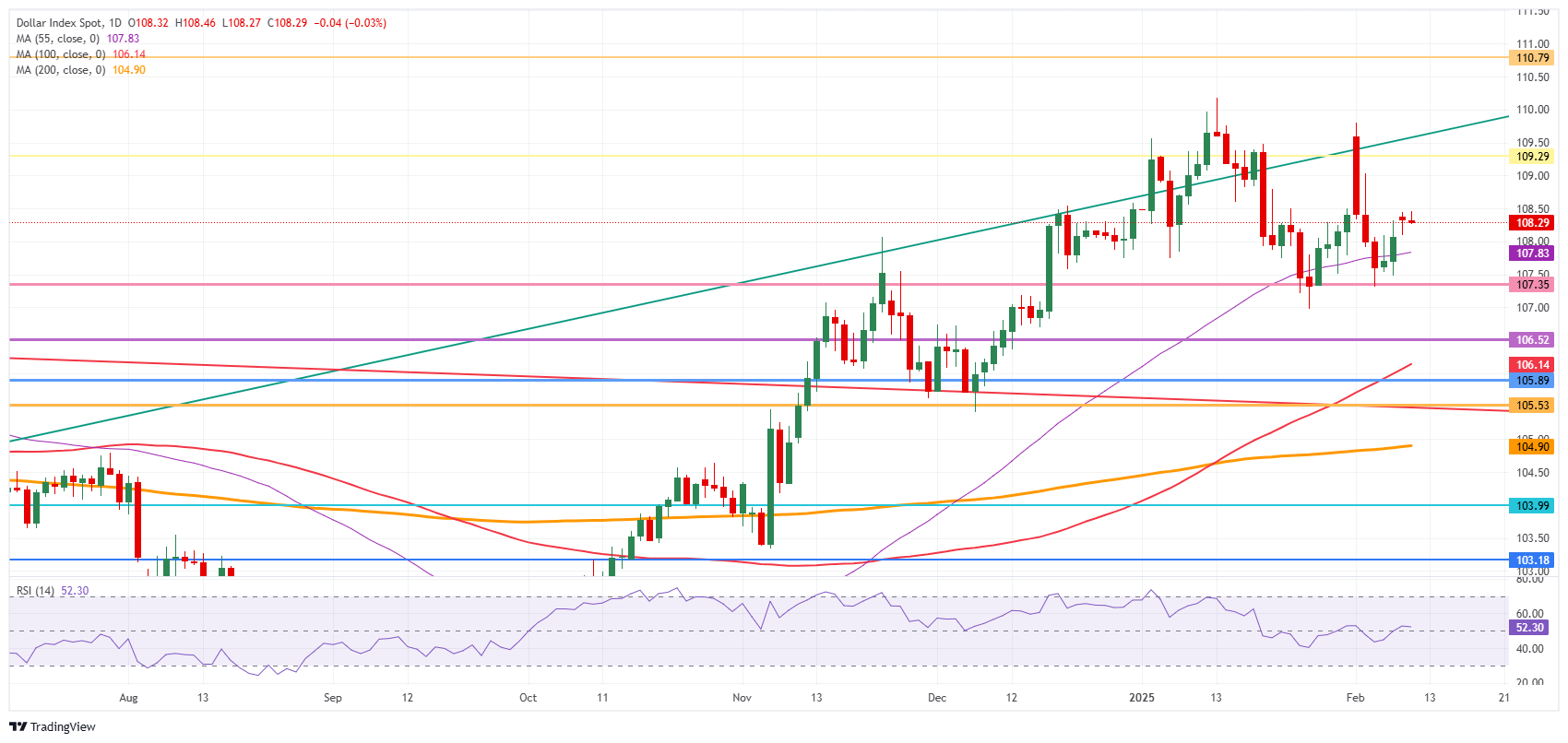
US Dollar Index: Daily Chart
Risk sentiment FAQs
In the world of financial jargon the two widely used terms “risk-on” and “risk off'' refer to the level of risk that investors are willing to stomach during the period referenced. In a “risk-on” market, investors are optimistic about the future and more willing to buy risky assets. In a “risk-off” market investors start to ‘play it safe’ because they are worried about the future, and therefore buy less risky assets that are more certain of bringing a return, even if it is relatively modest.
Typically, during periods of “risk-on”, stock markets will rise, most commodities – except Gold – will also gain in value, since they benefit from a positive growth outlook. The currencies of nations that are heavy commodity exporters strengthen because of increased demand, and Cryptocurrencies rise. In a “risk-off” market, Bonds go up – especially major government Bonds – Gold shines, and safe-haven currencies such as the Japanese Yen, Swiss Franc and US Dollar all benefit.
The Australian Dollar (AUD), the Canadian Dollar (CAD), the New Zealand Dollar (NZD) and minor FX like the Ruble (RUB) and the South African Rand (ZAR), all tend to rise in markets that are “risk-on”. This is because the economies of these currencies are heavily reliant on commodity exports for growth, and commodities tend to rise in price during risk-on periods. This is because investors foresee greater demand for raw materials in the future due to heightened economic activity.
The major currencies that tend to rise during periods of “risk-off” are the US Dollar (USD), the Japanese Yen (JPY) and the Swiss Franc (CHF). The US Dollar, because it is the world’s reserve currency, and because in times of crisis investors buy US government debt, which is seen as safe because the largest economy in the world is unlikely to default. The Yen, from increased demand for Japanese government bonds, because a high proportion are held by domestic investors who are unlikely to dump them – even in a crisis. The Swiss Franc, because strict Swiss banking laws offer investors enhanced capital protection.
Author

Filip Lagaart
FXStreet
Filip Lagaart is a former sales/trader with over 15 years of financial markets expertise under its belt.
















