US Dollar turns flat in US session with markets a bit clueless on what to do next
- The Greenback is softening earlier gains, turning either flat or marginally stronger against most major peers.
- US data remains very mixed, casting a shadow over the upcoming US Jobs Reports on Friday.
- The US Dollar Index (DXY) falls back below 108.00, unable to hold on to bigger gains.
The US Dollar Index (DXY), which tracks the performance of the US Dollar against six major currencies, is starting to wobble at the end of Thursday's European trading session. The earlier pop came after comments from US President Donald Trump revealing his intentions to take over Gaza and reach a nuclear deal with Iran. Besides that, a plan to end the war in Ukraine will probably be put on the table either this or next week by the Trump administration as well. After a few weeks into his presidency, President Donald Trump is starting to soothen his harsh stance against several countries.
On the economic data front, comments from US Treasury Secretary Scott Bessent sparked some support in US yields. Bessent said that the Trump administration wants to bring down 10-year Treasury yields, not the Federal Reserve's (Fed) benchmark short-term interest rate, Bloomberg reports. For this Thursday, the weekly US Jobless Claims were a bit of a let-down with again higher numbers, ahead of Friday’s Nonfarm Payrolls print.
Daily digest market movers: That job market is starting to turn
- The Bank of England (BoE) has released its monetary policy decision. As expected a 25 basis point (bps) rate cut was applied to 4.50% from 4.75%. The vote split was 7 in favor for a 25 basis point rate cut against 2 votes for a 50 basis points rate cut.
- The US Challenger Job Cuts for January is ticking up further to already 49,795 layoffs with the previous number at 38,792.
- The US Jobless Claims are due for the week ending January 31.
- Initial Claims came in at 219,000, beating the 213,000 expectation and moving up from 207,000 last week.
- Continuing Claims are jumping to 1.886 millio, beating the 1.87 million headcount and above last week's 1.858 million.
- At 19:30 GMT, Federal Reserve Governor Christopher Waller participates in a discussion on the future payments at the GeoEconomics Center, hosted by the Atlantic Council in Washington D.C.
- San Francisco Fed President Mary Daly is set to speak as well at 20:30 GMT.
- At 22:10 GMT, Dallas Fed President Lorie Logan speaks on a panel discussion titled "Future Challenges for Monetary Policy in the Americas" at an event in Mexico City.
- Equities are catching a breather on the back of the soothing comments from US President Donald Trump. Across the board, from China over Europe to US Futures, are in the green.
- The CME FedWatch tool projects an 85.5% chance of the Fed keeping interest rates unchanged in the next meeting on March 19.
- The US 10-year yield is trading around 4.42%, recovering from its fresh yearly low at 4.40% printed on Wednesday.
US Dollar Index Technical Analysis: Too small recovery
The US Dollar Index (DXY) is finally breathing a sigh of relief, bouncing off from some technical levels in several major crosses against the US Dollar. Comments from US President Donald Trump and US Treasury Secretary Scott Bessent at least helped to trigger a slight turnaround in the DXY after its past three-day decline. Meanwhile, pressure will build up in the runup to the Nonfarm Payrolls report for January, which will be released on Friday.
On the upside, the first barrier at 109.30 (July 14, 2022, high and rising trendline) was briefly surpassed but did not hold on Monday. Once that level is reclaimed, the next level to hit before advancing further remains at 110.79 (September 7, 2022, high).
On the downside, the October 3, 2023, high at 107.35 has withstood the recent selling pressure. For now, that level still looks to be holding, though watch out for the Relative Strength Index (RSI), which still has some room for the downside. Hence, look for 106.52 (April 16, 2024, high) or even 105.90 (resistance in June 2024 and 100-day Simple Moving Average) as better support levels.
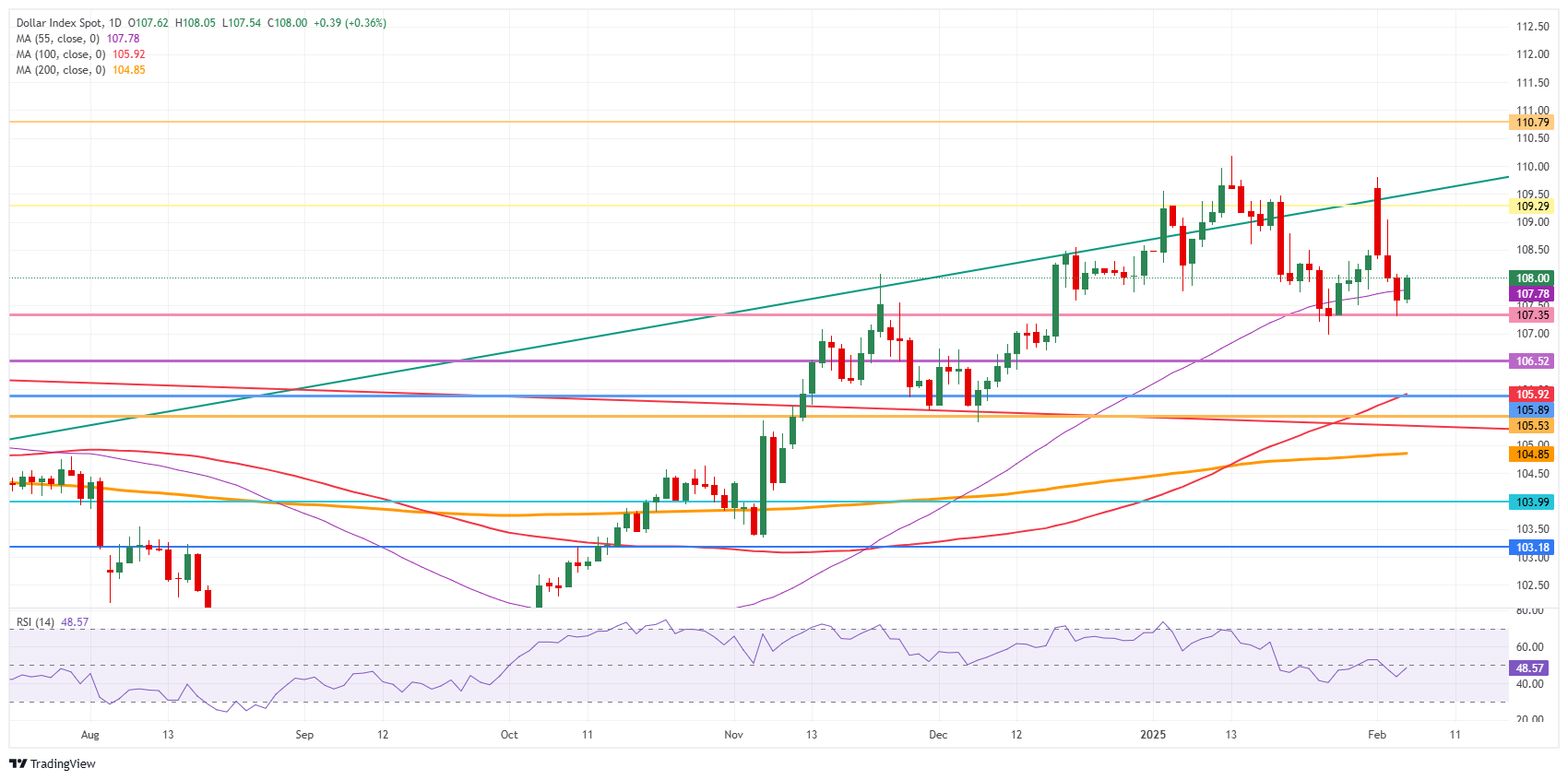
US Dollar Index: Daily Chart
Central banks FAQs
Central Banks have a key mandate which is making sure that there is price stability in a country or region. Economies are constantly facing inflation or deflation when prices for certain goods and services are fluctuating. Constant rising prices for the same goods means inflation, constant lowered prices for the same goods means deflation. It is the task of the central bank to keep the demand in line by tweaking its policy rate. For the biggest central banks like the US Federal Reserve (Fed), the European Central Bank (ECB) or the Bank of England (BoE), the mandate is to keep inflation close to 2%.
A central bank has one important tool at its disposal to get inflation higher or lower, and that is by tweaking its benchmark policy rate, commonly known as interest rate. On pre-communicated moments, the central bank will issue a statement with its policy rate and provide additional reasoning on why it is either remaining or changing (cutting or hiking) it. Local banks will adjust their savings and lending rates accordingly, which in turn will make it either harder or easier for people to earn on their savings or for companies to take out loans and make investments in their businesses. When the central bank hikes interest rates substantially, this is called monetary tightening. When it is cutting its benchmark rate, it is called monetary easing.
A central bank is often politically independent. Members of the central bank policy board are passing through a series of panels and hearings before being appointed to a policy board seat. Each member in that board often has a certain conviction on how the central bank should control inflation and the subsequent monetary policy. Members that want a very loose monetary policy, with low rates and cheap lending, to boost the economy substantially while being content to see inflation slightly above 2%, are called ‘doves’. Members that rather want to see higher rates to reward savings and want to keep a lit on inflation at all time are called ‘hawks’ and will not rest until inflation is at or just below 2%.
Normally, there is a chairman or president who leads each meeting, needs to create a consensus between the hawks or doves and has his or her final say when it would come down to a vote split to avoid a 50-50 tie on whether the current policy should be adjusted. The chairman will deliver speeches which often can be followed live, where the current monetary stance and outlook is being communicated. A central bank will try to push forward its monetary policy without triggering violent swings in rates, equities, or its currency. All members of the central bank will channel their stance toward the markets in advance of a policy meeting event. A few days before a policy meeting takes place until the new policy has been communicated, members are forbidden to talk publicly. This is called the blackout period.
Author

Filip Lagaart
FXStreet
Filip Lagaart is a former sales/trader with over 15 years of financial markets expertise under its belt.
















