UPS stock drops back to covid lows as Bank of America cuts price target
- UPS stock sinks for second day after missing Q2 earnings consensus.
- Failure to issue 2025 guidance has led UPS stock below $90 per share.
- Fed Chair speech has market trading mixed.
- Microsoft, Meta Platforms earnings after bell will lead sentiment.

United Parcel Service (UPS) stock sank for the second straight session on Wednesday following poor quarterly earnings results to visit the region below $90 that it hasn't seen since the onset of covid in 2020. For the second straight quarter, UPS executives opted not to provide 2025 guidance as the Trump administration hikes and lowers tariff rates that have a direct effect on trade flows.
The broader market is mixed with the Dow Jones down 0.1% at noon EST, while the NASDAQ Composite rises sheepishly. Investors are waiting on the post-interest rate decision speech from Federal Reserve (Fed) Chair Jerome Powell, which will have the power to shift markets in the late afternoon. Following the speech, Microsoft (MSFT), Meta Platforms (META) and Qualcomm (QCOM) all release quarterly earnings after the bell. In other words, it's a big day for the US equity market.
Additionally, Personal Consumption Expenditures (PCE) inflation data arrives on Thursday and the ever-important Nonfarm Payrolls (NFP) for July are out on Friday. Friday is also when the Trump administration will begin locking in tariff rates on countries with which it hasn't yet reached a trade deal.
UPS stock news
UPS only narrowly missed Q2 earnings on Tuesday, and revenue beat the Wall Street consensus by $350 million despite falling 3% from a year earlier. The delivery company reported $1.55 in adjusted earnings per share (EPS) on $21.2 billion.
Some decline in revenue was expected as UPS winds up its low-margin shipping partnership with Amazon (AMZN). The company's sale of its Coyote Logistics business to XPO has also led to an expected decline in its Supply Chain Solutions segment.
US shipping revenues fell 0.8% YoY to $14.1 billion, but international shipping revenue rose 2.6% YoY to $4.5 billion. Total packages shipped in the second quarter reached 19.74 million, a 5.7% decline from the year ago quarter's 20.93 million. However, that was largely due to the retrenchment from working with Amazon, and average revenue per piece rose 4.8% YoY to $14.34.
"Our second quarter results reflect both the complexity of the landscape and the strength of our execution," said CEO Carol Tomé in a statement. "We are making meaningful progress on our strategic initiatives, and we’re confident these actions are positioning the company for stronger long-term financial performance and enhanced competitive advantage."
Bank of America lowered its price target on UPS stock to $98 from $115, citing increased pressure from tariffs on small to medium-sized businesses.
UPS stock forecast
UPS stock has been trending lower since achieving an all-time high above $233 per share in February 2022. The position it is now in is nothing short of submission. Tracing its way back to the covid lows of 2020 shows how little faith the market has in this long-time powerhouse.
Weighing it down is the 7% dividend that it has raised every year since 2010. At $6.56, the 2025 dividend is set to account for about 94% of the full-year profit of $6.97 per share. That's if UPS still achieves that level of profitability, something uncertain now that it has pulled guidance.
The market is guessing that the board will choose to cut the dividend to give the company more breathing room as the next 18 months appear uncertain.
In the meantime, expect UPS to sit within the $82 to $90 support range that began five years ago. A break below $82, the covid low, would send UPS shares into no man's land.
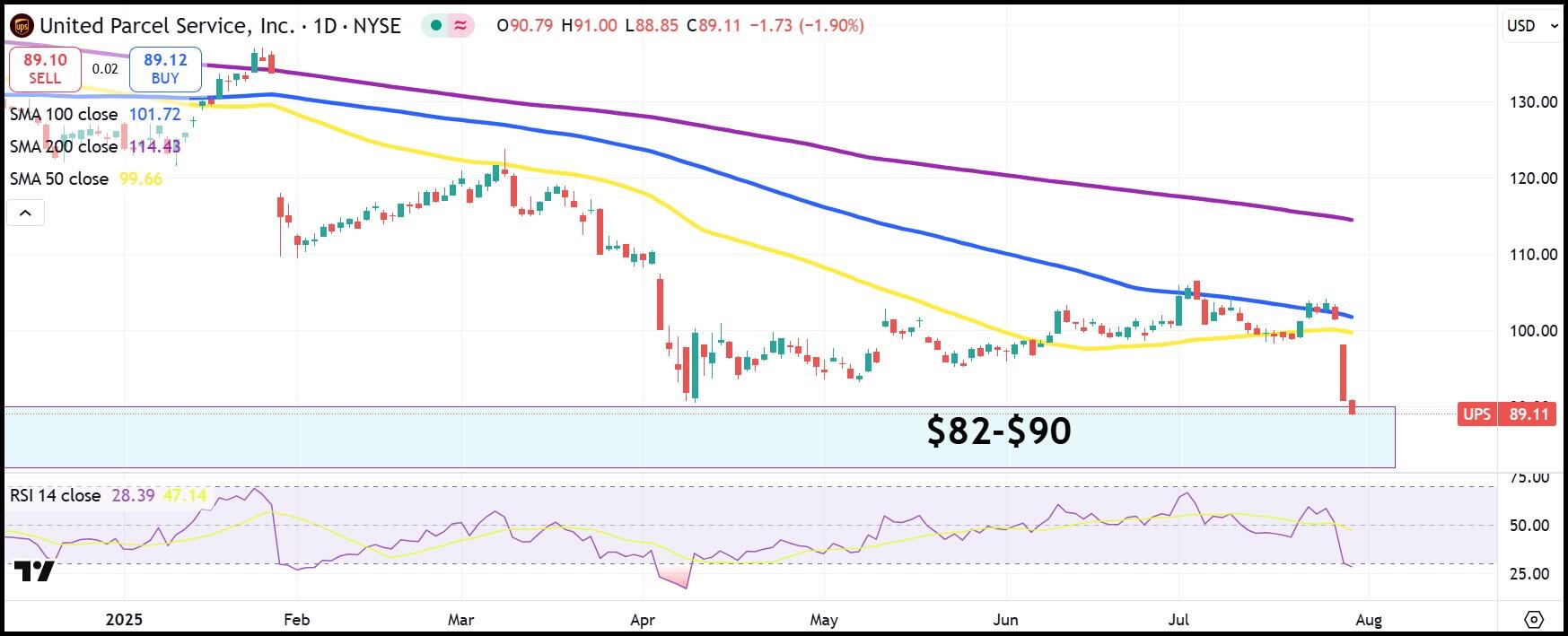
UPS daily stock chart
Author

Clay Webster
FXStreet
Clay Webster grew up in the US outside Buffalo, New York and Lancaster, Pennsylvania. He began investing after college following the 2008 financial crisis.

















