UnitedHealth stock spirals after missing quarterly EPS, lowering 2025 guidance
- UNH stock loses over 5% as earnings miss consensus.
- Medicals costs continue to rise for UnitedHealth Group.
- Insurer lowers 2025 revenue guidance, cuts adjusted EPS outlook to $16.
- UPS, Merck, Boeing earnings also disappoint.


UnitedHealth Group (UNH) stock sank over 5% on Tuesday after the largest health insurer in the US missed Wall Street's already lowered estimate for the second quarter. The Minnesota-based company reported adjusted earnings per share of $4.08, which was more than 8% off the $4.45 consensus target.
Additionally, the health insurer lowered its full-year 2025 guidance on revenue. UNH stock sank below $267 toward the vicinity of its five-year lows witnessed on May 15.
The Dow Jones Industrial Average (DJIA), which includes UNH as a top holding, shed 0.5%, while the NASDAQ Composite lost 0.4% and the S&P 500 dropped 0.3%. The negativity follows a poor showing from the JOLTS Job Openings report that arrived at 7.437 million open positions in June, which was below the 7.55 million consensus and the 7.771 revised figure from May.
Meanwhile, the Conference Board's US Consumer Confidence Index rose to 97.2 in July from 95.2 in June. However, the US stock market focused on a slew of negative earnings releases. Besides UnitedHealth, UPS (UPS), Merck (MRK), PayPal (PYPL) and Boeing (BA) all sold off substantially on poor showings.
UnitedHealth Group earnings review
Revenue of $111.62 billion was a bright spot in UnitedHealth's second-quarter release. The figure rose 13% YoY and beat consensus by $30 million.
The downside was once again the sharply rising medical costs that health insurers across the country are facing. The company reported a consolidated medical care ratio of 89.4%, which was 430 basis points higher than a year earlier and wiped out much of its profits.
Management blamed the government's reduction in Medicare funding, as well as higher medical intensity trends and unit costs. UnitedHealth's former CEO Andrew Witty left in May after first-quarter results showed a similar stark reversal in fortunes.
For the full-year 2025 outlook, management gave a midpoint of $446.75 billion, which compares negatively to the past guidance for $449 billion. Still, the insurer remains on a customer growth trajectory for both Optum and UnitedHealthcare segments.
Management also lowered the 2025 guidance for adjusted EPS to $16.00 from $20.90. Looking ahead, some investors are worried about the US government reducing funding to the Medicare Part D program that funds pharmaceuticals for seniors. The Trump administration is set to reduce funding by 40% in 2026, which will sharply increase costs for the retired population by way of spiking premiums.
UnitedHealth Group stock forecast
UNH stock is now well off its all-time high from November 2024 above $630, down 57% in just nine months. Trending below the 200-day, 100-day and 50-day Exponential Moving Averages, UNH is still trading above the May 15 low of $248.88.
Long-term holders will add to positions here, knowing that the insurance industry is generally safe and will revert higher as cyclical issues fade. But many will also stay on the sidelines as the US Justice Department continues its investigation of Medicare billing practices.
Trading near the oversold region on Tuesday with a Relative Strength Index (RSI) reading of 31, most institutional holders won't repurchase UNH until a confirmed close above the $342 level or a closing of the May 12 gap at $376.84.
Traders will expect some time to pass before UNH makes its way back to those levels. For right now, the only bull targets in sight are the 50-day and 100-day SMA in the $290s.
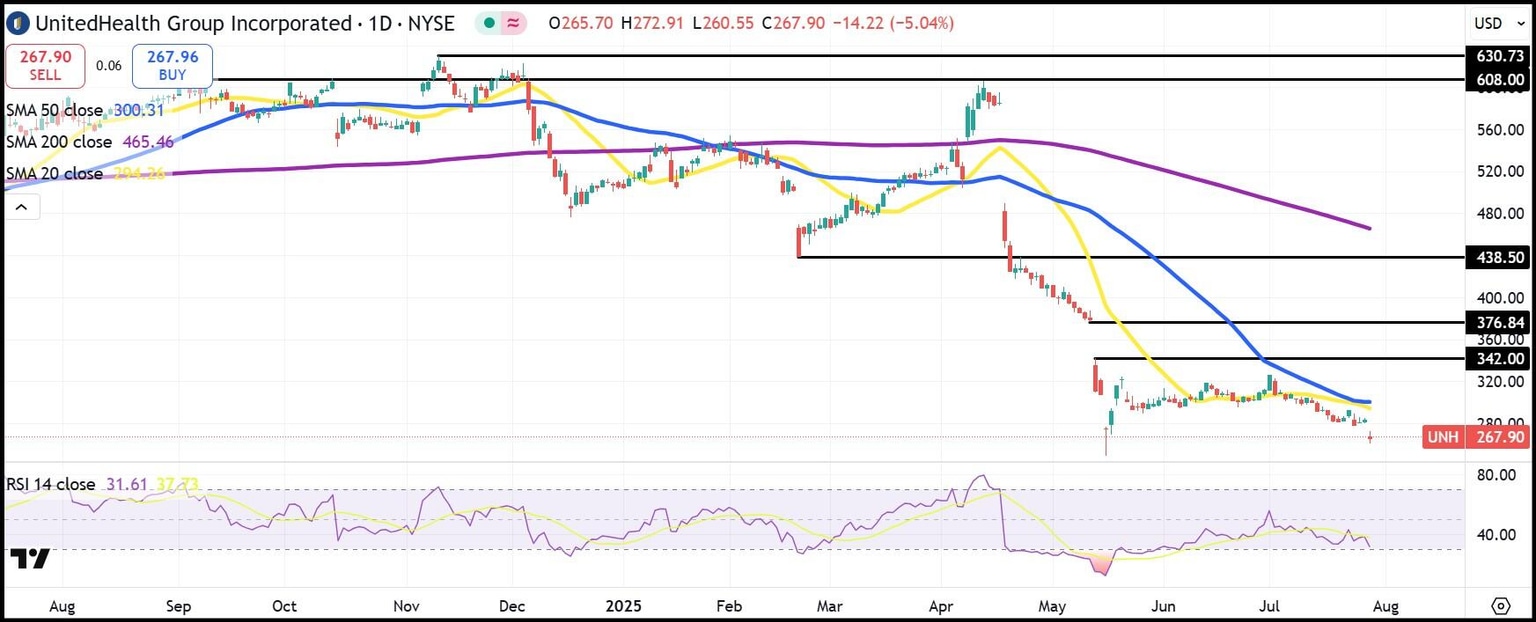
UNH daily stock chart
Premium
You have reached your limit of 3 free articles for this month.
Start your subscription and get access to all our original articles.
Author
Clay Webster
FXStreet
Clay Webster grew up in the US outside Buffalo, New York and Lancaster, Pennsylvania. He began investing after college following the 2008 financial crisis.