UnitedHealth Group stock surges on higher Medicare Advantage payments
- UNH stock rises most in two months on CMS payment change.
- Medicare Advantage payments are set to rise 4.33% on average in 2026.
- UnitedHealth managed 29%, the largest share, of Medicare Advantage plans last year.
- UNH stock rises above 200-day moving average for the first time in a month.

UnitedHealth Group (UNH) stock moved against the grain on Monday, powering more than 4% higher by the afternoon on news that the US government has decided to raise privately-managed health insurance payments for retirees by 4.33%.
The announcement, which appeared during the post-market last Friday, has helped drive buyers into nearly all US health insurers on Monday. Besides UNH, up 4.9%, CVS Health (CVS) rose 6.6%, and Humana (HUM) surged 7.3%.
UnitedHealth Group is the second-largest holding in the Dow Jones Industrial Average (DJIA), which rose 0.6% on Monday despite the NASDAQ slumping 0.8%.
UnitedHealth Group stock news
UNH stock is finally returning to form after UnitedHealthcare CEO Brian Johnson was gunned down outside an investor meeting in Midtown Manhattan on December 4, leading to a weeklong manhunt that brought light to UnitedHealth’s record of denying health claims and general unpopularity with the public.
The negative headlines led a group of investors from the Interfaith Center on Corporate Responsibility (ICCR) to ask the UnitedHealth board last week to devise a report on the insurer’s business practices in regard to denying or limiting claims. The ICCR represents $4 trillion in assets under management from its 300 institutional investors.
Last Friday’s announcement from the US Centers for Medicare & Medicaid Services (CMS) that it would raise Medicare Advantage reimbursement rates by 4.33% was then greatly welcomed by melancholy shareholders.
The CMS predicts that its payments to Medicare Advantage plans will rise by $21 billion in 2026 compared with this year due to the change, and the agency said it will seek public comment through February 10. By that time, the Trump administration will have assumed office.
On December 12, Trump chose celebrity heart surgeon Dr. Mehmet Oz as the administrator of the CMS. In his announcement, President-elect Trump said that “[Oz] will also cut waste and fraud within our country's most expensive government agency, which is a third of our nation's healthcare spend, and a quarter of our entire national budget."
The Biden administration may be attempting to side-step the incoming administration’s focus on cutting healthcare spending with the new announcement. Reversing this policy may prove unpopular with the American public, especially since Medicare Advantage plans have become quite popular.
UnitedHealth managed 29% of all Medicare Advantage plans in 2024, while Humana managed 18% and CVS managed 12%.
UnitedHealth stock forecast
UnitedHealth stock is back up above its 200-day Simple Moving Average (SMA) for the first time since December 11, more than a month ago. That's a good sign as it means the present downtrend may be nearing its end.
The Moving Average Convergence Divergence (MACD) indicator is well below the zero threshold, but its bullish crossover is becoming more pronounced. This is a sign that the comeback rally has legs. Between December 4 and December 17, when shares found support near $476, UNH stock corrected more than 20%. Now UNH stock has recovered nearly half that ground lost.
The 50-day SMA comes next near $557 before the 100-day near $570. UNH shares may consolidate at either of these levels before making a run back to the $600s. Long-term support remains in the $465 to $480 region.
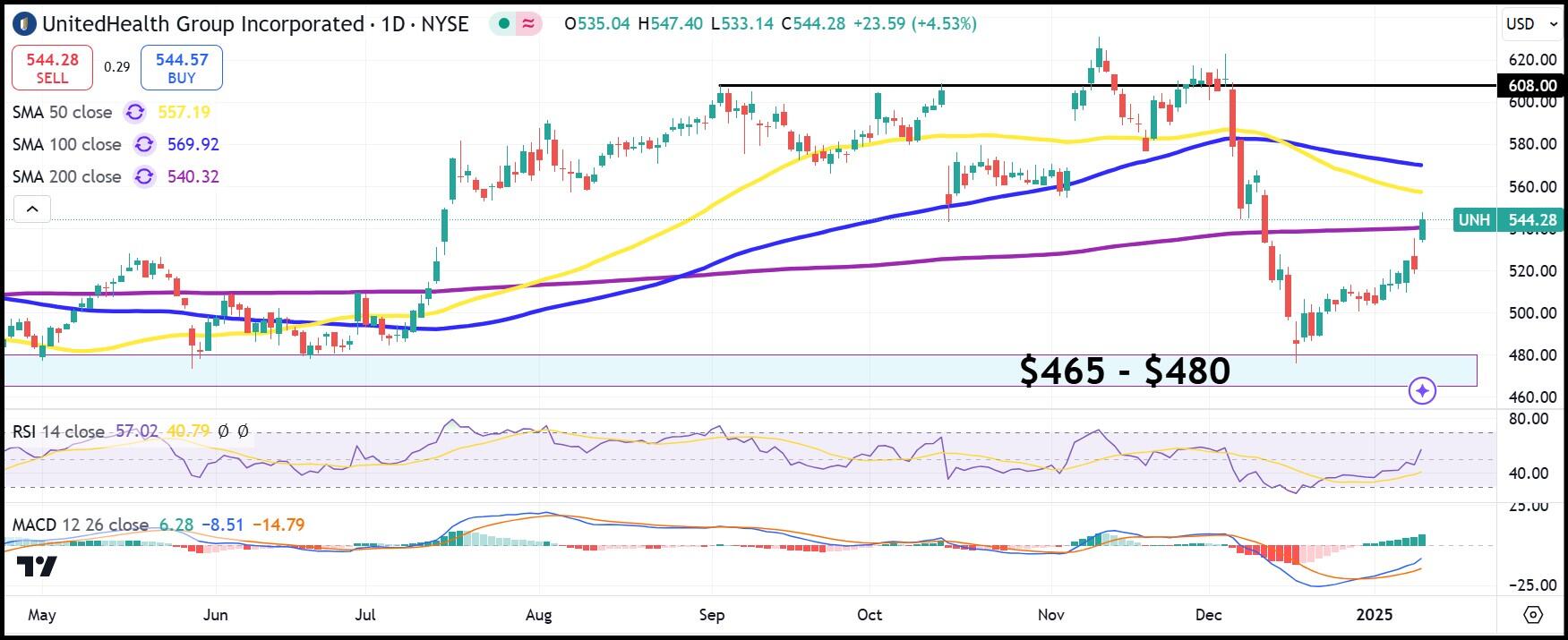
UNH daily stock chart
Author

Clay Webster
FXStreet
Clay Webster grew up in the US outside Buffalo, New York and Lancaster, Pennsylvania. He began investing after college following the 2008 financial crisis.