United States FX Today: USD under pressure ahead of the Michigan Consumer Confidence Index

The US Dollar (USD) retreated on Thursday with the US Dollar Index (DXY) down 0.3% over the session, weighed down by the publication of US inflation data.
Market attention now turns to the release of the Michigan Consumer Confidence Index for September, due on Friday at 14:00 GMT.
Markets are anticipating a reading of 58.0, close to the previous month's 58.2, after a sharp decline in August due to a resurgence of inflation concerns and tighter conditions for the purchase of durable goods.
Against a backdrop of uncertain monetary policy, this statistic could rekindle debate over the Federal Reserve's (Fed) interest rate trajectory.
Investors will be watching for the slightest sign of improvement or deterioration in consumer confidence, a crucial barometer for the direction of consumer spending and, by extension, of US economic momentum.
Confidence at half-mast, reflecting persistent economic tension
The Michigan Consumer Confidence Index, compiled by the University of Michigan, stood at 58.2 points in August, down from 61.7 in July, marking its first decline in four months.
This decline, albeit moderate, reflects a return to caution among American households. As survey director Joanne Hsu explained, "The decline in confidence is widespread, regardless of income level, age or financial wealth".
Households remain concerned about the persistent rise in prices: 43% of respondents feel that inflation is eroding their standard of living, the highest rate in five months.
Purchasing conditions for durable goods suffered particularly badly, reaching their lowest level in a year, especially for automobiles, affected by soaring prices and customs tariffs. Indeed, nearly 62% of consumers cited tariffs as a negative factor, the highest level since last May.
This deterioration in economic perception is accompanied by growing pessimism about the job market. In August, 63% of those surveyed expected unemployment to rise over the next 12 months, compared with just 37% a year earlier.
Cautiousness is also evident in inflation expectations, with a one-year price increase forecast of 4.8%, in line with rising tariff tensions.
DXY technical analysis: The US Dollar retreats in line with its current trend
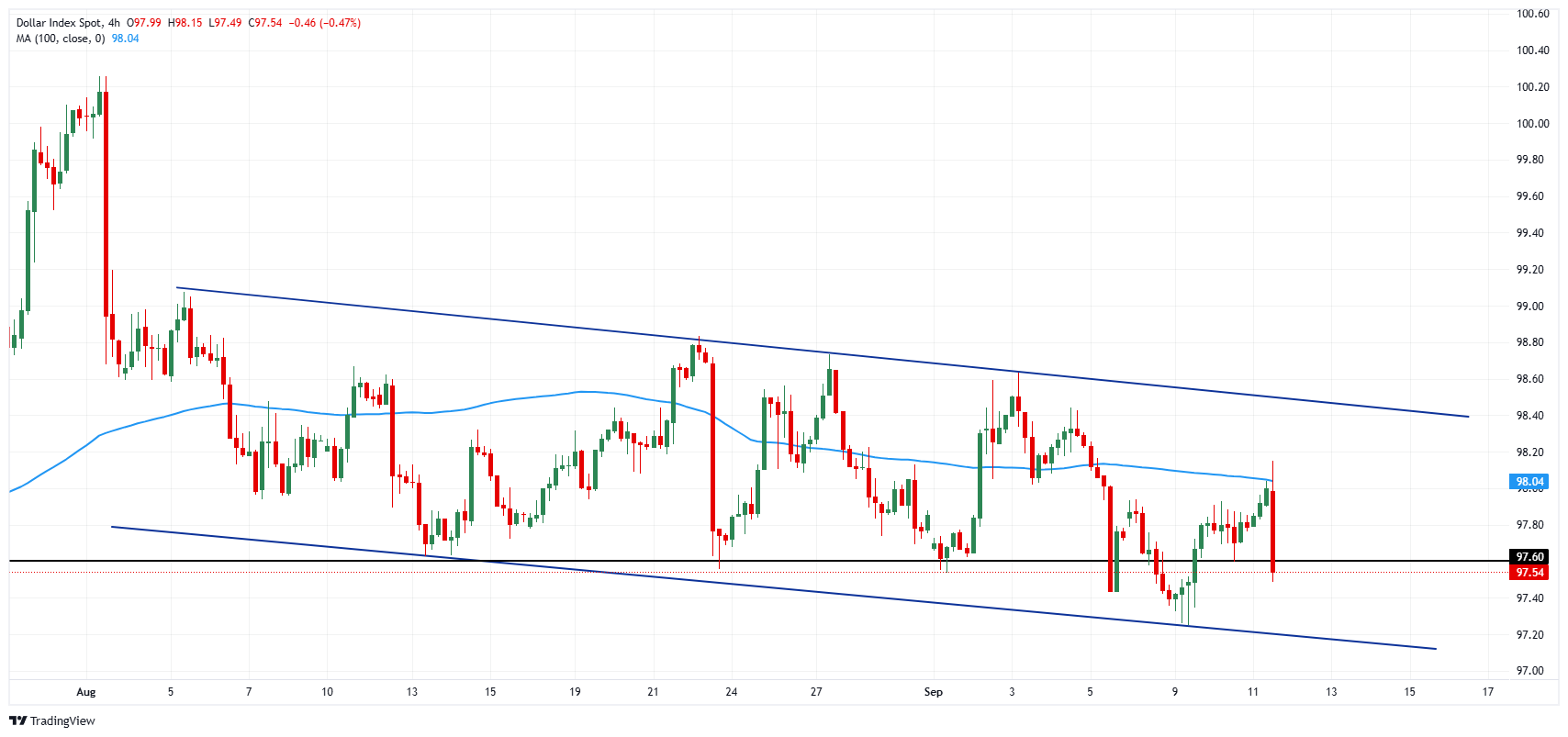
US Dollar Index 4-hour chart. Source: FXStreet
The US Dollar Index retreats on Thursday, breaking below a static support level at 97.60, which may strengthen the downtrend pressure in the short term.
Thus, the downtrend that has lasted since August remains in effect, with the Greenback in a bearish channel on the 4-hour chart.
A breakout from this channel, currently between 97.25 and 98.55, remains necessary before we can consider a more significant impetus — on the downside as well as the upside.
While the current trend is largely dictated by expectations of a Fed rate cut in September, Friday’s consumer data could provide additional information on the extent of the rate cut to come, and above all, on the trajectory the Fed could follow for the rest of the year. This, of course, should have ample influence on the US Dollar price.
US Dollar Price Today
The table below shows the percentage change of US Dollar (USD) against listed major currencies today. US Dollar was the strongest against the Canadian Dollar.
| USD | EUR | GBP | JPY | CAD | AUD | NZD | CHF | |
|---|---|---|---|---|---|---|---|---|
| USD | -0.34% | -0.23% | -0.16% | -0.14% | -0.40% | -0.34% | -0.39% | |
| EUR | 0.34% | 0.09% | 0.03% | 0.20% | -0.10% | 0.03% | -0.10% | |
| GBP | 0.23% | -0.09% | -0.04% | 0.09% | -0.25% | -0.06% | -0.19% | |
| JPY | 0.16% | -0.03% | 0.04% | 0.08% | -0.22% | -0.05% | -0.17% | |
| CAD | 0.14% | -0.20% | -0.09% | -0.08% | -0.40% | -0.17% | -0.25% | |
| AUD | 0.40% | 0.10% | 0.25% | 0.22% | 0.40% | 0.13% | 0.00% | |
| NZD | 0.34% | -0.03% | 0.06% | 0.05% | 0.17% | -0.13% | -0.15% | |
| CHF | 0.39% | 0.10% | 0.19% | 0.17% | 0.25% | -0.01% | 0.15% |
The heat map shows percentage changes of major currencies against each other. The base currency is picked from the left column, while the quote currency is picked from the top row. For example, if you pick the US Dollar from the left column and move along the horizontal line to the Japanese Yen, the percentage change displayed in the box will represent USD (base)/JPY (quote).
Author

Ghiles Guezout
FXStreet
Ghiles Guezout is a Market Analyst with a strong background in stock market investments, trading, and cryptocurrencies. He combines fundamental and technical analysis skills to identify market opportunities.

















