UBS ends Credit Suisse Crisis with $3.25 billion buyout, CS stock purchased for 0.76 CHF
- UBS purchased Credit Suisse for $3.25 billion over the weekend.
- AT1 bondholders will not receive bailout.
- CS stock (ADR) trades at $0.84 in premarket.
- Credit Suisse shareholders will receive one UBS share for every 22.48 CS shares.

Credit Suisse is no more. Over the weekend the Swiss National Bank organized a buyout of the struggling bank by the only other Swiss lending giant – UBS. Credit Suisse stock, aka ADRs, that closed Friday at $2.01 in New York are trading off 58% in Monday's premarket at $0.84. That is pretty much in line with the deal announced on Sunday. Swiss (CSGN.SW) and American (CS) shareholders will receive one UBS share for every 22.48 shares of Credit Suisse stock held. This amounts to approximately 41% of Credit Suisse stock's closing price on Friday.
Credit Suisse stock news: A major haircut but better than bondholders
Normally, in the case of a bank that needs to be saved, the equity segment of the capital stack gets wiped out. Possibly because the entity has such a large profile in Switzerland, regulators instead wiped out the value of $17.3 billion worth of Additional Tier 1 (AT1) bonds. It appears that Credit Suisse's heavy debt load was a significant enough sticking point for Swiss regulators to crush the normally senior creditors. The Swiss central bank also took on downside risk for UBS to make the deal pencil out, and UBS will have access to the $54 billion lifeline supplied by the central bank last week.
Credit Suisse shareholders are receiving the equivalent of 0.76 Swiss Francs for every share turning into UBS stock, which translates to about $0.82. Following much prodding from the Swiss central bank, UBS will purchase Credit Suisse for approximately $3.25 billion in an all-stock deal. Early talks said that UBS offered just $1 billion in the beginning, but the Swiss National Bank kept gold-plating the deal in order to raise the buyout price. Credit Suisse closed last Friday with a market cap of $8 billion.
"UBS benefits from CHF 25 billion of downside protection from the transaction to support marks, purchase price adjustments and restructuring costs, and additional 50% downside protection on non-core assets," UBS said in a statement.
UBS will now control $5 trillion worth of assets, becoming an even larger mega bank. The acquirer said it seeks to create $8 billion worth of cost savings in the next few years but that the acquisition will not begin to show serious momentum for the bottom line until 2027.
Many observers now wonder if the downfall of Credit Suisse somehow brings overal disrepute to Swiss banking, a centuries long industry with an international reputation. On the other side of the pond, US regulators are still doing their best to shore up faith in the banking system after the collapse of Silvergate Capital, Silicon Valley Bank and Signature Bank over the past month. This weekend management teams and even the White House took counsel from Warren Buffet.
UBS stock forecast
UBS stock is up 1.2% in Monday's premarket, which is at least a postive sign of the market's acceptance. Monday will tell us if UBS stock has further room to fall or if the March 2023 banking crisis has more room to run. UBS stock was hitting resistance above $22 before the events of the past two weeks.
Support from December 16 at $17.61 is still nearby if need be. Also the $16.50 price level has been significant for UBS stock on more than a dozen occasions over the past year. Look to either of these price levels if you are hungry for an entry. UBS is hovering near the oversold level on the Relative Strength Index (RSI), but it is probabaly best to watch the price action this week in order to form a better outlook.
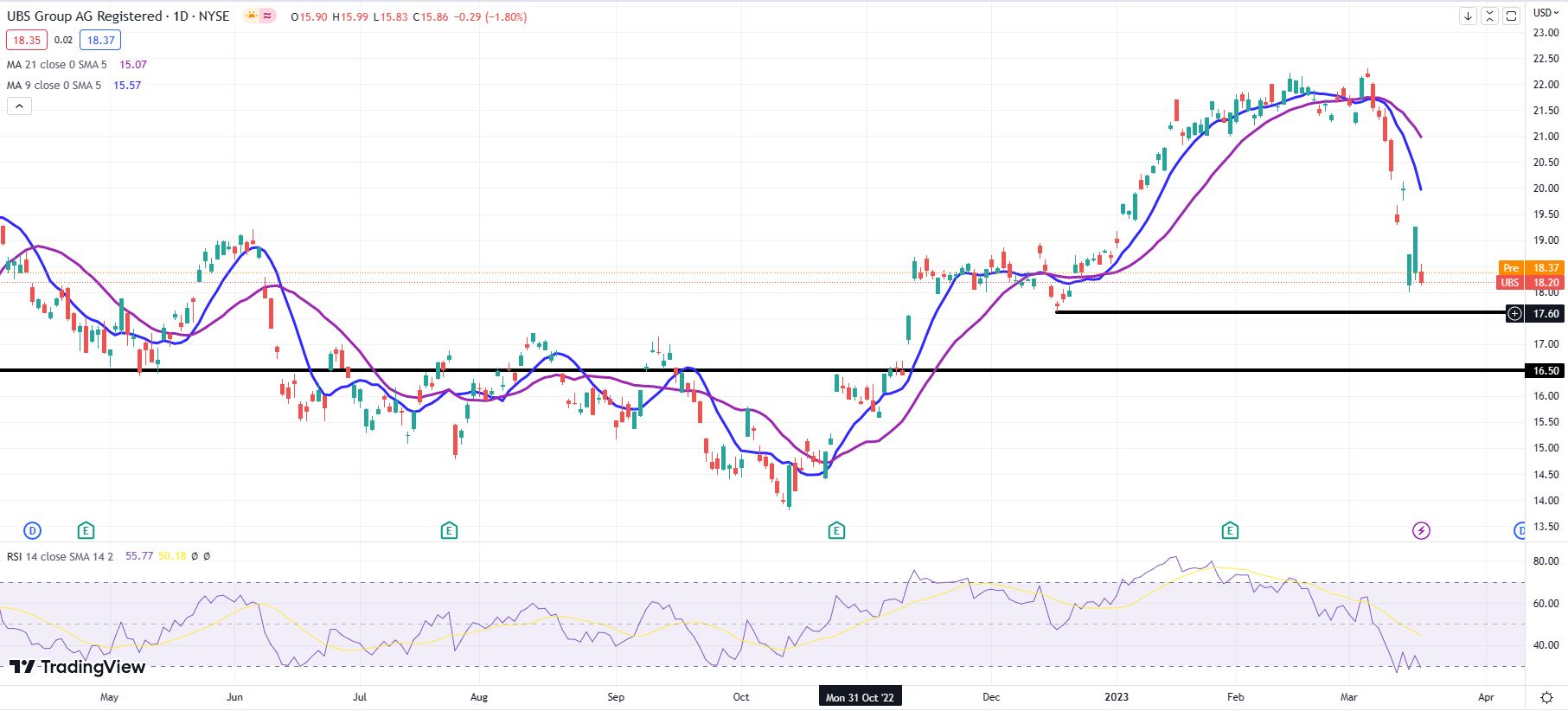
UBS daily chart
Author

Clay Webster
FXStreet
Clay Webster grew up in the US outside Buffalo, New York and Lancaster, Pennsylvania. He began investing after college following the 2008 financial crisis.