The Trade Desk stock flails following CFO exit
- Trade Desk stock plunges nearly 40% on Friday after Q2 earnings.
- Q2 adjusted EPS was largely in line with consensus, and revenue beat estimates.
- CFO is leaving her position after more than a decade in financial roles with company.
- TTD stock could find support in $43 to $47 range from April.

The Trade Desk (TTD), a much-watched growth stock offering a digital advertising auction platform, has capitulated on Friday after the company announced the departure of its longtime chief financial officer. The Trade Desk beat its second quarter revenue consensus but arrived in-line with adjusted earnings projections.
TTD stock has plunged 39% at the time of writing, late in the morning session, to trade at $53.75. Many observers think the sell-off overwrought, but the share price has been steadily declining on continued selling.
The price action has nothing to do with the broad market as the Dow Jones Industrial Average (DJIA) recovers from Thursday's sell-off, up 0.3%, and the NASDAQ continues making new all-time highs, up 0.8%.
The Trade Desk earnings news
The Trade Desk's CFO, Laura Schenkein, will be leaving her post after more than a decade with the company, but she will stay on through the end of the year in an advising role as Alex Kayyal takes over the position.
The Trade Desk earned $0.41 in adjusted earnings per share (EPS), in-line with Wall Street's consensus, and revenue of $694 million beat the consensus by $8 million, up almost 19% from a year ago. Adjusted for inflation, the adjusted EPS figure was about even with the year-ago figure of $0.39.
"CTV continues to be our fastest-growing channel with no signs of slowing down," said CEO Jeffrey Green, noting strengthening partnerships with Disney, NBCU, Walmart, Roku, LG and Netflix.
Green said that about three-fourths of client spend was now running through the Kokai platform. In addition, he added that the OpenPath platform was progressing and had allowed The New York Post to achieve a "97% boost in their programmatic display revenue as a result."
Schenkein projected that The Trade Desk will see revenue of $717 million in Q3, in-line with consensus and up about 14% from a year earlier. She estimated adjusted EBITDA of $277 million, up from Q2's $271 million and about $1 million ahead of consensus. Overall, the guidance points to somewhat slowing business fundamentals but nothing drastic.
Other traders signaled their dissatisfaction with the ad growth environment as more advertisers shifted ad dollars in light of the AI revolution in large language models. Many internet users are shifting to AI chatbots rather and large, direct platforms like Meta Platforms (META) and Amazon (AMZN).

X.com post on August 8, 2025
Bank of America Securities analyst Jessica Rief Ehrlich cut her price target on TTD shares by 58% from $130 to $55, downgrading the company from Buy to Neutral. Truist maintained its $100 price target on TTD stock but said the quarter "failed to impress".
The Trade Desk stock forecast
TTD stock has plunged below its 50-day and 100-day Simple Moving Averages (SMAs), easily blowing through the gap up registered on May 9 after the previous earnings release. Prior to the present earnings release, TTD was retesting the 200-day SMA near $90.
Presently, The Trade Desk stock is resting at the mid-March support near $53, but bears will surely expect the stock to fall to the April lows between $43 and $47. This type of capitulation usually doesn't end on the first day.
Though the stock is heavily oversold on the Relative Strength Index, hitting 24 on Friday, further basing will be required before bulls target the 100-day SMA near $67.
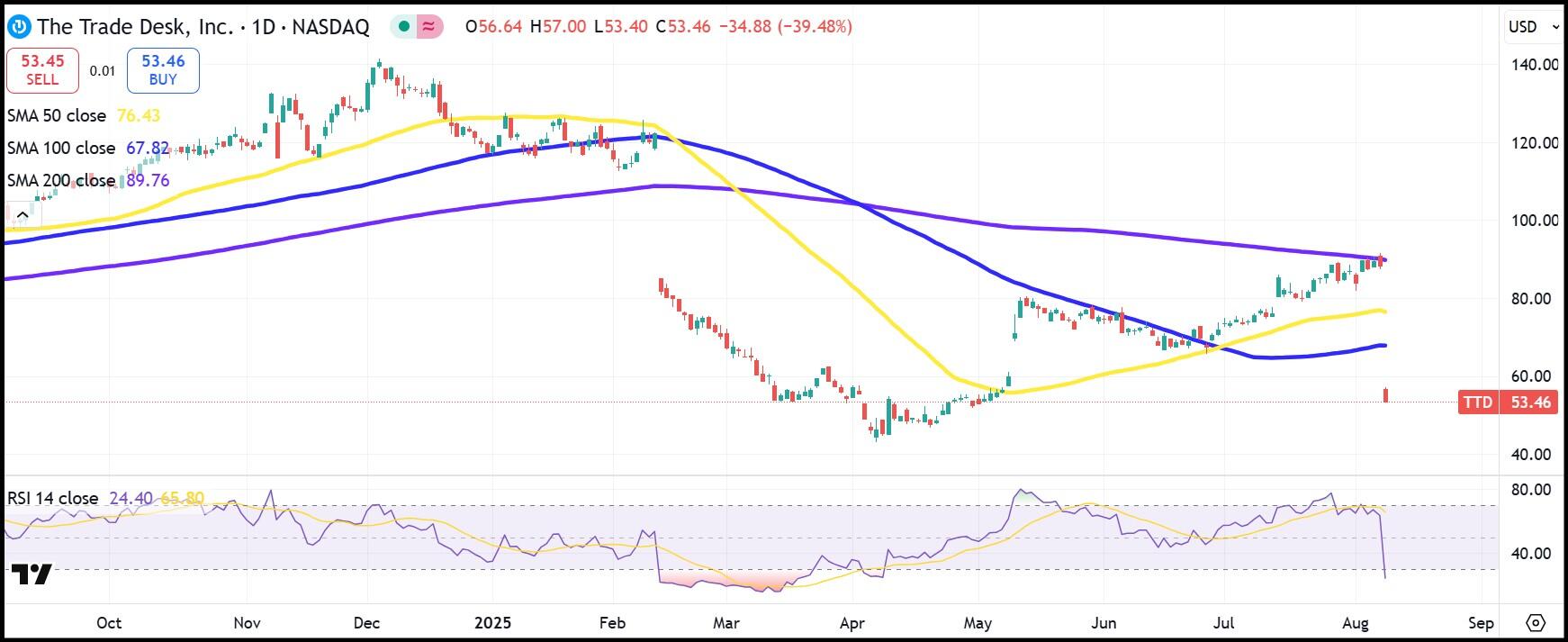
TTD daily stock chart
Author

Clay Webster
FXStreet
Clay Webster grew up in the US outside Buffalo, New York and Lancaster, Pennsylvania. He began investing after college following the 2008 financial crisis.