The conflict in Libya will be a focus for oil traders this week
- Turkey, Russia and Libya will be a focus for the week ahead as tensions escalate with the closure of Eastern Libya ports.
- Germany hosts a conference on Sunday that aimed to broker a peace deal.

Germany was hosting a conference on Sunday that aimed to broker a peace deal between the two sides battling for control of Libya, (this is one for the oil traders to watch in this week's open – more on that here). This is a conflict that is going to finally attract the market's attention this week with Turkey and Russia, the main power-brokers involved, backing opposite sides, trying to find a political solution.
- Libya's oil output to drop to 72,000 bpd from 1.2 mln bpd in few days if blockades continue - National Oil Corp spokesperson
Casting minds back to 2011, the Libyan mess began with the overthrow of Col. Muammar el-Qaddafi following the intervention by European forces, with American help. The Westerners were justifying their involvement on humanitarian grounds and ultimately were inspiring the toppling of Muammar Gaddafi's regime. Western forces then largely abandoned the energy-rich Libya to warring militias and chaos has erupted since.
Since the West moved out, there has been growing intervention by other countries such as the United Arab Emirates (UAE), France, Turkey, Russia and Egypt seeking to secure their own interests in the post-Gaddafi era. Russian influence started first and foremost on gas and oil infrastructure. If Russia makes heavy investments in oil and gas infrastructure in Libya, that means that’s one more pipeline into Europe that’s in the hands of Russians, which will certainly raise some heads and geopolitical concerns.
A conflict out of control, requiring European intervention
It is a conflict that European Union politicians have now warned is in danger of spiralling into out of control, raising the risks of proxy wars and even terrorism on mainland Europe. The UAE, Egypt and to a certain extent, France and Russia, have all been supporting renegade military commander Khalifa Haftar, who since 2014 has been trying to take power in Libya through military force. The military operation he launched in April 2019 to take over the capital Tripoli has further complicated the situation. On the other side, the Tripoli-based Government of National Accord (GNA), a governing body which has been recognised by the United Nations, was undermined by foreign intervention, formally supported by the United States and the European Union. Italy, Turkey and Qatar have been its main backers in recent times. In the face of another offensive on Tripoli, the GNA requested help from its backers and Turkey responded, announcing the deployment of troops to Libya earlier this year "to support the legitimate government and avoid a humanitarian tragedy".
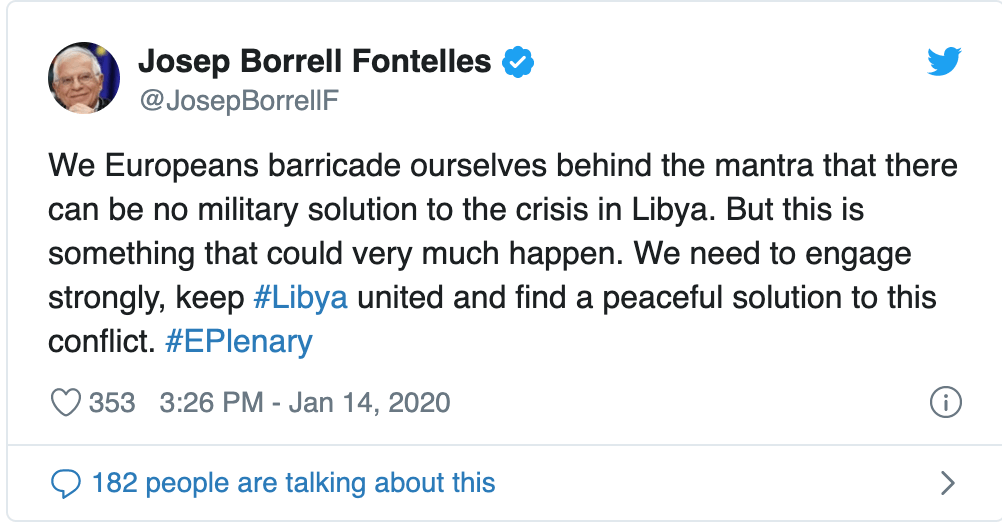
– European Union’s top diplomat.
Turkey and Russia, the main power brokers
Turkey and Russia are trying to work together to resolve the conflict. The two had managed to broker a ceasefire between the GNA and Haftar's forces which came into effect on January 12th. Turkish president, Recep Tayyip Erdogan, urged Europe to support Ankara's moves in Libya, days after he ordered the deployment of troops there. He warns that if Libya's United Nations-recognised government in Tripoli were to fall, Europe could face new threats from "terrorist" groups. However, the deal struck between Erdogan and Putin ultimately means that both sides in Libya will need to compromise to put an end of the current conflict and to negotiate a long-term political solution in Libya.
Bilateral meetings between the EU and US
During the Berlin Libya conference, there are also lots of bilateral meetings. Josep Borrell Fontelles, High Representative of the Union for Foreign Affairs and Security Policy and Vice-President of the European Commission meets Mike Pompeo, United States Secretary of State. A senior State Department official said that Secretary of State Mike Pompeo would urge three things: the continuation of a cease-fire; the withdrawal of all external forces; and a return to a Libyan-led political process facilitated by the United Nations.
Market implications
The rise in risk appetite sparked by the US-China trade deal has prompted oil traders to take profits, however, oil markets will be spooked by the news that Eastern Libya ports, currently under the control of commander Khalif Haftar, are stopping oil exports from the region. The move has brought down Libya's national crude output to half the usual amount. At times of conflict in oil-rich nations, the regional supply implications tend to put a squeeze on the market-leading to higher prices.
Author

Ross J Burland
FXStreet
Ross J Burland, born in England, UK, is a sportsman at heart. He played Rugby and Judo for his county, Kent and the South East of England Rugby team.