Tesla Stock Forecast: TSLA sinks to lowest level in 15 months with earnings on tap
- Tesla stock shaves off more than 3% on Monday.
- Tesla reports Q1 results after the market closes on Tuesday.
- TSLA stock already collapsed 14% during the previous week.
- Wall Street expects $0.50 in adjusted EPS on a QoQ decline in revenue.

Tesla (TSLA) sank 3.4% to close at $142.05 per share on Monday, just one day before the electric vehicle (EV) automaker is scheduled to deliver quarterly results. Tesla stock hasn’t traded this low since January 2023, a 15-month low, and all the data available suggest that another poor showing from Elon Musk’s company is likely to send the share price still further.
As earnings season resumed this week, the major indices rose on investor optimism. The NASDAQ gained 1.1%, while the S&P 500 and Dow Jones also advanced 0.9% and 0.7%, respectively. US Treasury yields largely retreated on the day.
Tesla stock news
Over the weekend, Tesla cut prices on various models and trims in China and Germany. These cuts follow on the heels of price cuts in the US market that observers attribute to a continued pullback in EV demand.
CEO Elon Musk justified the strategy, saying that other automakers just cut prices less transparently.
Other cars change prices constantly and often by wide margins via dealer markups and manufacturer/dealer incentives. Only a fool thinks the “MSRP” is the real price.
— Elon Musk (@elonmusk) April 21, 2024
Tesla prices must change frequently in order to match production with demand.
Most models received a discount of about $2,000 in various foreign currencies, and Tesla also cut the price of the Full Self Driving software by one-third to $8,000.
The decisions come after Musk announced last week that the global automaker would be cutting its workforce by 10%, yet another sign of flagging demand. Earlier this month, Tesla announced that its 387K deliveries in the first quarter were well below both the year-ago quarter and the analyst consensus.
These many headlines do not foreshadow positive Q1 results. After the market closes on Tuesday, analysts expect Tesla to earn $0.50 in adjusted earnings per share (EPS) on $22.26 billion in revenue. This compares to $0.71 in adjusted EPS and $25.17 billion in revenue during the fourth quarter.
EV stocks FAQs
Electric vehicles or EVs are automobiles that use rechargable batteries and electric motors to accelerate rather than internal combustion engines (ICEs). They have been around for more that 100 years, but battery technology research & development was meager for much of the 20th century. Lithium-ion battery technology became advanced enough to produce EVs at scale in the late 1990s and 2000s, and sales have been steadily increasing since then Tesla’s Roadster was unveiled in 2008. EVs are viewed as a means of reducing carbon emissions since battery electric vehicles (BEVs) themselves produce zero emissions. Other vehicles called plug-in hybrid electric vehicles (PHEVs) utilize both battery electric power and ICEs as a backup.
EVs are growing from a small base, but they rose from 9% of global new auto sales in 2021 to 14% of the total in 2022. This was a 65% YoY growth rate, and the industry delivered 10.2 million EVs worldwide in 2022. Projections show this number climbing above 16 million in 2023. Across the world, market shares differ greatly among nations. Nearly 88% of Norwegian new car sales in 2022 were EVs. On the other hand, the United States, where much of the modern innovation in EVs was forged, had less than 8% of new vehicle sales go to EVs in 2022. The largest EV market in the world, China, saw 30% of the market go to EVs that year.
We know you’re thinking Elon Musk, but he’s probably more like the father of the mass-market, contemporary EV. All the way back in 1827, a Hungarian priest named Anyos Jedlik invented the electric motor and used it the following year to power a vehicle of sorts. French scientist Gaston Planté invented the lead-acid battery in 1859, and German engineer Andreas Flocken built the first true electric car for the public in 1888. EVs made up about 38% of all vehicles sold in the US around 1900. They began losing market share rapidly after 1910 when gasoline-powered vehicles grew much more affordable. They largely died off until new research programs in the 1990s led to gradual private sector investment in the 2000s.
China’s BYD is by far the largest manufacturer of EVs in the world. In 2022 it sold 1.8 million EVs and in the second half of the year made up 20% of the global market. The asterisk given to BYD is that the vast majority of these vehicles are hybrids. Tesla’s 12% market share is often treated as more significant than BYD, because it only sells BEVs and is the most famous EV brand in the world. Volkswagen, BMW and Wuling then round out the top five. As a new sector with heavy investment though, many startups have flooded the market. These include China’s Nio, Li Auto and Xpeng; a Swedish-Chinese manufacturer called Polestar; and Lucid and Rivian from the US.
Tesla stock forecast
Tesla stock already sank 14% in the previous week. The long-term downtrend for Tesla stock is now in its third year. More importantly, the weekly chart below shows that last week's major decline shot through a descending trendline that had provided support since last August.
Again opening below that trendline on Monday and falling further, TSLA looks destined to repeat its range low at $101.81 in the early days of 2023. Long-term support levels at $154 and $164 failed to help shareholders this time around.
This seems even more likely when you glance at what bears are saying about the overall market. JPMorgan's Marko Kolanovic writes this week that last week's profound pullback still has legs.
"We think the sell-off has further to go," Kolanovic wrote in a client note. "We remain concerned about continued complacency in equity valuations, inflation staying too hot, further Fed repricing and a profit outlook where the implied acceleration this year might end up too optimistic."
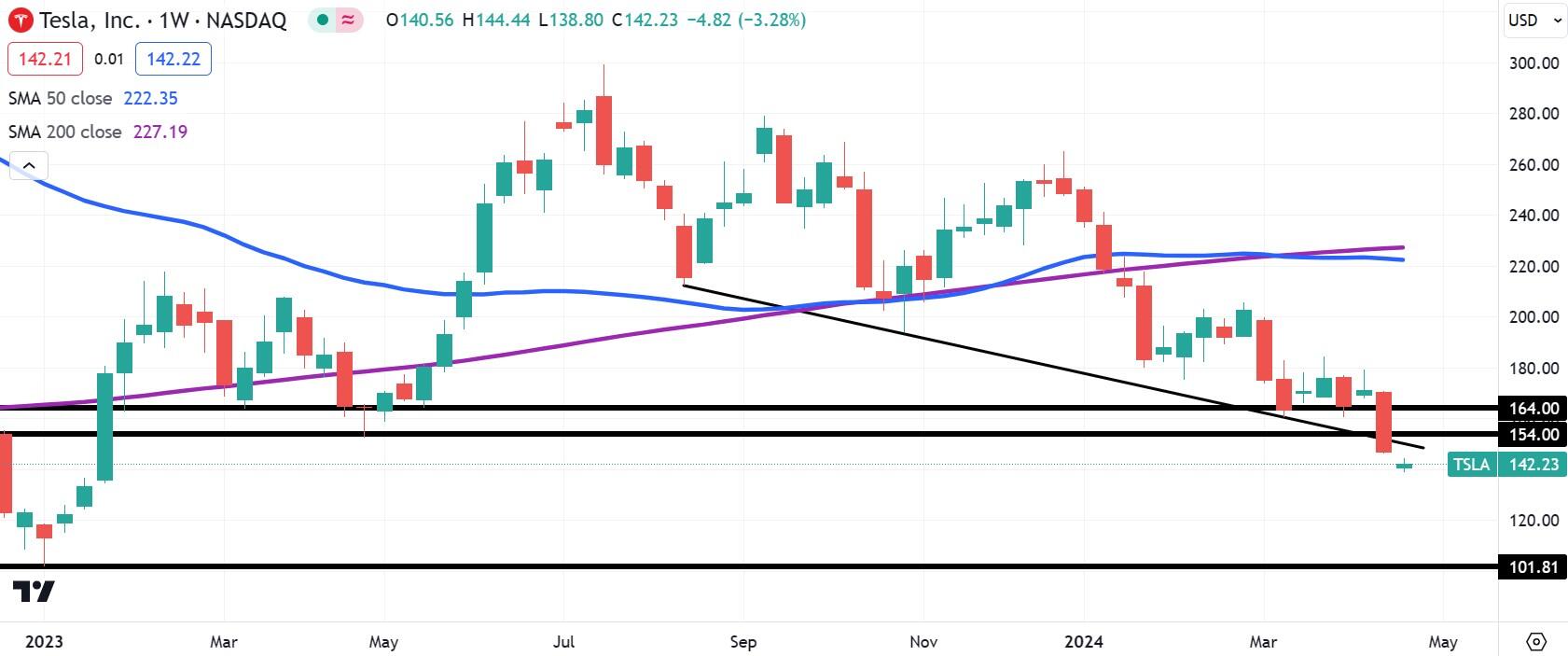
TSLA weekly stock chart
Author

Clay Webster
FXStreet
Clay Webster grew up in the US outside Buffalo, New York and Lancaster, Pennsylvania. He began investing after college following the 2008 financial crisis.














