|

Tesla shaking hands with notable higher timeframe resistance

Resistance putting in an appearance on the monthly timeframe

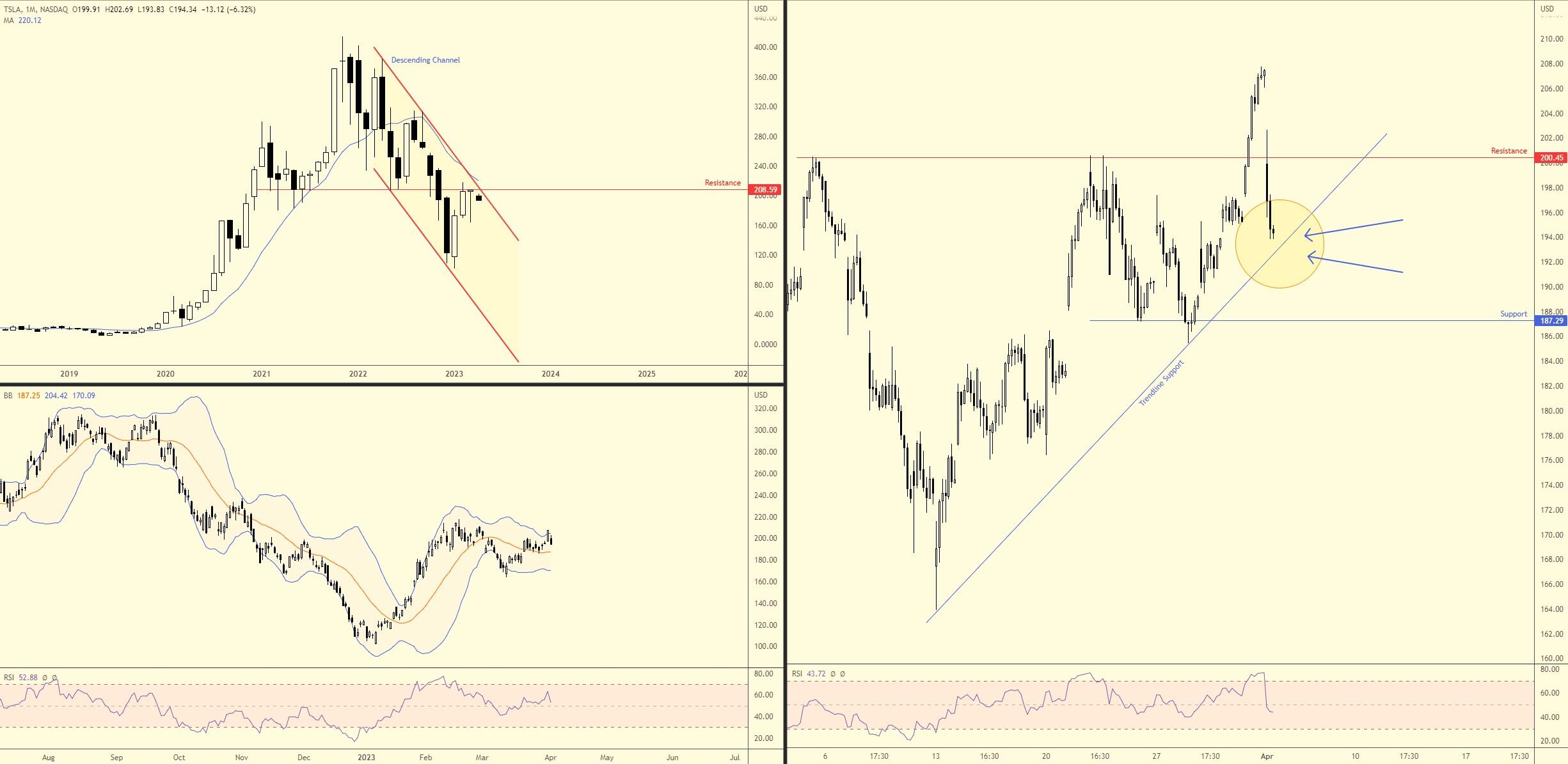
As seen from the monthly timeframe, price action is crossing swords with key resistance at $208.59. We can also see that the unit is testing space just south of channel resistance, taken from the high of $384.29, and the 12- month simple moving average, currently fluctuating around $220.15. Combined, this represents a notable technical ceiling to be mindful of.

Daily chart testing upper bollinger band

Price movement out of the daily timeframe witnessed a close outside of the upper Bollinger Band on Friday (set to 2 standard deviations [calculated through the 20-period simple moving average]). Tesla is trading 6.0% lower at the time of writing after gapping south at the open (note that the company fell a whopping 65.0% last year, erasing the prior year’s upside and about half of 2020’s gains) and appears poised to at least revert back to the Bollinger Band’s mean value of around $187.26.

The Relative Strength Index (RSI) is also on the doorstep of its 50.00 centreline; a move under the aforementioned line would indicate negative momentum (average losses exceeding average gains) and perhaps prompt a (price) drop under the Bollinger Band’s 20-period SMA.

All eyes on H1 trendline support

Having noted the monthly and daily timeframes testing resistance, the H1 trendline support drawn from the low $163.92 will likely be watched. Defending the ascending line is likely to be short-lived, with a break to the downside favoured, targeting support coming in from $187.29.

Adding to the bearish vibe and potential breakout below H1 trendline support, the H1 RSI recently voyaged south of its 50.00 centreline.
TSLA

Author

Aaron Hill

Aaron Hill

FP Markets

After completing his Bachelor’s degree in English and Creative Writing in the UK, and subsequently spending a handful of years teaching English as a foreign language teacher around Asia, Aaron was introduced to financial trading,


More from Aaron Hill
Share:

Editor's Picks

AUD/USD holds above 0.6950 as bullish USD caps gains

AUD/USD edges lower during the Asian session on Tuesday, stalling a two-day recovery move from a two-month low, touched last week. An extended rout in the fixed income market keeps US bond yields elevated near multi-year highs. This, along with geopolitical uncertainties, helps the US Dollar retain its bullish tone despite receding October Fed hike bets. However, expectations for another RBA rate hike this month could act as a tailwind for the Aussie.

USD/JPY remains confined in a range; 158.00 holds the key

USD/JPY extends its consolidative move during the Asian session on Tuesday, trading below 158.00 amid diverging forces. Hawkish BoJ expectations support the Japanese Yen amid looming intervention risks. Meanwhile, geopolitical uncertainty and elevated US bond yields keep the US Dollar near its YTD high despite receding October Fed hike bets. This, in turn, holds back traders from placing aggressive directional bets.

$4,100: For how long can Gold defend that level?

Gold resumes the recent downtrend, approaching $4,100 early Tuesday. The US Dollar consolidates near 17-month highs amid high Treasury yields and a rebound in oil prices. From a short-term technical view, Gold’s path of least resistance appears to be down.


Ethereum: BitMine scoops extra ETH tokens following Q3 outperformance
Ethereum (ETH) treasury firm BitMine Immersion continued its buying streak of the top altcoin last week. The firm acquired 15,112 ETH, lifting its holdings to 6.016 million ETH, representing 4.9% of ETH's circulating supply and worth $16.16 billion at the time of writing. That brings the company roughly 98.5% closer to acquiring 5% of ETH's supply, a goal it tags "Alchemy of 5%."
The scarcity trade is gaining momentum – The biggest commodity moves may still be ahead
Something extraordinary is happening across global Commodity markets. Oil is above $100. Diesel has reached record prices. Copper has broken records. Global food prices are rising again. China is restricting fuel exports. Governments are releasing emergency reserves.
Eurozone inflation just hit 3.8%, its highest in three years. This chart shows why the ECB can’t simply hike its way out

The ECB would normally have a relatively straightforward answer to inflation running almost twice its target: raise interest rates. But these are not normal circumstances. This time, the bond market is already doing part of the tightening for it, leaving the ECB facing an increasingly difficult dilemma.