Tesla Q4 EPS preview: Sluggish sales and new frontiers

Tesla’s rollercoaster ride
Zacks Rank #4 (Sell) stock Tesla (TSLA) will report Q4 earnings after Wednesday’s close. Long-term, Tesla, the leading EV maker, has been one of the best-performing stocks since its initial public offering in 2010, rewarding shareholders with an average compound annual return of ~42%. However, since 2020, the stock has taken shareholders on a rollercoaster ride amid tariff fears, reputational hits, increased competition, and a slowing EV market. Nevertheless, despite the noise, Tesla shares have quadrupled since the late 2023 low of $100 and are hovering near all-time highs as earnings approach.
Tesla Q4 EPS details
- When: Wednesday, January 28th after the stock market close.
- EPS Estimates: Wall Streetconsensus estimates call for EPS of $0.45 (a 40% year-over-year decline) and revenue of ~$24.75 billion.
- Implied/average move: The options market implies a post-market move of +/- $29.56 or 6.58%. Meanwhile, Tesla has registered an average move of 9.64% with five down moves and three up moves over the past eight quarters.
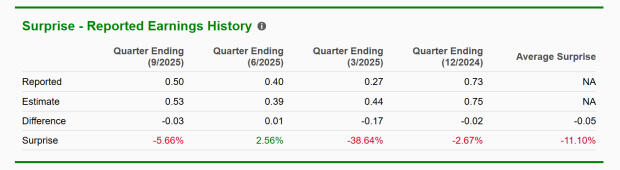
- EPS Surprise History: Tesla has missed Zacks Consensus Analyst Estimates by 11.10% over the past four quarters.
Tesla: Why legacy EV business takes a back seat
Tesla’s legacy EV business accounts for roughly three-quarters of its entire revenue stream. However, unlike past years, Tesla investors are unlikely to be hyper-focused on this result for three reasons:
- Bad News is Already Priced In: With the end of the Federal EV tax credit, a slowdown in sales is already priced into TSLA shares.
- Interest Rates are Expected to Fall: Higher interest rates have led to a slowing of the EV business across the board. However, with interest rates expected to fall later in the year, this headwind will be alleviated.
- Diversification beyond Legacy EV Business: Tesla is diversifying its revenue streams beyond its legacy EV business.
Tesla: Key earnings drivers
Unlike traditional EV makers, Tesla shares have always traded at a premium due to its ability to innovate. While companies like Ford (F) and General Motors (GM) are one-dimensional, Tesla has expanded its product offering dramatically in recent years. Below are three key areas to watch.
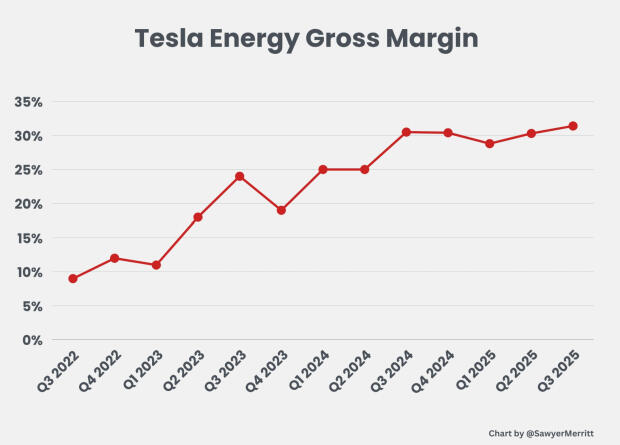
Tesla Energy: Tesla’s most underrated business segment. Amid increasing demand from energy-hungry data centers, Tesla Energy is growing at a robust 84% year-over-year. With the AI buildout only gaining steam, Tesla Energy is well-positioned to achieve triple-digit growth over the next few years. In addition to strong growth, Tesla Energy’s gross margins are expanding and reaching new highs.
Tesla Robotaxi/FSD: The Tesla robotaxi network is finally being tested in two cities: San Francisco and Austin. Investors are betting that if Tesla can prove that its full-self-driving service is safer than the average human, it can gain regulatory approval and expand nationwide, adding a significant new revenue stream. From this perspective, Tesla just received welcome news. Third-party data from AI-powered insurer Lemonade (LMND) shows that Tesla FSD is 2x safer than the average human driver, leading the company to offer Tesla FSD users a 50% discounted insurance rate. The Lemonade data will help to substantiate Tesla’s FSD’s safety claims.
Optimus Timeline: Elon Musk predicts that Tesla’s “Optimus” humanoid robot will eventually become Tesla’s best-selling product. As of now, Optimus is expected to be released next year. However, any update to this timeline will be market- moving.
Tesla Semi: Tesla’s long-delayed “Semi” truck is expected to enter high-volume production later this year. Tuesday, Tesla entered into an agreement with Pilot Travel Centers to install 35 charging stations across the U.S.
Bottom line
While Tesla’s legacy EV business faces headwinds, the long-term value of the company will be determined by the success its of its energy, self-driving, and humanoid robot businesses. As Tesla approaches earnings, investors will focus on whether Elon Musk’s ambition for a diversified tech ecosystem can offset the current slowdown in its EV business.
Want the latest recommendations from Zacks Investment Research? Download 7 Best Stocks for the Next 30 Days. Click to get this free report
Author

Zacks
Zacks Investment Research
Zacks Investment Research provides unbiased investment research and tools to help individuals and institutional investors make confident investing decisions.
















