Taiwan Semiconductor Stock News: TSM climbs nearly 10% on revenue guidance as AMD, NVDA reach all-time highs
- TSM stock climbs more than 7% on earnings beat.
- 2024 revenue growth guidance given above 20%.
- Management says AI demand will continue to aid 2024 growth.
- AMD, Nvidia stocks jump to new highs on Taiwan Semiconductor guidance.

Taiwan Semiconductor (TSM), the global leader in computer chip fabrication, surged 9.8% on Thursday after the firm beat Wall Street consensus for the fourth quarter and projected at least 20% revenue growth in 2024.
The NASDAQ Composite closed up 1.35% on the news as well, which is the first day all week that markets gained ground. Nvidia (NVDA) and Advanced Micro Devices (AMD) both popped to all-time highs on the sector news since they are associated with Taiwan Semi as major customers and will likely be part of this year's growth story in the semiconductor industry.
Taiwan Semiconductor earnings news
GAAP earnings for Taiwan Semiconductor reached $1.44 in the fourth quarter, beating consensus by 5 cents. Likewise, revenue of $19.62 billion overtook the consensus by $50 million but fell more than 1% from a year ago.
Management at Taiwan Semiconductor said that the revenue growth outlook in 2024 would grow between 20% and 25% in 2024, primarily due to larger orders for advanced chips used in AI workloads.
Only a few firms design the advanced computer chips used in artificial intelligence (AI), and the two most prominent are the fabulous and fabless Nvidia and AMD. Both of them then contract with Taiwan Semi to produce their chips in its state-of-the-art fabs.
Taiwan Semiconductor CEO C.C. Wei said, "2023 was a challenging year for the global semiconductor industry, but we also witnessed the rising emergence of generative AI-related applications with TSMC as a key enabler."
The company’s sector-leading 3-nanometer chip fabrication accounted for 15% of production, while 5-nanometer made up 35% of Q4 production. This segment will continue to grow in 2024, according to the CEO, which is why he thinks first-quarter revenue could reach $18.8 billion, above the consensus $18.2 billion.
Nasdaq FAQs
What is the Nasdaq?
The Nasdaq is a stock exchange based in the US that started out life as an electronic stock quotation machine. At first, the Nasdaq only provided quotations for over-the-counter (OTC) stocks but later it became an exchange too. By 1991, the Nasdaq had grown to account for 46% of the entire US securities’ market. In 1998, it became the first stock exchange in the US to provide online trading. The Nasdaq also produces several indices, the most comprehensive of which is the Nasdaq Composite representing all 2,500-plus stocks on the Nasdaq, and the Nasdaq 100.
What is the Nasdaq 100?
The Nasdaq 100 is a large-cap index made up of 100 non-financial companies from the Nasdaq stock exchange. Although it only includes a fraction of the thousands of stocks in the Nasdaq, it accounts for over 90% of the movement. The influence of each company on the index is market-cap weighted. The Nasdaq 100 includes companies with a significant focus on technology although it also encompasses companies from other industries and from outside the US. The average annual return of the Nasdaq 100 has been 17.23% since 1986.
How can I trade the Nasdaq 100?
There are a number of ways to trade the Nasdaq 100. Most retail brokers and spread betting platforms offer bets using Contracts for Difference (CFD). For longer-term investors, Exchange-Traded Funds (ETFs) trade like shares that mimic the movement of the index without the investor needing to buy all 100 constituent companies. An example ETF is the Invesco QQQ Trust (QQQ). Nasdaq 100 futures contracts allow traders to speculate on the future direction of the index. Options provide the right, but not the obligation, to buy or sell the Nasdaq 100 at a specific price (strike price) in the future.
What Factors Drive the Nasdaq 100
Many different factors drive the Nasdaq 100 but mainly it is the aggregate performance of the component companies revealed in their quarterly and annual company earnings reports. US and global macroeconomic data also contributes as it impacts on investor sentiment, which if positive drives gains. The level of interest rates, set by the Federal Reserve (Fed), also influences the Nasdaq 100 as it affects the cost of credit, on which many corporations are heavily reliant. As such the level of inflation can be a major driver too as well as other metrics which impact on the decisions of the Fed.
Taiwan Semiconductor stock forecast
Taiwan Semiconductor stock is now trading above $112, a price level shareholders haven't seen since late February of 2022. In other words, this is an 11-month high. TSM stock used the 13-week Simple Moving Average (SMA) as a jump-off point.
TSM stock is now in the demand zone that fortified price action for most of 2021. This area stretches from roughly $110 to $120. Above here is the augmented double top formation in the region just above $142. Other than the high $120s, there isn't much of a serious layer of resistance until that double top.
The Relative Strength Index (RSI) is not yet overbought, sitting as it is near 68. Some consolidation over the next few weeks could set this region up as a weigh station on TSM stock's next climb higher. But any break below the psychological $100 level will be viewed as a sign that it's time to sell.
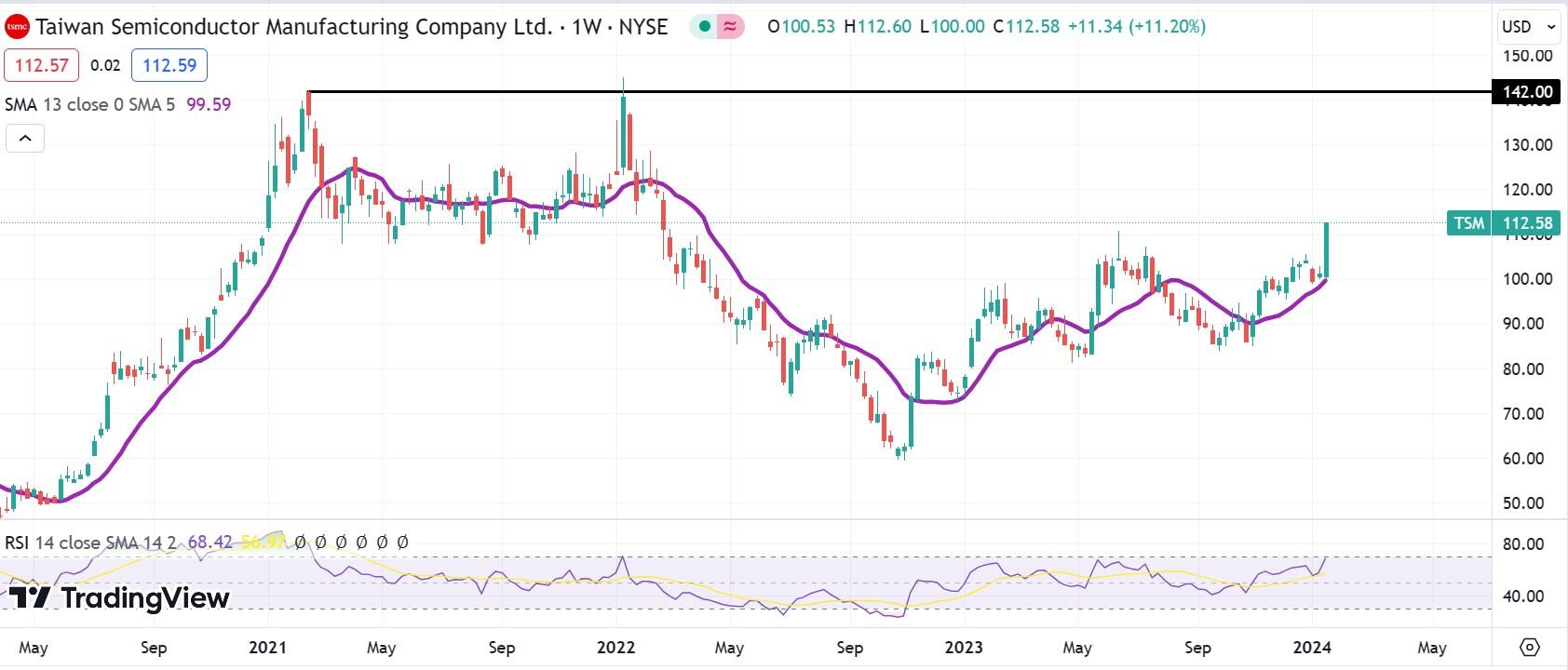
TSM daily stock chart
Author

Clay Webster
FXStreet
Clay Webster grew up in the US outside Buffalo, New York and Lancaster, Pennsylvania. He began investing after college following the 2008 financial crisis.