Swiss Franc vulnerable as Swiss National Bank drops strong-Franc policy
- The Swiss Franc is forecast to fall as the Swiss National Bank (SNB) drops its strong FX policy.
- The central bank had previously strengthened the Franc as a means of subduing inflation.
- The SNB is jettisoning the approach as it considers the CHF is “too strong” for Swiss exporters.

The Swiss Franc (CHF) trades in a range in the upper 0.8700s against the US Dollar (USD) on Wednesday. Overall the outlook is not particularly positive for the Swiss Franc given the policy stance of its central bank, the Swiss National Bank (SNB), which does not want to encourage a strong Franc any longer.
Risk appetite is recovering during the European session with the DAX, CAC 40 and FTSE 100 all up on the day. The positive-risk backdrop is also not helpful to the Swiss Franc as it is a safe-haven.
Swiss Franc at risk from SNB policy approach
Swiss Franc’s upside is likely to be capped as the Swiss National Bank (SNB) changes its policy to the currency. Previously it had strengthened the CHF to subdue inflation, however, recently SNB Chairman Thomas Jordan said the Franc has become unpalatably strong for Swiss businesses, many of whom are exporters.
His comments reflect the data on Switzerland Foreign Exchange Reserves (CHFER), which shows non-CHF FX reserves have been recovering since the autumn of 2023. This could be a sign the SNB is selling the Swiss Franc to purchase other currencies, with the aim of dampening CHF’s value.
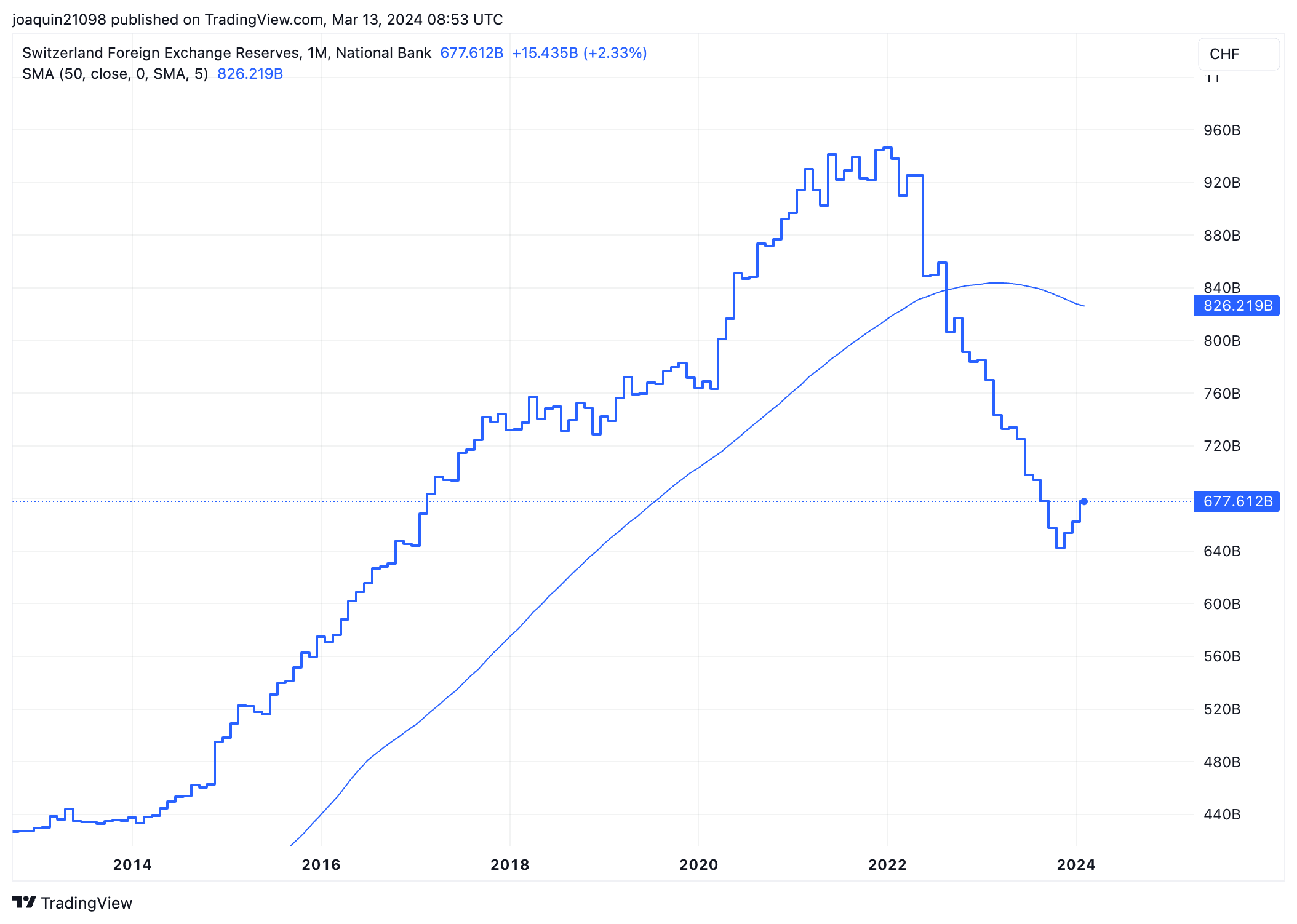
Switzerland Foreign Exchange Reserves: Monthly chart
According to analysts at HSBC, the Swiss Franc is likely to weaken against the US Dollar over the near term, since “FX strength is no longer a tool or policy aspiration,” for the SNB, and global equity markets are going from strength to strength.
On the Horizon
Swiss Producer and Import Prices for February are the next key release for the Swiss Franc, although they do not generally have a big impact on the exchange rate. An unexpected rise in the metric, however, which comes out at 7:30 GMT on Thursday, would support the Swiss Franc and vice versa for a fall. Previous results showed a 2.3% fall YoY and a 0.5% decline MoM in January.
US Producer Prices Ex Food & Energy for February, released on Thursday at 12:30 GMT, could also impact the US Dollar and USD/CHF. Current expectations are for a slowdown to 1.9% YoY from the 2.0% increase seen in January. Similarly, US Retail Sales data, released at the same time, could also rock US pairs.
Technical Analysis: Swiss Franc versus US Dollar pinned below trendline
The USD/CHF – the number of Swiss Francs one US Dollar can buy – is stuck below several key technical levels.
The first of these is the falling trendline of a descending channel at around 0.8780. The second, the key 50-week Simple Moving Average (SMA) at 0.8850 (not shown in the chart). These are touch resistance levels and it is possible this could mark the inflection point of a reversal where the pair starts moving down again.

US Dollar vs Swiss Franc: 4-hour chart
USD/CHF has pierced below the key February 22 low of 0.8742 but failed to close below. Nevertheless, this suggests weakness and raises the possibility of a deeper decline unfolding to 0.8645.
A break below that level would probably indicate a reversal of the short-term trend. The next target to the downside would be 0.8645, followed by the January 31 lows of 0.8551.
There is still a fairly strong possibility USD/CHF could recover and resume its trend higher. A break above the trendline and the 0.8892 high would indicate a continuation of the short-term uptrend to a possible target at 0.9056.
SNB FAQs
What is the Swiss National Bank?
The Swiss National Bank (SNB) is the country’s central bank. As an independent central bank, its mandate is to ensure price stability in the medium and long term. To ensure price stability, the SNB aims to maintain appropriate monetary conditions, which are determined by the interest rate level and exchange rates. For the SNB, price stability means a rise in the Swiss Consumer Price Index (CPI) of less than 2% per year.
How does the Swiss National Bank interest-rate policy affect the Swiss Franc?
The Swiss National Bank (SNB) Governing Board decides the appropriate level of its policy rate according to its price stability objective. When inflation is above target or forecasted to be above target in the foreseeable future, the bank will attempt to tame excessive price growth by raising its policy rate. Higher interest rates are generally positive for the Swiss Franc (CHF) as they lead to higher yields, making the country a more attractive place for investors. On the contrary, lower interest rates tend to weaken CHF.
Does the Swiss National Bank intervene in the forex market?
Yes. The Swiss National Bank (SNB) has regularly intervened in the foreign exchange market in order to avoid the Swiss Franc (CHF) appreciating too much against other currencies. A strong CHF hurts the competitiveness of the country’s powerful export sector. Between 2011 and 2015, the SNB implemented a peg to the Euro to limit the CHF advance against it. The bank intervenes in the market using its hefty foreign exchange reserves, usually by buying foreign currencies such as the US Dollar or the Euro. During episodes of high inflation, particularly due to energy, the SNB refrains from intervening markets as a strong CHF makes energy imports cheaper, cushioning the price shock for Swiss households and businesses.
When does the Swiss National Bank Governing Council decide on monetary policy?
The SNB meets once a quarter – in March, June, September and December – to conduct its monetary policy assessment. Each of these assessments results in a monetary policy decision and the publication of a medium-term inflation forecast.
Author

Joaquin Monfort
FXStreet
Joaquin Monfort is a financial writer and analyst with over 10 years experience writing about financial markets and alt data. He holds a degree in Anthropology from London University and a Diploma in Technical analysis.