Starbucks Earnings News: Caffeine crash hits investors as SBUX slides 16%
- SBUX stock sinks as consumers spend less.
- Starbucks misses Wall Street earnings forecast by 15%.
- Chinese compables fall 11%, while US comparables drop 3%.
- Fiscal Q2 revenue misses the mark by $600 million.

Starbucks (SBUX) stock has collapsed on Wednesday following quarterly earnings that show a major slowdown in consumer spending in the US and China. Shares caved 16% at the start of the Wednesday session.
After closing at $88.49 on Tuesday, SBUX is trading below $74 at the time of writing. Stock indices are mixed on Wednesday as traders await the Federal Reserve’s (Fed) interest rate decision and comments from Fed Chair Jerome Powell later in the day.
Starbucks stock news
In the second fiscal quarter, which ended March 31, Starbucks posted earnings of $0.68 per share, which was a miss of 12 cents or 15%.
Revenue of $8.56 billion declined 2% from a year prior and missed Wall Street consensus by $600 million.
“We continue to feel the impact of a more cautious consumer, particularly with our more occasional customers, and a deteriorating economic outlook has weighed on customer traffic, an impact felt broadly across the industry,” said Laxman Simhan. “In the US, severe weather impacted both our US and total company comp by nearly 3% during the quarter. The remainder of our challenges were attributable to fewer visits from our more occasional customers.”
On a quarterly basis overall, Starbucks saw its revenue at North American based stores drop 10% and 5% internationally. On an annual basis, North American sales were flat, while international sales slid 5%.
On a comparable basis, Starbucks’ global sales fell 4% YoY. That figure was comprised of a 6% decline in comparable transactions, offset by a 2% rise in comparable ticket price. Chinese comparables fell 11%, while US comparables fell 3%.
In the US case, it appears that rising prices curtailed spending among customers with a 7% decline in transactions. Despite adding new drink options to the menu for the summer, Starbucks said to expect full-year revenue to rise in the low single digits rather than the earlier guidance for 7% to 10%.
The coffee company opened 364 net new stores in the fiscal second quarter, resulting in a total of 38,951 stores. Slightly more than half are company operated.
S&P 500 FAQs
The S&P 500 is a widely followed stock price index which measures the performance of 500 publicly owned companies, and is seen as a broad measure of the US stock market. Each company’s influence on the computation of the index is weighted based on market capitalization. This is calculated by multiplying the number of publicly traded shares of the company by the share price. The S&P 500 index has achieved impressive returns – $1.00 invested in 1970 would have yielded a return of almost $192.00 in 2022. The average annual return since its inception in 1957 has been 11.9%.
Companies are selected by committee, unlike some other indexes where they are included based on set rules. Still, they must meet certain eligibility criteria, the most important of which is market capitalization, which must be greater than or equal to $12.7 billion. Other criteria include liquidity, domicile, public float, sector, financial viability, length of time publicly traded, and representation of the industries in the economy of the United States. The nine largest companies in the index account for 27.8% of the market capitalization of the index.
There are a number of ways to trade the S&P 500. Most retail brokers and spread betting platforms allow traders to use Contracts for Difference (CFD) to place bets on the direction of the price. In addition, that can buy into Index, Mutual and Exchange Traded Funds (ETF) that track the price of the S&P 500. The most liquid of the ETFs is State Street Corporation’s SPY. The Chicago Mercantile Exchange (CME) offers futures contracts in the index and the Chicago Board of Options (CMOE) offers options as well as ETFs, inverse ETFs and leveraged ETFs.
Many different factors drive the S&P 500 but mainly it is the aggregate performance of the component companies revealed in their quarterly and annual company earnings reports. US and global macroeconomic data also contributes as it impacts on investor sentiment, which if positive drives gains. The level of interest rates, set by the Federal Reserve (Fed), also influences the S&P 500 as it affects the cost of credit, on which many corporations are heavily reliant. Therefore, inflation can be a major driver as well as other metrics which impact the Fed decisions.
Starbucks stock forecast
Starbucks' stock price is fast approaching the $70 to $71 support range. This may produce a decent entry for bulls looking to capitalize on the lower share price. This support range was used at least partially in both the March to June section of 2020, as well as the May to June period in 2022.
Below there lies the covid nadir just above $50. Do not expect SBUX to reverse quickly. The coffee chain will need to post upbeat results at the next earnings call for that to happen.
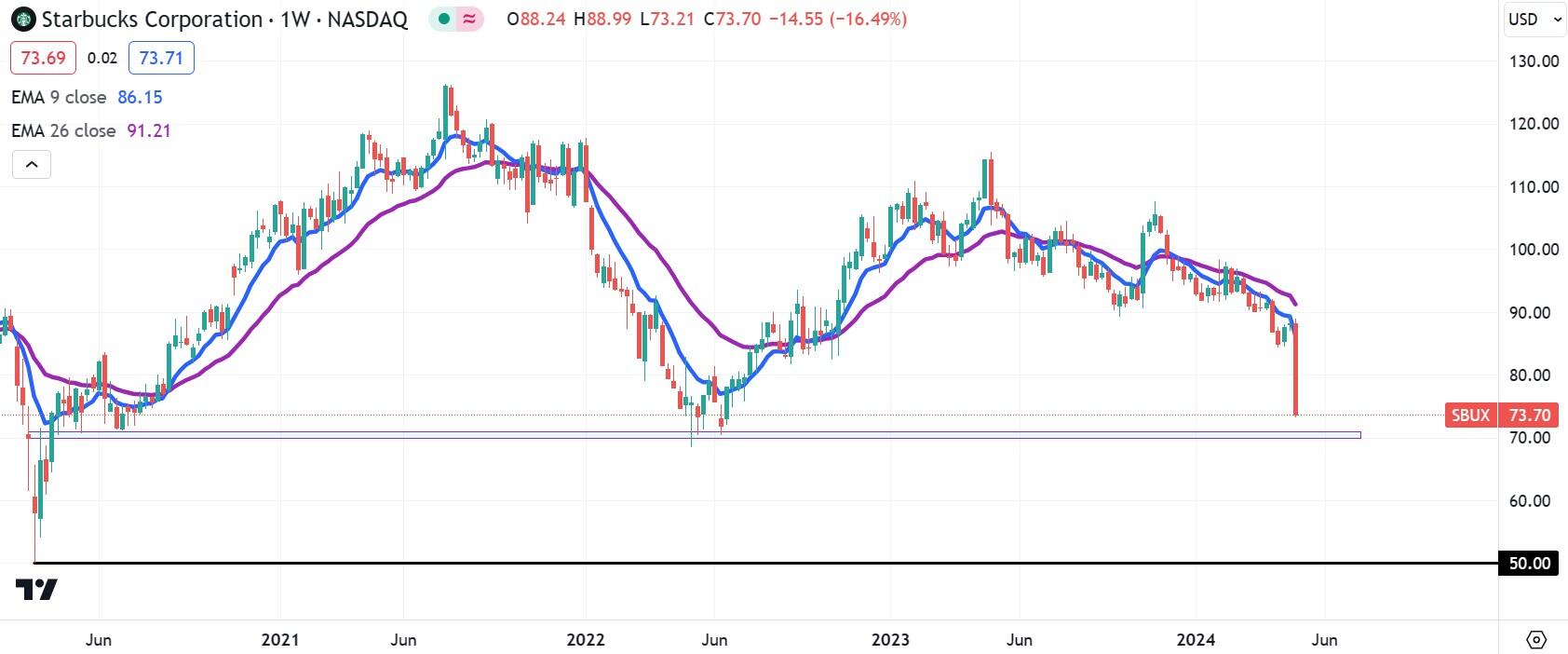
SBUX weekly stock chart
Author

Clay Webster
FXStreet
Clay Webster grew up in the US outside Buffalo, New York and Lancaster, Pennsylvania. He began investing after college following the 2008 financial crisis.