S&P 500 News: Index sinks as US Treasury yields, Boeing weigh on market
- The stock market was closed on Monday in observance of the MLK, Jr. holiday.
- The all-time high of 4,818 from two years ago still sits within striking distance.
- Houthis struck a US-owned cargo ship near the Red Sea on Monday.
- Goldman Sachs announced double beat of Q4 consensus on better wealth management performance.
- NY Empire State Manufacturing Index for January sank to lowest level since pandemic.

Boeing (BA) stock continued to lead the market lower afterhours on Tuesday as more news appeared concerning the two Boeing airliners that collided at O'Hare Airport in Chicago. The passenger jets owned by All Nippon Airways and Delta Airlines smashed their wingtips into one another, but no passengers on either jet were hurt.
The S&P 500 index sold off 0.37% on Tuesday after the NY Empire State Manufacturing Index for January featured a huge miss, reaching a level not seen since the depths of the pandemic nearly four years ago.
The NASDAQ Composite also shed 0.19% to start the week, and the Dow Jones lost a more serious 0.62% as 2-year through 30-year Treasuries saw their yields rise more than 2% along the curve.
Goldman Sachs and Morgan Stanley released fourth-quarter results that were a mixed bag before the bell on Tuesday. A number of other regional banks will report earnings this week alongside high-profile companies like Taiwan Semiconductor (TSM) and Travelers (TRV).
Middle East hostilities continue to put pressure on the market by raising oil prices. The Houthis in Yemen attacked a US-owned cargo ship in the Gulf of Aden on Monday. The UK and the US responded with a barrage of missiles on Houthi targets in Yemen, and Iran bombed buildings in northern Iraq it said were part of an Israeli intelligence program. The Houthis say they are responding to US support for Israel’s war on Gaza.
S&P 500 News: Poor manufacturing data reported before Wednesday’s Retail Sales
The New York Fed Empire State Manufacturing Index for January declined to -43.7 compared to estimates of -5 and a December reading of -14.5. This was the lowest reading since May 2020 and a sign that the economy might be doing worse than thought.
Of course, that index only surveys manufacturing businesses in the state of New York, which is only a snapshot of the larger country. But it does come after the December data also showcased a major miss.
Still, the market is largely looking forward to the US Retails Sales data out on Wednesday. The data is expected to show December Retails Sales rising 0.4% on a monthly basis compared with November’s 0.3%. A positive reading that beats consensus would raise optimism that has been depleted by the morning's poor manufacturing figures.
A US Treasury auction on Tuesday saw 6-month bills exchanged for yields below 5%, the first time that happened since May 15, 2023. Lower yields are good for the stock market, but the auction was overshadowed by longer-dated yields rising.
Bank earnings on tap this week
It’s back to financial earnings this week after large banks kicked off earnings season last Friday. Analysts expect a muted earnings season with just a 1.3% earnings increase for S&P 500 companies compared with a year ago, according to John Stoltzfus, chief investment strategist at Oppenheimer Asset Management.
Goldman Sachs and Morgan Stanley are giving the market a mixed outlook on Tuesday. Goldman reported GAAP earnings per share (EPS) of $5.48, which turned out to be a whopping $1.55 or 39% above consensus.
Revenue at the storied investment bank rose 7% from a year ago to $11.32 billion as Goldman’s asset & wealth management unit ended a year of lackluster results back in a competitive position. Revenue beat expectations by $360 million.
Morgan Stanley missed the profit target by about 17% in the fourth quarter. This owed to legal fines and other charges amounting to $535 million poking into its pretax income. Revenue of $12.9 billion narrowly beat the consensus among analysts, however, and earnings would have been quite positive without the charges.
PNC Financial (PNC) was the first of a number of large regional banks to report earnings this week. Before the Tuesday open, PNC reported a 17% beat on Q4 adjusted EPS and a slight beat on revenue.
Wednesday sees Charles Schwab (SCHW) and US Bancorp (USB) report earnings results, followed by Truist Financial (TFC) and KeyCorp (KEY) on Thursday, as wells as Ally Financial (ALLY), Comerica (CMA) and Fifth Third (FITB) on Friday.
On Thursday, Taiwan Semiconductor will report results that will shed light on the entire computer chip space. Analyst consensus expects adjusted EPS of $1.37 on $19.58 billion in sales.
On Friday, Travelers, the 180th largest holding in the S&P 500, is expected to report earnings of $5.04 on revenue of $9.95 billion. Analysts unanimously agreed on revising their earnings lower for the reporting quarter.
Nasdaq FAQs
What is the Nasdaq?
The Nasdaq is a stock exchange based in the US that started out life as an electronic stock quotation machine. At first, the Nasdaq only provided quotations for over-the-counter (OTC) stocks but later it became an exchange too. By 1991, the Nasdaq had grown to account for 46% of the entire US securities’ market. In 1998, it became the first stock exchange in the US to provide online trading. The Nasdaq also produces several indices, the most comprehensive of which is the Nasdaq Composite representing all 2,500-plus stocks on the Nasdaq, and the Nasdaq 100.
What is the Nasdaq 100?
The Nasdaq 100 is a large-cap index made up of 100 non-financial companies from the Nasdaq stock exchange. Although it only includes a fraction of the thousands of stocks in the Nasdaq, it accounts for over 90% of the movement. The influence of each company on the index is market-cap weighted. The Nasdaq 100 includes companies with a significant focus on technology although it also encompasses companies from other industries and from outside the US. The average annual return of the Nasdaq 100 has been 17.23% since 1986.
How can I trade the Nasdaq 100?
There are a number of ways to trade the Nasdaq 100. Most retail brokers and spread betting platforms offer bets using Contracts for Difference (CFD). For longer-term investors, Exchange-Traded Funds (ETFs) trade like shares that mimic the movement of the index without the investor needing to buy all 100 constituent companies. An example ETF is the Invesco QQQ Trust (QQQ). Nasdaq 100 futures contracts allow traders to speculate on the future direction of the index. Options provide the right, but not the obligation, to buy or sell the Nasdaq 100 at a specific price (strike price) in the future.
What Factors Drive the Nasdaq 100
Many different factors drive the Nasdaq 100 but mainly it is the aggregate performance of the component companies revealed in their quarterly and annual company earnings reports. US and global macroeconomic data also contributes as it impacts on investor sentiment, which if positive drives gains. The level of interest rates, set by the Federal Reserve (Fed), also influences the Nasdaq 100 as it affects the cost of credit, on which many corporations are heavily reliant. As such the level of inflation can be a major driver too as well as other metrics which impact on the decisions of the Fed.
Earnings of the week
Tuesday, January 16 - Morgan Stanley (MS), Goldman Sachs (GS), PNC Financial (PNC), Interactive Brokers (IBKR)
Wednesday, January 17 - Prologis (PLD), Charles Schwab (SCHW), US Bancorp (USB), Kinder Morgan (KMI), Alcoa (AA)
Thursday, January 18 - Taiwan Semiconductor (TSM), Truist Financial (TFC), KeyCorp (KEY), Fastenal Company (FAST)
Friday, January 19 - Ally Financial (ALLY), Comerica (CMA), Fifth Third (FITB), Travelers (TRV)
What they said about the market – Bank of America Securities
Bank of America Securities released a report this week telling investors to expect a sideways price action in the market before a rally in the second half of the year. The advice comes in the company’s 2024 Equity Technical Strategy Year Ahead report. The report acknowledges that US presidential election years are normally quite good for markets but notes that the first half of those years (year four of a presidential term) typically feature greater uncertainty in the first half of the year.
The analysts at BofA Securities expect the S&P 500 to end 2024 between 5,300 and 5,400.
“The SPX can struggle in early Year 4 given lackluster January through May returns in presidential election years”
S&P 500 forecast
The S&P 500 remains poised as it has for the past month just under the all-time high of 4,818 registered back in the first week of 2022. The index made a spectacular run to end 2023 for nine consecutive up weeks and has since entered a consolidation phase.
The price action largely sits above 4,700, however, which goes to show that the floor for this market is quite high. This leads to the impression that the index and investors writ large are just sitting tight for the next rally.
Also, despite the recent consolidation, the weekly chart continues to show the MACD line above the signal line in the Moving Average Convergence Divergence (MACD) indicator. This means that the rally would appear to still be in gear.
Support sits at 4,607, but the S&P 500 hasn’t needed it yet.
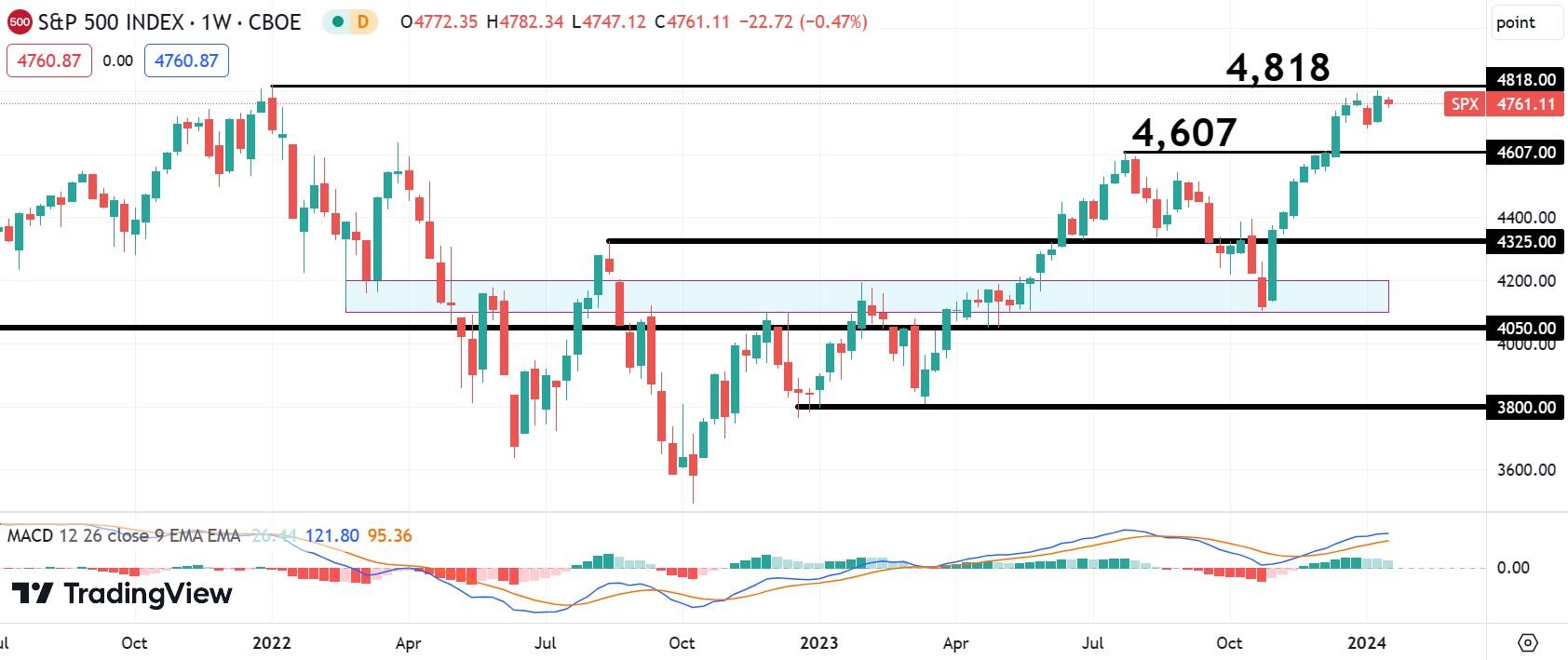
S&P 500 weekly chart
Author

Clay Webster
FXStreet
Clay Webster grew up in the US outside Buffalo, New York and Lancaster, Pennsylvania. He began investing after college following the 2008 financial crisis.