S&P 500 futures: The Index stays trapped in a two-way auction

A failed push into the upper structure rotated price back toward the central pivot, leaving New York to decide between renewed acceptance higher or a lower-range test.
S&P 500 (ES) — Daily desk report (Feb 19)
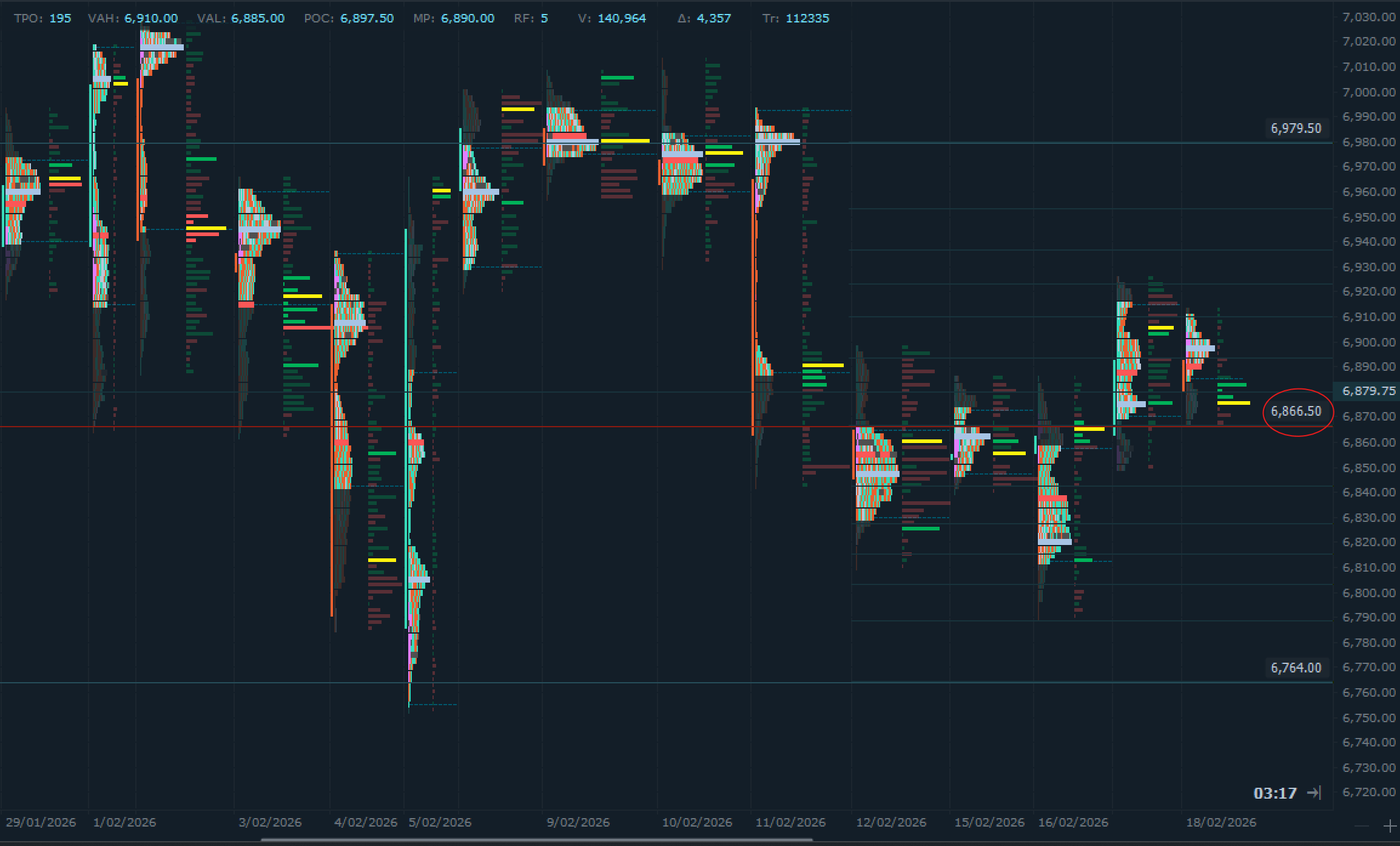
New York setup: Two-way structure remains active — CP is the decision point
The two-way auction is still in play following yesterday’s data-driven rotation, and the last three sessions have continued to stress-test both sides of the range.
Yesterday’s trades (Feb 18) pushed into the upper gate (6893–6909) but failed to find acceptance above the structure. Momentum faded, and price rotated back toward the daily CP (6866) — keeping the market in “levels-first” mode rather than directional trend mode.
Heading into the final hours of the London session, ES is trading around 6884, which keeps the price above the daily CP and maintains the repair effort toward the upper structure. New York should be the session that decides whether this market can transition from rotation into acceptance.
Today’s map (the battlefield)
- Daily Central Pivot (CP): 6866 (main decision point).
- Upper Gate: 6893–6909 (acceptance zone for upside continuation).
- Lower Gate: 6842–6827 (failure zone if CP breaks).
Upper references if acceptance holds: 6923 – 6936 – 6952 – 6979
Lower references if acceptance fails: 6815 – 6803 – 6788 – 6764
What matters into New York
With ES currently above CP but still below the upper gate, the cleanest “first test” remains the same: a push into 6893–6909, then the market shows its hand.
This is a two-way environment — the first touch isn’t the signal. Acceptance is the signal. Today’s key “line in the sand” levels are simple:
- Bull acceptance: sustained trade/value holding above 6909.
- Bear acceptance: sustained trade/value holding below 6827.
Open-type framework (first 30–60 minutes)
- Open above CP (6866) and hold: favours continuation into 6893–6909 and a potential breakout attempt.
- Open at/near CP and whip both sides: rotation day risk — trade edges only, avoid mid-range chop.
- Open below CP and fail to reclaim: shifts focus to the lower gate (6842–6827) and downside continuation if acceptance forms below it.
Scenarios
1) Bull case: Hold above CP – Retest/accept upper gate
If ES continues to hold above 6866, the market has room to repair higher.
- First objective: 6893–6909 (upper gate).
- Acceptance above 6909 brings 6923 / 6936 / 6952 / 6979 into focus.
Tell: less “spike and fade,” more “hold and build” above the gate.
2) Rotation case: CP becomes the magnet
If the market remains indecisive, expect 6866 to act as the gravity centre and rotations to both edges.
- Trade mindset: trade the edges, respect the middle.
- Be selective — mid-range chasing is where most damage happens in two-way trade.
3) Bear case: Lose CP – lower gate test – acceptance below opens the downside
If ES fails to hold 6866, the path shifts lower.
- First objective: 6842–6827 (lower gate).
- Acceptance below 6827 opens: 6815 / 6803 / 6788 / 6764.
Tell: weak bounces that fail to reclaim CP, followed by value building below the lower gate.
Execution note
In a two-way structure, the edge trades tend to pay best. If CP turns into a magnet, reduce size, keep targets realistic, and wait for clean acceptance/rejection at the gates instead of forcing trades in the middle.
Structure defines context; price reveals response.
These desk updates document a structure-first process, observing how price accepts or rejects predefined levels over time. Coverage spans futures, commodities, forex, bonds, crypto, stocks, and indices, with structure providing context before direction. This observation is for informational purposes only and does not constitute financial advice.
Author

Denis Joeli Fatiaki
Independent Analyst
Denis Joeli Fatiaki possesses over a decade of extensive experience as a multi-asset trader and Market Strategist.


![How Wall Street rigs the game [Video]](https://editorial.fxsstatic.com/images/i/market-chaos-01.jpg)