S&P 500 News: Index starts week on good foot, gains 1.2% on Monday
- S&P 500 loses 2.53% in final full week of October, its second consecutive week of +2% decline.
- Morgan Stanley’s Mike Wilson reiterates call for S&P 500 to fall another 5% to close year at 3,900.
- S&P 500 RSI drops to oversold territory at 29 last Friday.
- Fed FOMC meeting on Wednesday expected to keep rates unchanged.
- Apple, Starbucks, Caterpillar, Pfizer and Airbnb all report earnings this week.

The S&P 500 index gained 1.2% on Monday as the market took interest in battered down share prices following two consecutive weeks of greater than 2% losses. The NASDAQ Composite rose 1.16%, while the Dow Jones Industrial Average gained 1.58%.
Last week’s dismal performance that subtracted 2.53% from the index pushed the S&P 500 into oversold territory on the Relative Strength Index (RSI), as well as creating an official correction (-10% from the recent high).
This week the index revolves around a continued flurry of earnings calls and the Federal Reserve’s (Fed) FOMC meeting, where the central bank will determine what to do with interest rates.
Morgan Stanley’s chief bear, Mike Wilson, says to expect the index to dive further as he is reiterating his call for year-end at 3,900. For its part, Goldman Sachs says to take advantage of the attractive deals.
S&P 500 News: Where will the index finish 2023?
Mike Wilson is famous for calling 2022’s bear market swoon, and now he is once again telling anyone who will listen to forget about a Christmas rally.
The S&P 500 index is already down about 9.7% since the end of July, and Wilson thinks the pullback is far from over. He is predicting another +5% drop to the 3,900 level the index hasn’t seen since March.
This past weekend, Morgan Stanley released a research note with Wilson’s outlook.
"We think the S&P 500 price action into year-end is more likely to come down to where the average stock is trading rather than rallying to higher levels,” the note said. “[Our 3,900 year-end target for the index] implies a 17x multiple on our 2024 EPS forecast of approximately $230."
Wilson thinks that declining consumer and business confidence will continue to hold an equity rally at bay through the New Year.
Fed funds decision outweighed by refunding announcement
The CME Group’s FedWatch Tool gives the central bank a 97% chance of keeping rates fixed at Wednesday’s Federal Open Market Committee (FOMC) meeting on Wednesday. That means there is near certainty that the fed funds rate remains stuck at 5.25%-5.5%.
However, the FedWatch Tool puts the odds of rates remaining unchanged at the December 13 meeting at just 68%. Anything Fed Chair Jay Powell says on Wednesday could sway these odds in a mighty way. Any color on a rate cut appearing sooner than thought might lead to an equity market rally.
Traders are more focused, however, on Wednesday’s refunding announcement from the US Treasury. This is where the government details what tenures it's hoping to sell in the near future to make up for the shortfall stemming from Washington’s large budget deficit.
The composition of tenures – whether short-term bills or longer term 10 and 30-year bonds – will be watched closely on Wednesday. If Treasury yields surge during that session, expect the S&P 500 to sell off.
"There is some hope that the Treasury may pause its coupon increases it flagged back in August,” economists from Deutsche Bank wrote. “However, our strategists think this is unlikely. Remember the August refunding announcement has arguably proved to be the most important macro event of the last [three] months."
Apple, AirBNB, AMD to be most-watched earnings calls
McDonald’s (MCD) and SoFi (SOFI) earnings early Monday helped support index gains on Monday.
Tuesday will likely hinge on Advanced Micro Devices (AMD), the semiconductor company run by CEO Lisa Su. Wall Street expects the company to earn $0.68 in adjusted earnings per share (EPS) on $5.69 billion in sales for the third quarter. Analysts have mostly revised earnings lower this time around due to perceived weakness in the chip industry.
AirBNB (ABNB) arrives on Wednesday with the Street predicting $2.16 in adjusted EPS on $3.37 billion. Analysts are largely optimistic about this quarter.
Apple (AAPL) releases quarterly results on Thursday, and negative news has already cut the share price ahead of time. Production lead times have fallen in recent weeks, suggesting to some analysts that iPhone demand is below expectations. Consensus suggests adjusted EPS of $1.39 on $89.4 billion in sales.
Nasdaq FAQs
What is the Nasdaq?
The Nasdaq is a stock exchange based in the US that started out life as an electronic stock quotation machine. At first, the Nasdaq only provided quotations for over-the-counter (OTC) stocks but later it became an exchange too. By 1991, the Nasdaq had grown to account for 46% of the entire US securities’ market. In 1998, it became the first stock exchange in the US to provide online trading. The Nasdaq also produces several indices, the most comprehensive of which is the Nasdaq Composite representing all 2,500-plus stocks on the Nasdaq, and the Nasdaq 100.
What is the Nasdaq 100?
The Nasdaq 100 is a large-cap index made up of 100 non-financial companies from the Nasdaq stock exchange. Although it only includes a fraction of the thousands of stocks in the Nasdaq, it accounts for over 90% of the movement. The influence of each company on the index is market-cap weighted. The Nasdaq 100 includes companies with a significant focus on technology although it also encompasses companies from other industries and from outside the US. The average annual return of the Nasdaq 100 has been 17.23% since 1986.
How can I trade the Nasdaq 100?
There are a number of ways to trade the Nasdaq 100. Most retail brokers and spread betting platforms offer bets using Contracts for Difference (CFD). For longer-term investors, Exchange-Traded Funds (ETFs) trade like shares that mimic the movement of the index without the investor needing to buy all 100 constituent companies. An example ETF is the Invesco QQQ Trust (QQQ). Nasdaq 100 futures contracts allow traders to speculate on the future direction of the index. Options provide the right, but not the obligation, to buy or sell the Nasdaq 100 at a specific price (strike price) in the future.
What Factors Drive the Nasdaq 100
Many different factors drive the Nasdaq 100 but mainly it is the aggregate performance of the component companies revealed in their quarterly and annual company earnings reports. US and global macroeconomic data also contributes as it impacts on investor sentiment, which if positive drives gains. The level of interest rates, set by the Federal Reserve (Fed), also influences the Nasdaq 100 as it affects the cost of credit, on which many corporations are heavily reliant. As such the level of inflation can be a major driver too as well as other metrics which impact on the decisions of the Fed.
Earnings of the week
Tuesday, October 31 - Advanced Micro Devices (AMD), Amgen (AMGN), Caterpillar (CAT), First Solar (FSLR), Pfizer (PFE)
Wednesday, November 1 - Airbnb (ABNB), CVS Health (CVS), DuPont (DD), Humana (HUM), Qualcomm (QCOM), Yum Brands (YUM), Electronic Arts (EA), PayPal (PYPL), AIG (AIG)
Thursday, November 2 - Apple (AAPL), Moderna (MRNA), Palantir Technologies (PLTR), Starbucks (SBUX), Duke Energy (DUK), Booking Holdings (BKNG), Monster Beverage (MNST), and DraftKings (DKNG)
Friday, November 3 - Dominion Energy (D) and Fluor (FLR)
What they said about the market – David Kostin
Writing over the weekend, Goldman Sachs’ equity team leader David Kostin says that negativity around growth prospects is creating a buying opportunity. While higher discount rates are holding growth stock multiples down, many value-oriented, cyclical stocks are offering attractive prices. What’s more, many of these stocks are acting resilient in the face of higher interest rates as the broad economy continues to expand in the face of a more restrictive lending environment.
“We therefore remain wary of long-duration and highly levered stocks but think investors should treat cyclical sell-offs as a buying opportunity.”
S&P 500 forecast
Last Friday, the S&P 500 closed down near the 4,100 level. As mentioned for weeks now, the 4,100 to 4,200 demand zone is expected to support the index. From February through May of this year, the band saw plenty of volume and largely acted as a resistance zone.
The speed at which the S&P 500 has melted below 4,200, however, should give caution. If any further trouble emerges this week on the macro or earnings front, expect the index to drop back to the 4,050 level, which acted as resistance in February and March and then as support in March, April and May.
Any break there could send the index all the way back to 3,800, though that seems less likely. The easiest way to turn the page would be if the index break above and then sustains the 4,200 level for several sessions.
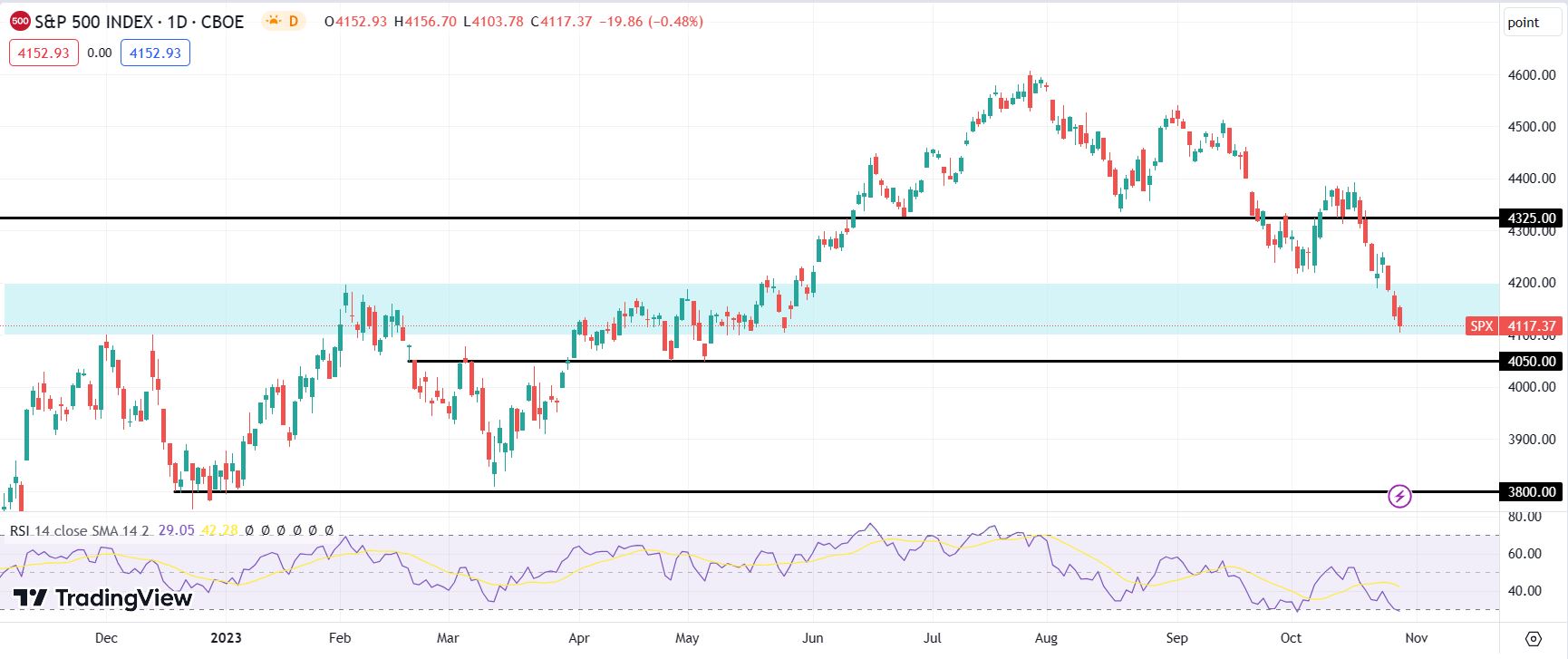
S&P 500 daily chart
Author

Clay Webster
FXStreet
Clay Webster grew up in the US outside Buffalo, New York and Lancaster, Pennsylvania. He began investing after college following the 2008 financial crisis.
















