S&P 500 Forecast: Market contracts after Powell dims hope of March rate cut
- The Standard & Poor’s 500 closed up 0.76% on Monday at an all-time high.
- Fed Chair Powell said on Wednesday that 'progress on inflation is not assured'.
- Among pharmaceuticals, Pfizer, Abbvie and Merck report this week.
- Among tech, Microsoft, Apple, Amazon, Alphabet, Meta Platforms, AMD all release quarterly results.
Following the Federal Open Market Committee (FOMC) decision to maintain the current interest rate regime on Wednesday, Federal Reserve (Fed) Chair Jerome Powell downplayed March as a starting point for trimming interest rates. The central bank hasn't raised rates since July 2023, but Powell said at a press conference that the central bank still needed more certainty that inflation was headed toward the 2% target before considering cuts.
The S&P 500 closed more than 1.6% lower since Powell refused to provide a timeline for when rates would begin easing, but the Chair did say he was hopeful that lower inflation would eventually allow the central bank to begin cutting this year. The NASDAQ Composite fell more than 2% on the day.
The market has been generally optimistic up until now that the central bank would offer its first cut at the March meeting, but Powell seemed uninterested in addressing timing.
"Economic outlook though is uncertain, ongoing progress on inflation is not assured," Powell said, adding that the Fed is "prepared to maintain current policy rate for longer if needed."
Qualcomm (QCOM) stock jumped nearly 3% late Wednesday after the semiconductor company reported $2.75 in earnings per share (EPS) on $9.92 billion in revenue. Mastercard (MA) also beat consensus on the top and bottom line. Adjusted EPS of $3.18 topped expectations by 10 cents, and revenue of $6.55 billion rose 12.5% from a year ago.
S&P 500 News: Tech stocks lead earnings this week
This week is turning out less exciting for tech investors than expected so far. Both Microsoft (MSFT) and Alphabet (GOOGL) beat the Wall Street earnings consensus late Tuesday, but both stocks sank on Wednesday morning.
The parent company of Google and Youtube saw ad revenue growth arrive below the market’s target, so shares of Alphabet stock sank more than 6% on Wednesday. MSFT stock was down 1.5% midday as well despite posting a healthy quarter and showing resolute growth in its Azure cloud business.
Thursday, more mega cap tech stocks will post their results. These include Amazon (AMZN), Apple (AAPL) and Meta Platforms (META), owner of Facebook.
Exxon Mobil (XOM) and Chevron (CVX) results on Friday make the session a report card for the oil industry. Also AbbVie (ABBV) results on Friday will be a coda to earlier week announcements from Pfizer (PFE) and Merck (MRK) among pharmaceutical majors.
S&P 500 FAQs
What is the S&P 500?
The S&P 500 is a widely followed stock price index which measures the performance of 500 publicly owned companies, and is seen as a broad measure of the US stock market. Each company’s influence on the computation of the index is weighted based on market capitalization. This is calculated by multiplying the number of publicly traded shares of the company by the share price. The S&P 500 index has achieved impressive returns – $1.00 invested in 1970 would have yielded a return of almost $192.00 in 2022. The average annual return since its inception in 1957 has been 11.9%.
How are companies chosen to be included in the S&P 500?
Companies are selected by committee, unlike some other indexes where they are included based on set rules. Still, they must meet certain eligibility criteria, the most important of which is market capitalization, which must be greater than or equal to $12.7 billion. Other criteria include liquidity, domicile, public float, sector, financial viability, length of time publicly traded, and representation of the industries in the economy of the United States. The nine largest companies in the index account for 27.8% of the market capitalization of the index.
How can I trade the S&P 500?
There are a number of ways to trade the S&P 500. Most retail brokers and spread betting platforms allow traders to use Contracts for Difference (CFD) to place bets on the direction of the price. In addition, that can buy into Index, Mutual and Exchange Traded Funds (ETF) that track the price of the S&P 500. The most liquid of the ETFs is State Street Corporation’s SPY. The Chicago Mercantile Exchange (CME) offers futures contracts in the index and the Chicago Board of Options (CMOE) offers options as well as ETFs, inverse ETFs and leveraged ETFs.
What factors drive the S&P 500?
Many different factors drive the S&P 500 but mainly it is the aggregate performance of the component companies revealed in their quarterly and annual company earnings reports. US and global macroeconomic data also contributes as it impacts on investor sentiment, which if positive drives gains. The level of interest rates, set by the Federal Reserve (Fed), also influences the S&P 500 as it affects the cost of credit, on which many corporations are heavily reliant. Therefore, inflation can be a major driver as well as other metrics which impact the Fed decisions.
Earnings of the week
Monday, January 29 - Whirlpool (WHR), Nucor (NUE)
Tuesday, January 30 - General Motors (GM), United Parcel Service (UPS), Sysco (SYY), Pfizer (PFE), Alphabet (GOOGL), Microsoft (MSFT), Starbucks (SBUX), Mondelez International (MDLZ), Advanced Micro Devices (AMD)
Wednesday, January 31 - Phillips 66 (PSX), Mastercard (MA), MetLife (MET), Qualcomm (QCOM), Boeing (BA)
Thursday, February 1 - Merck (MRK), Honeywell (HON), Altria (MO), Amazon (AMZN), Apple (AAPL), Meta Platforms (META)
Friday, February 2 - Exxon Mobil (XOM), Chevron (CVX), AbbVie (ABBV), Charter Communications (CHTR)
S&P 500 forecast
The S&P 500 index ran to a new all-time high on Monday but has fallen 0.8% before the Powell presser on Wednesday. This puts the index back at the 9-day Simple Moving Average (SMA). Any dark clouds from Powell, and the S&P 500 will rotate back to the previous all-time high of 4,818. That record high lasted more than two years.
The index remains in an uptrend, however, so the money is on this rally to continue. A break below the 21-day SMA, as well as the January 27 higher low of 4,714, would invalidate the bullish theory.
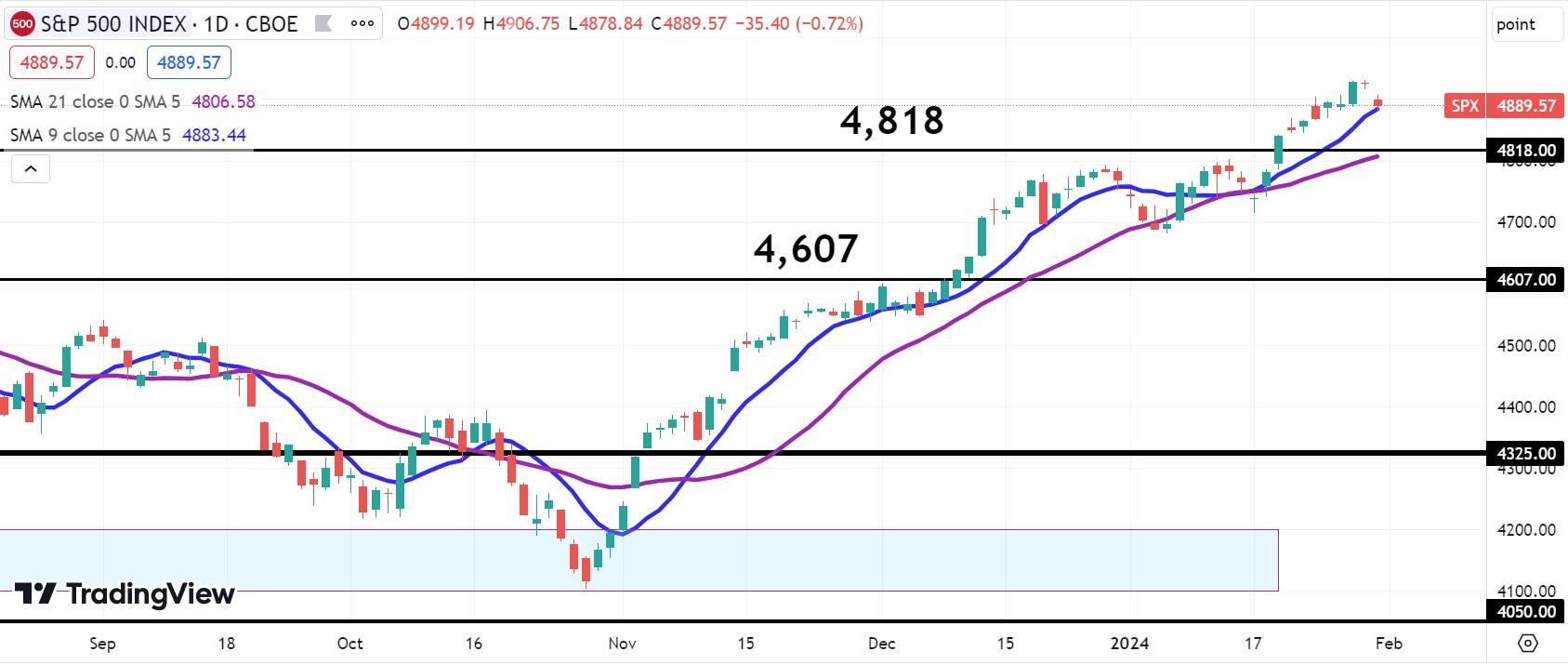
S&P 500 daily chart
Author

Clay Webster
FXStreet
Clay Webster grew up in the US outside Buffalo, New York and Lancaster, Pennsylvania. He began investing after college following the 2008 financial crisis.