South Korean Won plunges to fresh 2-year lows vs the US Dollar
- South Korean President Yoon Suk Yeol declared martial law.
- The SK Parliament passed a resolution to lift the martial law.
- USD/SKW hit a two-year high before retracing, remains biased higher

Political tensions hit the South Korean Won
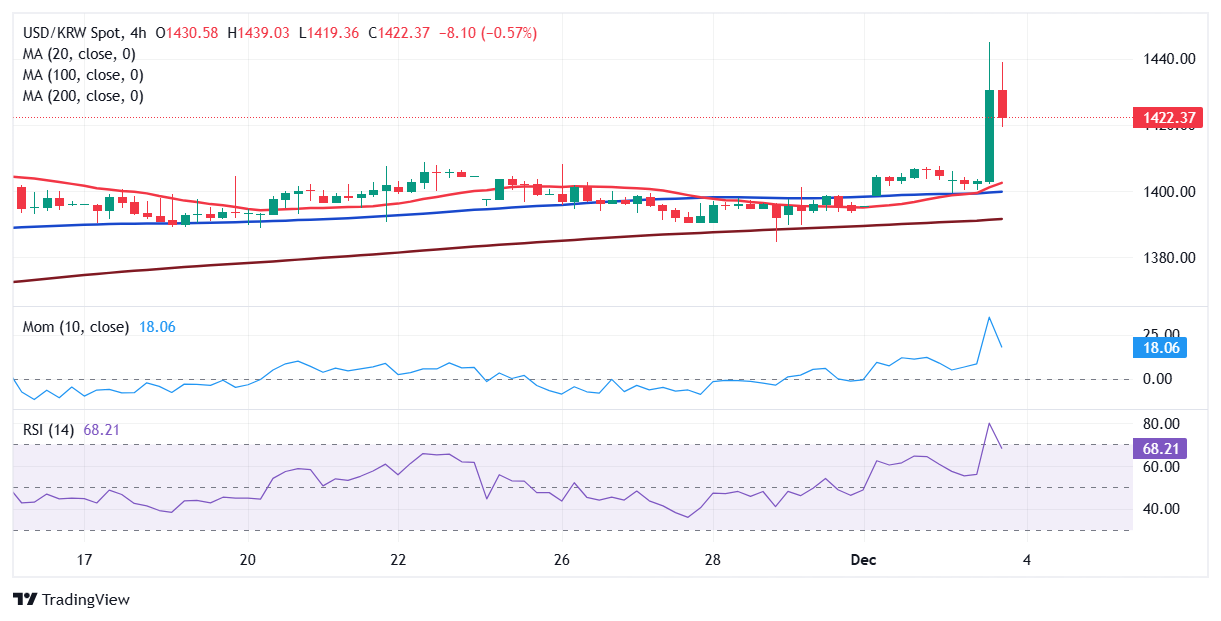
The South Korean Won (SKW) fell against the US Dollar (USD), resulting in the USD/SKW pair hitting a two-year high of 1,444.93. The pair now retreated towards 1,420 but holds on to sharp intraday gains, providing an unexpected boost to the American currency during American trading hours, amid fresh risk-aversion.
“I declare martial law to protect the free Republic of Korea from the threat of North Korean communist forces, to eradicate the despicable pro-North Korean anti-state forces that are plundering the freedom and happiness of our people, and to protect the free constitutional order,” Yoon said, according to a Reuters.
Mounting political turmoil hit the SKW as President Yoon Suk Yeol declared martial law. The late retracement came after the local Parliament passed a resolution to demand the lifting of martial law. Nevertheless, the latest news from the country showed the army closed the Parliament and was clearing lawmakers out of the representatives’ building.
USD/KRW Technical outlook
The USD/KWR pair remains quite volatile, and given the ongoing political uncertainty, the risk skews to the upside. The pair posted a record high of 1,472.46 in October 2022, a potential bullish target and break-out point. Additional gains should see the pair testing the 1,500 threshold.
Should tensions cool down, near-term support lies at 1,419.36, the intraday low, followed by 1,403.68, the December 2 daily high.
Risk sentiment FAQs
In the world of financial jargon the two widely used terms “risk-on” and “risk off'' refer to the level of risk that investors are willing to stomach during the period referenced. In a “risk-on” market, investors are optimistic about the future and more willing to buy risky assets. In a “risk-off” market investors start to ‘play it safe’ because they are worried about the future, and therefore buy less risky assets that are more certain of bringing a return, even if it is relatively modest.
Typically, during periods of “risk-on”, stock markets will rise, most commodities – except Gold – will also gain in value, since they benefit from a positive growth outlook. The currencies of nations that are heavy commodity exporters strengthen because of increased demand, and Cryptocurrencies rise. In a “risk-off” market, Bonds go up – especially major government Bonds – Gold shines, and safe-haven currencies such as the Japanese Yen, Swiss Franc and US Dollar all benefit.
The Australian Dollar (AUD), the Canadian Dollar (CAD), the New Zealand Dollar (NZD) and minor FX like the Ruble (RUB) and the South African Rand (ZAR), all tend to rise in markets that are “risk-on”. This is because the economies of these currencies are heavily reliant on commodity exports for growth, and commodities tend to rise in price during risk-on periods. This is because investors foresee greater demand for raw materials in the future due to heightened economic activity.
The major currencies that tend to rise during periods of “risk-off” are the US Dollar (USD), the Japanese Yen (JPY) and the Swiss Franc (CHF). The US Dollar, because it is the world’s reserve currency, and because in times of crisis investors buy US government debt, which is seen as safe because the largest economy in the world is unlikely to default. The Yen, from increased demand for Japanese government bonds, because a high proportion are held by domestic investors who are unlikely to dump them – even in a crisis. The Swiss Franc, because strict Swiss banking laws offer investors enhanced capital protection.
Author

FXStreet Team
FXStreet
Composed of a group of economic journalists and FX experts, the FXStreet content team produces and oversees all content published on FXStreet. It provides a purely journalistic approach to the Forex market.