|

SOS Stock Price: Sos Ltd extends decline as Bitcoin miners tumble during market sell off

  • NYSE:SOS fell by 2.79% during Thursday’s trading session.
  • Bitcoin miners slump as growth stocks tumble during a late day downturn.
  • SOS is banking on its recent investment in US crypto mining locations.

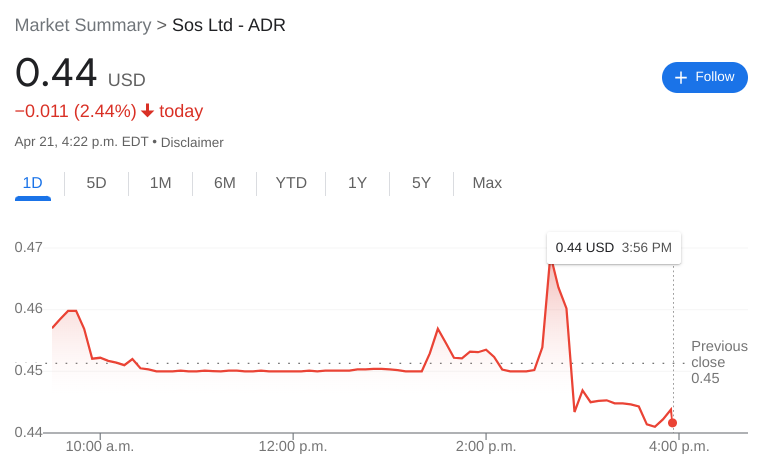
NYSE:SOS fell for the third straight day on Thursday as the broader markets continued to see downard selling pressure following a surge in the 10-year treasury yield rate. The key rate hit 2.9% on Thursday which is its highest level since 2018. Shares of SOS fell by 2.79% and closed the trading session at $0.44. The broader markets succumbed to the yield rate spike as all three major averages dropped lower into the close. The Dow Jones fell by 368 basis points, the S&P 500 lost 1.48%, and the NASDAQ plummeted by 2.07% during the session.


Stay up to speed with hot stocks' news!


As treasury yields surged on Thursday, growth sectors felt the bulk of the pressure as the NASDAQ extended its losses to nearly 17% so far this year. Bitcoin miners, like SOS, were beaten down as rivals like Ebang (NASDAQ:EBON), Canaan Inc ADR (NASDAQ:CAN), Riot Blockchain (NASDAQ:RIOT), and Marathon Digital Holdings (NASDAQ:MARA) were all trading well below water. The industry traded lower despite the price of Bitcoin rising during the session as the benchmark crypto nearly touched the $43,000 price level before falling back down to just below $41,500 at the time of this writing.

SOS stock forecast
SOS Stock

While it’s been a tough year for SOS, the company is banking on its expansion over into the US. SOS recently established a new project in Price County, Wisconsin where it is building a Super-Computing and Hosting Center which will host over 18,500 supercomputers. It is unclear when SOS will begin to benefit from the mining activities, but needless to say, it’s a step in the right direction after China banned crypto mining earlier this year.

Author

More from Stocks Reporter
Share:

Editor's Picks

AUD/USD hits nine-week lows below 0.7000 on RBA Bullock's remarks

AUD/USD reverses a brief uptick and turns lower to hit nine-week lows below 0.7000 in the European morning on Tuesday, as traders digest cautious remarks from Reserve Bank of Australia (RBA) Governor Michele Bullock during the press conference. Earlier on, the RBA raised the cash rate to 4.60%, as widely expected, leaving the door open to further rate hikes if needed.

USD/JPY consolidates near 157.50 as a bullish USD counters intervention risks

USD/JPY struggles to capitalize on the overnight bounce from a one-week low, consolidating around 157.50 in the Asian session on Tuesday. Trump's concerns about the Japanese Yen's weakness fueled speculation about another US-Japan joint intervention. This, along with the hawkish BoJ, underpins the JPY and caps the currency pair. Meanwhile, rising Fed rate-hike bets and oil-driven inflation fears continue to push US bond yields to multi-year highs, keeping the US Dollar pinned near a two-month high and supporting the pair.

Gold steadies after sharp drop as traders assess Fed outlook, Middle East risks

Gold steadies on Tuesday after suffering a sharp sell-off at the start of the week. The move appears to be a corrective bounce, as the broader narrative remains tied to expectations of further Federal Reserve interest rate hikes.

Crypto Today: Bitcoin, Ethereum, XRP correct upward amid declining ETF inflows

The cryptocurrency market upholds a neutral-to-bullish bias on Tuesday, with Bitcoin edging closer to a breakout above $84,000. Altcoins mirror BTC’s outlook, with Ethereum holding above $2,700 and Ripple pushing past the reclaimed $1.50 level.

What drove the Australian Dollar below 0.7000 as the Reserve Bank of Australia hiked to 4.60%?

The Australian Dollar (AUD) came under immediate downside pressure following the Reserve Bank of Australia’s (RBA) decision to raise its official cash rate by 25 basis points to 4.60% — marking its fourth interest rate increase in 2026.

Fed vs BoJ: Both hiked. The market only believes one of them – and the chart shows which

The Fed and the BoJ have just done something remarkably similar. Both central banks raised interest rates by 25 bps last week, both are confronting inflation risks, and both signal that future decisions will depend on incoming economic data.