|

SNG Stock Price: Synairgen plc completes six-fold leap in two days as CEO says things are moving very quickly

  • LON: SNG is trading more than 10% higher, above 210 pence after its coronavirus cure proved efficient. 
  • Synairgen PLC's CEO Richard Marsen said that "things are moving very quickly."
  • The pharma firm's collaboration with larger companies may scale up production.

LON: SNG was trading at around 35 pence per share only on Friday and is now around  210 pence – around six times its value. Synairgen PLC's stock is rising by over 10% on Tuesday, extending its surge recorded on Monday following the announcement that its drug drastically improves the survival chances of COVID-19 patients and helps them avoid complications – a 79% difference. 

Richard Marsden, Chief Executive Officer of Synairgen, told Bloomberg TV that "things are moving very quickly" when referring to receiving approval for wide approval of the drug. British authorities have been eager to throw money at any vaccine or cure and have also been willing to fast-track of approvals. Other countries will likely follow the UK in giving a green light for usage if London does so.

Moreover, Marsden said that he is in touch with several larger pharmaceutical companies regarding scaling up the production of the medication. While the large firms may take a cut from SNG's profits, the rapid distribution could help it gain market share. It could also open the door to one of the giants purchasing the Synargien, which is only valued at around £328 million. That seems like a modest sum for a company at the forefront of the worst medical disaster in recent history.

Synairgen Stock Price
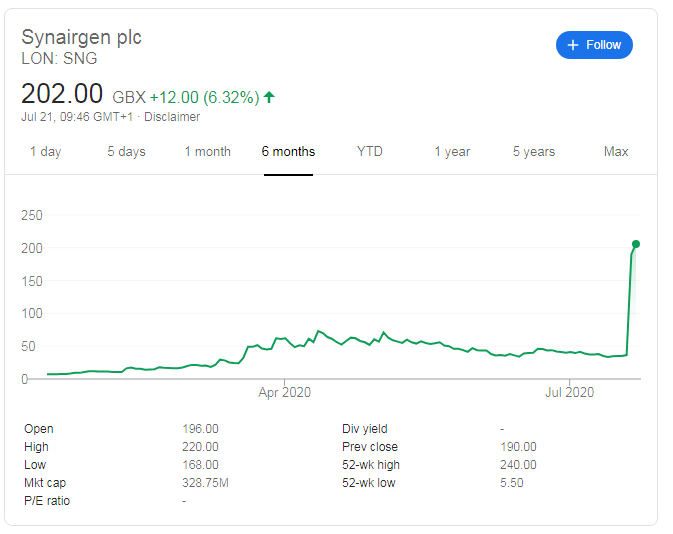
 

LON: SNG has already hit a high of  240 pence, and may be experiencing some profit-taking. Any upbeat news may push it higher. The round 200 pence level serves as a battleground. 

Author

Yohay Elam

Yohay Elam

FXStreet

Yohay is in Forex since 2008 when he founded Forex Crunch, a blog crafted in his free time that turned into a fully-fledged currency website later sold to Finixio.


More from Yohay Elam
Share:

Editor's Picks

GBP/USD gains traction above 1.3400 as markets bet on BoE rate hikes

The GBP/USD pair gathers strength to around 1.3430 during the Asian trading hours on Friday. The British Pound edges higher against the US Dollar on the UK government leadership transition and growing expectations of further Bank of England interest rate hikes.

EUR/USD nudges higher above 1.1400 as traders ramp up their bets on ECB hikes

The EUR/USD pair posts modest gains around 1.1430 during the early Asian session on Friday, bolstered by a softer US Dollar. The European Central Bank is grappling with elevated core inflation, forcing traders to price in more aggressive tightening despite mixed guidance from ECB officials. 


Gold: 21-day SMA is yet again the level to beat for XAU/USD bulls

Gold is defending the $4,100 level early Friday, trying hard to capitalize on this week’s rebound from four-day lows of $4,022 even as tensions in the Middle East appear to have somewhat eased. Despite the recent upswing, Gold remains on track to book a weekly loss, undermined by the revival of inflationary concerns.

Bitcoin recovers on easing US-Iran tensions; DeXe and Arbitrum rally

Bitcoin price rises above $63,000 extending its recovery as tensions between the US and Iran ease following missile strikes earlier this week. DeXe (DEXE) and Arbitrum (ARB) are leading gains over the last 24 hours as the broader market risk-off sentiment eases.

Five sessions, one round trip: Why the whipsaw is exactly what Warsh ordered

Markets opened July with a December hike as the base case and spent five trading sessions unlearning and relearning it. A 57K payrolls print bled the tightening bets out of the strip; a re-shut Strait of Hormuz is pushing them back in. Wednesday's minutes from the June Federal Open Market Committee meeting landed mid-round-trip, describing a world that had already stopped existing.

Bye, forward guidance: How to trade when central banks choose silence

Central banks have spent years telling markets what might come next. Now, traders face the possibility that they say a lot less. From the Federal Reserve to the European Central Bank and the Bank of England, policymakers are pushing back against forward guidance.














