Silver stalls near $38.00 as traders await Trump-Zelenskyy talks
- Silver trades flat near $38.00 on Monday, pressured by a firm US Dollar and rising Treasury yields.
- Caution prevails ahead of the Trump–Zelenskyy meeting, with Silver underpinned by lingering uncertainty following the inconclusive Trump-Putin talks.
- Silver remains range-bound below $38.50, with a double-top pattern and converging moving averages signaling fading momentum.

Silver (XAG/USD) is treading water around $38.00 on Monday, as traders stay on the sidelines ahead of a key meeting between US President Donald Trump and Ukrainian President Volodymyr Zelenskyy. A firm US Dollar (USD) and rising Treasury yields are capping upside potential, keeping pressure on the non-yielding metal.
The benchmark 10-year yield has climbed to 4.345% and the 30-year stands at 4.946%, both trading at 11-day highs. The rise in yields is pressuring precious metals by raising the opportunity cost of holding non-interest-bearing assets like Silver.
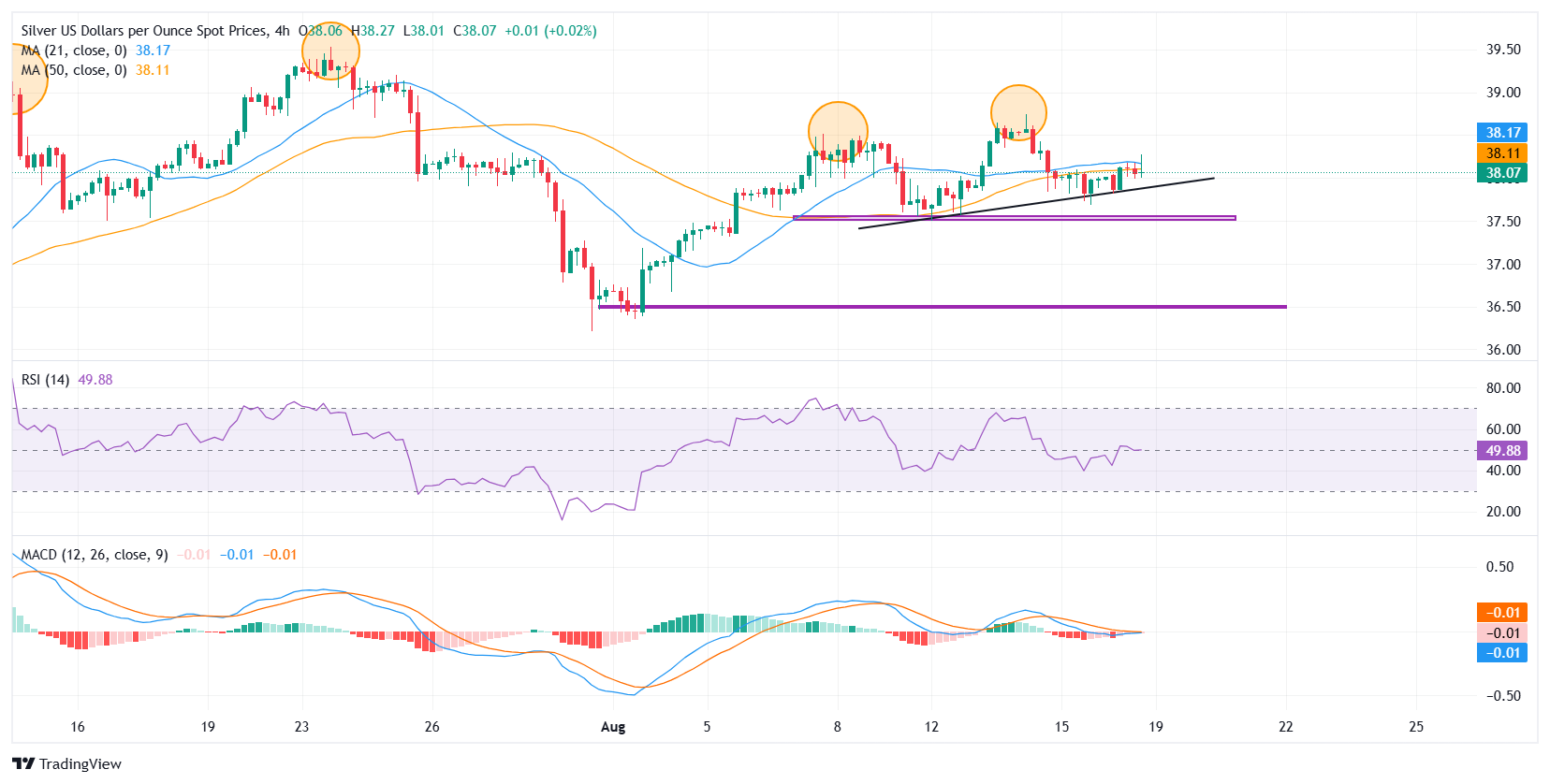
From a technical standpoint, Silver is hovering just above the neckline of a bearish double-top formation that has developed in the $38.50-$39.00 region. The pattern highlights persistent rejection from key resistance, suggesting that upside momentum is losing steam. A decisive break below the horizontal support at $37.50 could open the door for a deeper pullback toward $36.50 and possibly $35.50. The 21-period and 50-period Simple Moving Averages (SMAs) on the 4-hour chart are converging near current price levels, further signaling consolidation and waning directional bias.
The Relative Strength Index (RSI) is hovering near the neutral 50 mark, offering no strong directional signals, while the Moving Average Convergence Divergence (MACD) indicator is showing a flat bias, with the MACD and signal lines showing early signs of converging around the zero line. This setup reinforces the view that the metal is currently in a consolidation phase, with neither bulls nor bears asserting control decisively.
That said, the downside remains cushioned for now, as broader market sentiment turns cautious ahead of the Trump–Zelenskyy summit scheduled for later today. This comes after the weekend summit between US President Donald Trump and Russian President Vladimir Putin failed to deliver a breakthrough. While no ceasefire agreement was reached, discussions around potential security guarantees for Ukraine offered a glimmer of hope for future progress. The high-level talks are drawing increased global attention, with several European leaders, including French President Emmanuel Macron, German Chancellor Friedrich Merz, European Commission President Ursula von der Leyen, and UK Prime Minister Keir Starmer, expected to join today’s White House discussions, underscoring the geopolitical weight of the meeting.
On the other hand, expectations of a 25 basis point rate cut at the Federal Reserve’s September meeting are offering some support to Silver prices. According to the CME FedWatch Tool, markets are currently pricing in the likelihood of a rate cut at 84%, reinforcing the view that the Fed could begin easing policy as early as next month. A dovish shift would typically weigh on the US Dollar and Treasury yields, creating a more favorable backdrop for non-yielding assets like Silver. Traders will also look ahead to Wednesday’s FOMC meeting minutes for insight into the Fed's internal debate, while Fed Chair Jerome Powell’s speech at the Jackson Hole Symposium on Friday will be closely watched for fresh clues on the timing and scope of future rate moves.
Silver FAQs
Silver is a precious metal highly traded among investors. It has been historically used as a store of value and a medium of exchange. Although less popular than Gold, traders may turn to Silver to diversify their investment portfolio, for its intrinsic value or as a potential hedge during high-inflation periods. Investors can buy physical Silver, in coins or in bars, or trade it through vehicles such as Exchange Traded Funds, which track its price on international markets.
Silver prices can move due to a wide range of factors. Geopolitical instability or fears of a deep recession can make Silver price escalate due to its safe-haven status, although to a lesser extent than Gold's. As a yieldless asset, Silver tends to rise with lower interest rates. Its moves also depend on how the US Dollar (USD) behaves as the asset is priced in dollars (XAG/USD). A strong Dollar tends to keep the price of Silver at bay, whereas a weaker Dollar is likely to propel prices up. Other factors such as investment demand, mining supply – Silver is much more abundant than Gold – and recycling rates can also affect prices.
Silver is widely used in industry, particularly in sectors such as electronics or solar energy, as it has one of the highest electric conductivity of all metals – more than Copper and Gold. A surge in demand can increase prices, while a decline tends to lower them. Dynamics in the US, Chinese and Indian economies can also contribute to price swings: for the US and particularly China, their big industrial sectors use Silver in various processes; in India, consumers’ demand for the precious metal for jewellery also plays a key role in setting prices.
Silver prices tend to follow Gold's moves. When Gold prices rise, Silver typically follows suit, as their status as safe-haven assets is similar. The Gold/Silver ratio, which shows the number of ounces of Silver needed to equal the value of one ounce of Gold, may help to determine the relative valuation between both metals. Some investors may consider a high ratio as an indicator that Silver is undervalued, or Gold is overvalued. On the contrary, a low ratio might suggest that Gold is undervalued relative to Silver.
Author

Vishal Chaturvedi
FXStreet
I am a macro-focused research analyst with over four years of experience covering forex and commodities market. I enjoy breaking down complex economic trends and turning them into clear, actionable insights that help traders stay ahead of the curve.














