Silver Price Forecast: XAG/USD approaches $54.00 amid US Dollar’s weakness
- Silver reaches highs above $54.00, aiming at November's peak, near $54.40
- The precious metal is drawing support from lower US Yields as Fed easing hopes grow.
- XAG/USD appreciates 7% in a four-day rally this week.

Silver (XAG/USD) trades higher for the fourth consecutive day on Thursday. The precious metal reaches levels a few pips below $54.00 on the early European session, favoured by a softer US Dollar as investors remain confident that the US Federal Reserve will cut rates in December.
US macroeconomic data released on Wednesday beat expectations, with Durable Goods Orders increasing beyond forecasts and jobless claims dropping to a seven-month low. Futures markets, however, keep pricing an 85% chance of a quarter-point rate cut in December, and further easing next year, which keeps US Treasury yields and the US Dollar on the defensive.
Technical Analysis: Bulls aim for the $54.40 level
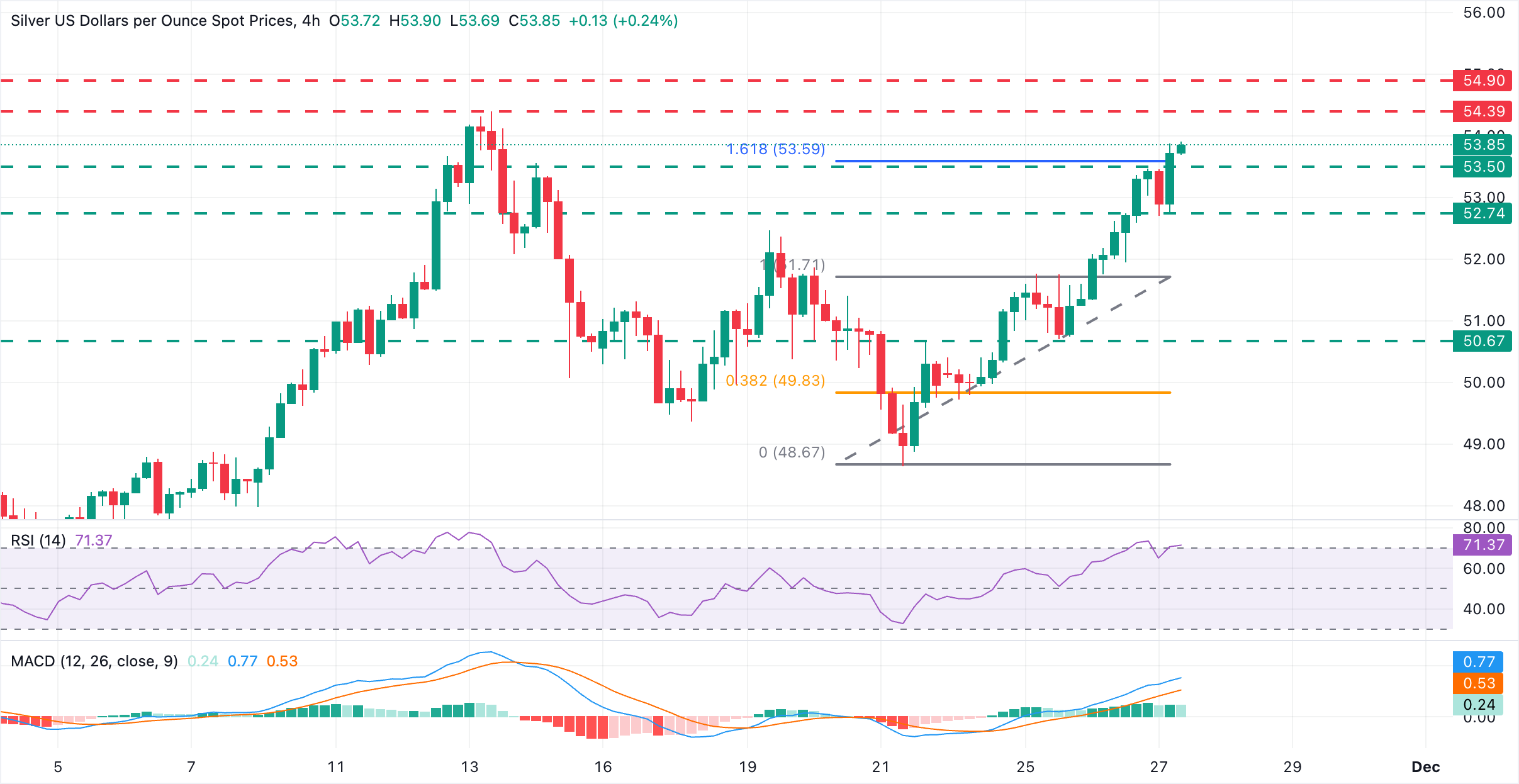
The technical picture is strongly bullish, after a more than 7% appreciation this week. The Relative Strength Index (RSI) in 4-hour charts has reached overbought levels, but the Moving Average Convergence Divergence (MACD) remains firm, printing green bars in the histogram, which highlights the bullish momentum.
Bulls are focusing on the November 13 highs, at the $54.40 area, ahead of the long-term high, near $55.00, hit in mid-October. Further up, the 261% Fibonacci extension of the November 21-25 rally is at the $56.60 area.
On the downside, Thursday's high near 53.50 is likely to provide some support in case of a bearish reversal. Further down, the intraday low is at the $52.75 area, ahead of the November 25 low, near $50.65.
Silver FAQs
Silver is a precious metal highly traded among investors. It has been historically used as a store of value and a medium of exchange. Although less popular than Gold, traders may turn to Silver to diversify their investment portfolio, for its intrinsic value or as a potential hedge during high-inflation periods. Investors can buy physical Silver, in coins or in bars, or trade it through vehicles such as Exchange Traded Funds, which track its price on international markets.
Silver prices can move due to a wide range of factors. Geopolitical instability or fears of a deep recession can make Silver price escalate due to its safe-haven status, although to a lesser extent than Gold's. As a yieldless asset, Silver tends to rise with lower interest rates. Its moves also depend on how the US Dollar (USD) behaves as the asset is priced in dollars (XAG/USD). A strong Dollar tends to keep the price of Silver at bay, whereas a weaker Dollar is likely to propel prices up. Other factors such as investment demand, mining supply – Silver is much more abundant than Gold – and recycling rates can also affect prices.
Silver is widely used in industry, particularly in sectors such as electronics or solar energy, as it has one of the highest electric conductivity of all metals – more than Copper and Gold. A surge in demand can increase prices, while a decline tends to lower them. Dynamics in the US, Chinese and Indian economies can also contribute to price swings: for the US and particularly China, their big industrial sectors use Silver in various processes; in India, consumers’ demand for the precious metal for jewellery also plays a key role in setting prices.
Silver prices tend to follow Gold's moves. When Gold prices rise, Silver typically follows suit, as their status as safe-haven assets is similar. The Gold/Silver ratio, which shows the number of ounces of Silver needed to equal the value of one ounce of Gold, may help to determine the relative valuation between both metals. Some investors may consider a high ratio as an indicator that Silver is undervalued, or Gold is overvalued. On the contrary, a low ratio might suggest that Gold is undervalued relative to Silver.
Author

Guillermo Alcala
FXStreet
Graduated in Communication Sciences at the Universidad del Pais Vasco and Universiteit van Amsterdam, Guillermo has been working as financial news editor and copywriter in diverse Forex-related firms, like FXStreet and Kantox.