|

RBA Monetary Policy Statement: Further rate hikes may be needed

The RBA Monetary Policy Statement released by the Reserve Bank of Australia is out as follows:

Projections are based on a 3.75% rate peak, with rates dropping to 3% by mid-25.

Further monetary policy tightening may be required.

Energy prices will contribute considerably to inflation in the coming year.

We are steadfast in the commitment to return inflation to target.

The board intends to keep as much employment gains as possible.

The longer inflation remains above target, the higher the likelihood of a price-wage spiral.

Goods disinflation has been minimal thus far, but energy price inflation will remain high this year.

Forecast cpi inflation of 4.5% in 2023, 3.2% in 2024, and 3.0% in mid-2025.

Forecast trimmed mean inflation of 4.0% by the end of 2023, 3.1% by the end of 2024, and 2.9% by the middle of 2025.

China is projected to easily meet its 5% growth target this year.

Forecasts GDP growth of 1.2% in 2023, 1.7% in 2024, and 2.1% in mid-2025.

AUD/USD update
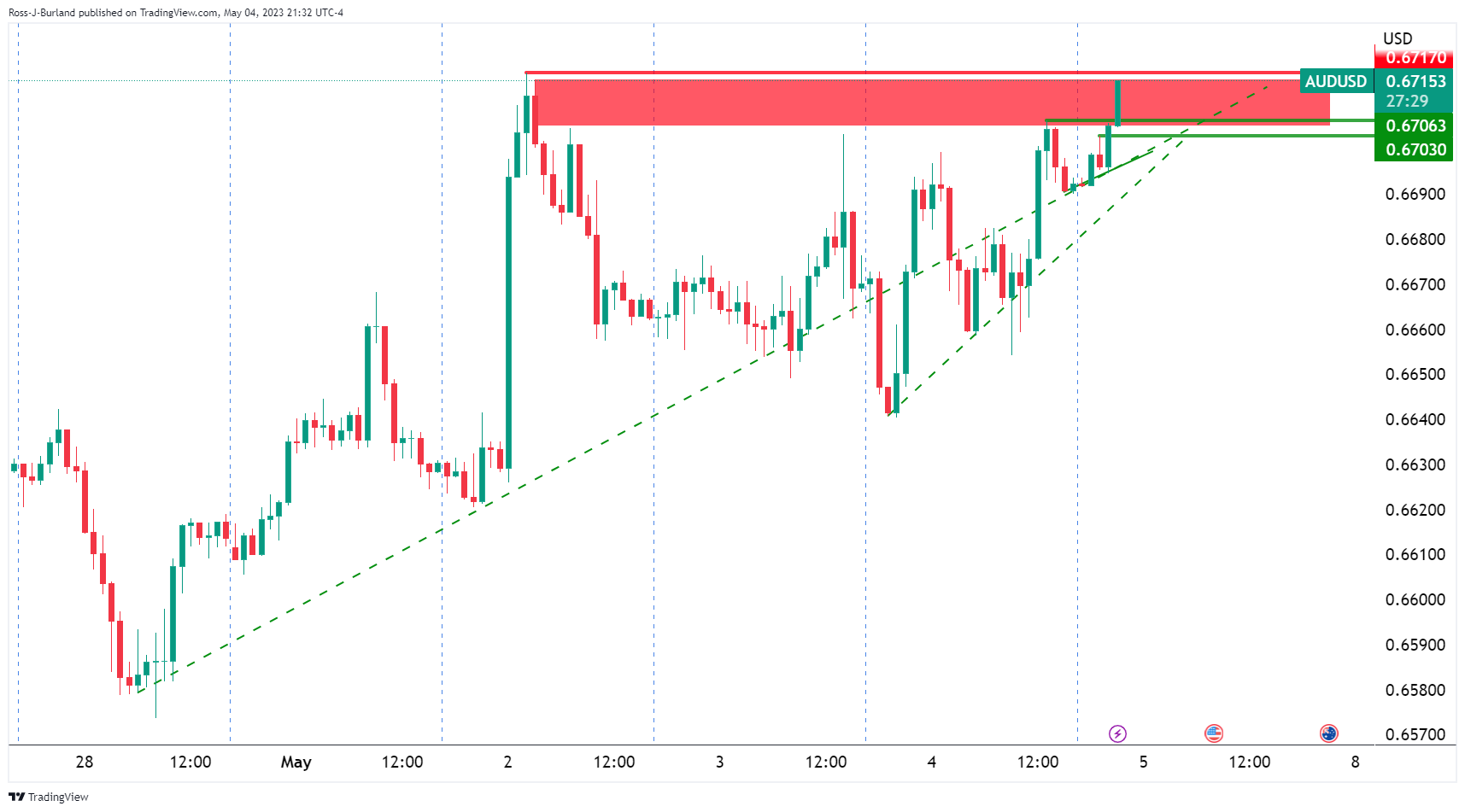
H1 chart above and M5 chart below.
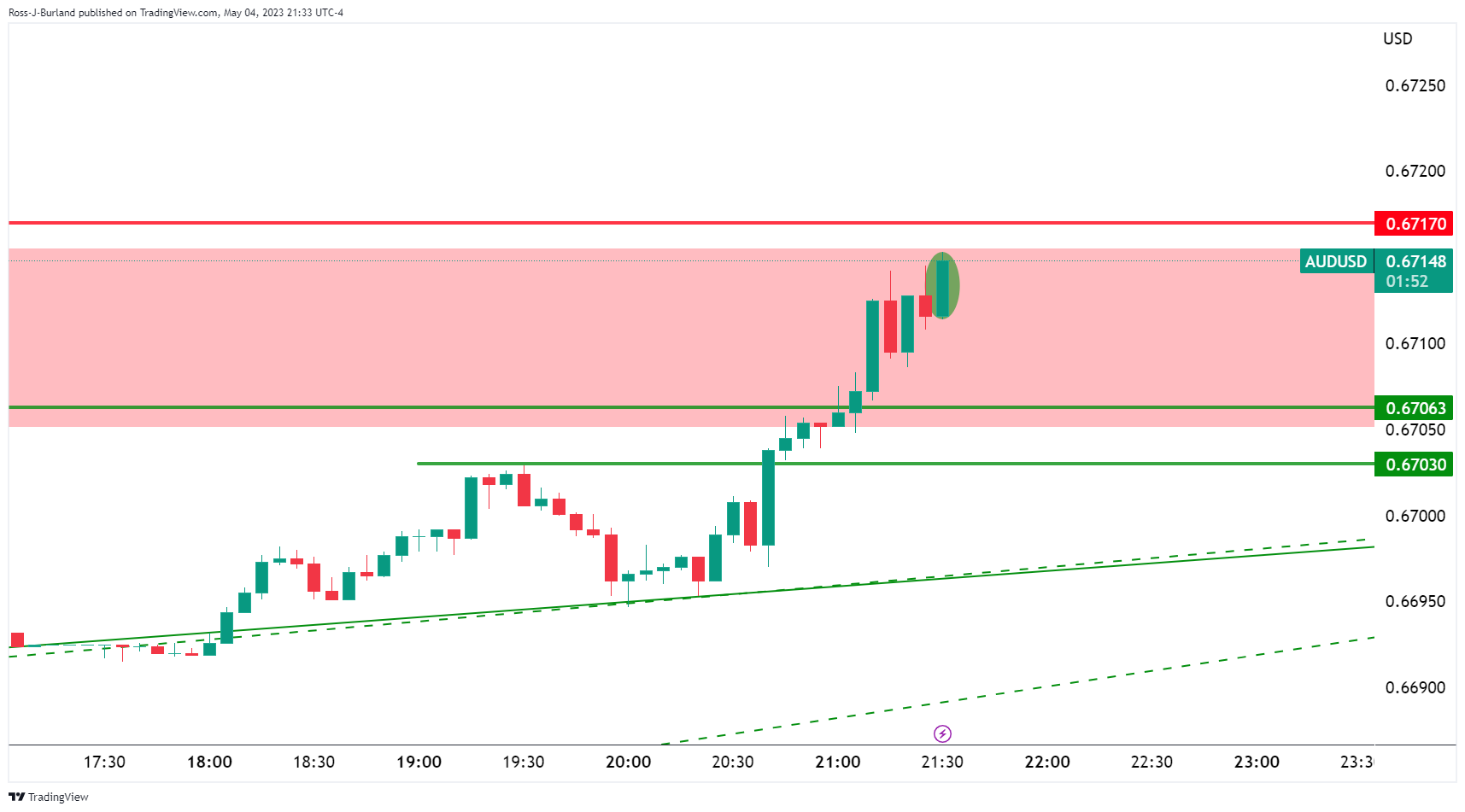
AUD/USD has been given a boost on the statements towards 0.6717, Tuesday's high. 

About the RBA Monetary Policy Statement 

The RBA Monetary Policy Statement released by the Reserve Bank of Australia reviews economic and financial conditions, determines the appropriate stance of monetary policy and assesses the risks to its long-run goals of price stability and sustainable economic growth. It is considered as a clear guide to the future RBA interest rate policy. Any changes in this report affect the AUD volatility. If the RBA statement shows a hawkish outlook, that is seen as positive (or bullish) for the AUD, while a dovish outlook is seen as negative (or bearish).

Author

Ross J Burland

Ross J Burland, born in England, UK, is a sportsman at heart. He played Rugby and Judo for his county, Kent and the South East of England Rugby team.


More from Ross J Burland
Share:

Editor's Picks

GBP/USD flies to two-week highs, targets 1.3400

GBP/USD trades well above the 1.3300 barrier on Thursday as the Greenback comes under renewed selling pressure following a softer-than-expected US NFP report in June. Meanwhile, Cable extends its multi-day recovery and looks to challenge 1.3400 sooner rather than later.

EUR/USD: Signs of life emerge above 1.1400

EUR/USD leaves behind two daily pullbacks in a row and advances to multi-day peaks near 1.1470 on Thursday, partially offsetting the sharp decline in place since June. The pair’s decline follows the intense retracement in the US Dollar, which is particularly sponsored by disheartening prints from June’s Payrolls and the sharp sell-off in USD/JPY. The US markets will be closed on Friday due to the Independence Day holiday.

Gold hits six-day tops past $4,100

Gold extends its bullish momentum on Thursday, climbing above the $4,100 mark per troy ounce to reach its highest level in a week. The precious metal’s sharp rebound comes as the US Dollar retreats following disappointing US NFP data.

Strategy's STRC volatility points to late Bitcoin cycle reset — Bitwise
The recent volatility surrounding Strategy's perpetual preferred stock, STRC, could signal that Bitcoin (BTC) is approaching a cycle bottom, according to Bitwise CIO Matt Hougan. In a Wednesday report, Hougan argued that the sharp decline in STRC and Strategy's MSTR stock should be viewed as "classic end-of-cycle dynamics" rather than evidence of a broader structural threat to Bitcoin.
The market may no longer be giving the Magnificent Seven a free pass
For much of the past three years, investing has felt surprisingly simple. Whenever markets stumbled, investors knew where to look. Apple, Microsoft, Nvidia, Amazon, Alphabet, Meta and Tesla repeatedly led Wall Street higher, shrugging off inflation fears, higher interest rates and geopolitical shocks.
Kevin Warsh offers no policy clues: Why markets still got their answer

Financial markets came to Sintra looking for clues about the Federal Reserve's (Fed) next move. They largely left with confirmation that Fed Chair Kevin Warsh intends to make those clues much harder to find.