Pound Sterling outperforms USD as Trump's tariff fears wane
- The Pound Sterling moves higher against its major peers despite deepening risks of stagflation in the UK economy.
- UK gilt yields tumble on firm BoE dovish bets.
- The risk-premium in the US Dollar has diminished as investors digest Trump’s tariff fears.

The Pound Sterling (GBP) recovers its entire intraday losses and climbs above 1.2500 against the US Dollar (USD) in Monday’s North American session. The GBP/USD pair bounces back as the US Dollar retreats after investors digest fears of United States (US) President Donald Trump imposing 25% tariffs on Colombia overnight.
Over the weekend, President Trump threatened to impose tariffs on its South American trading partner for not allowing military flights carrying illegal immigrants in their territory. Later, Trump put proposed tariffs on hold after Colombia accepted his terms.
The US Dollar Index (DXY), which tracks the Greenback’s value against six major currencies, falls back to near 107.50 from an intraday high of 107.80. The Greenback lost its risk premium as market participants expected President Trump would use tariffs only to negotiate deals.
“This seems to feed into the growing sense that Trump is underdelivering on protectionism compared to pre-inauguration remarks, and that ultimately some of those tariff threats may not materialize as long as some concessions are made on trade,” said ING.
Going forward, this week’s primary trigger for the US Dollar will be the Federal Reserve’s (Fed) monetary policy decision, which will be announced on Wednesday. The Fed is almost certain to keep interest rates unchanged in the range of 4.25%-4.50%. Investors will pay close attention to Fed Chair Jerome Powell’s press conference after the interest rate decision, who is expected to face the question of whether the Fed will positively react to Trump’s call for immediate rate cuts.
Daily digest market movers: Pound Sterling rises despite deepening UK stagflation risks
- The Pound Sterling strengthens against its major peers at the start of the week. The British currency rises even though investors are worried about the growing risks of stagflation in the United Kingdom (UK) economy. Friday’s S&P Global UK Purchasing Managers Index (PMI) report for January showed that employment levels dropped for the fourth straight month and cost pressures accelerated in the private sector, a scenario that leads to higher inflation as producers pass on the impact of higher input costs to customers.
- A slowdown in labor demand appears to be the outcome of Chancellor of the Exchequer Rachel Reeves’ announcement of increasing employers’ contribution to National Insurance (NI).
- The first indicators of business conditions in 2025 add to the gloom about the UK economy, with companies cutting employment amid falling sales and concerns about business prospects. Inflation pressures have, meanwhile, reignited, pointing to a stagflationary environment, Chris Williamson, Chief Business Economist at S&P Global Market Intelligence, said.
- Deteriorating job market conditions and rising price pressures are expected to add more troubles for the Bank of England (BoE), which is scheduled to announce its first monetary policy decision of 2025 on February 6. Traders are confident that the BoE will reduce interest rates by 25 basis points (bps) to 4.5%.
- Meanwhile, firm BoE dovish bets have also weighed on yields on UK 30-year gilts, down over 1% to near 5.15% on Monday.
British Pound PRICE Today
The table below shows the percentage change of British Pound (GBP) against listed major currencies today. British Pound was the strongest against the Australian Dollar.
| USD | EUR | GBP | JPY | CAD | AUD | NZD | CHF | |
|---|---|---|---|---|---|---|---|---|
| USD | -0.19% | -0.18% | -1.02% | 0.12% | 0.44% | 0.29% | -0.69% | |
| EUR | 0.19% | 0.09% | -0.68% | 0.45% | 0.64% | 0.60% | -0.40% | |
| GBP | 0.18% | -0.09% | -1.10% | 0.37% | 0.55% | 0.53% | -0.48% | |
| JPY | 1.02% | 0.68% | 1.10% | 1.18% | 1.65% | 1.56% | 0.47% | |
| CAD | -0.12% | -0.45% | -0.37% | -1.18% | 0.13% | 0.18% | -0.84% | |
| AUD | -0.44% | -0.64% | -0.55% | -1.65% | -0.13% | 0.00% | -0.98% | |
| NZD | -0.29% | -0.60% | -0.53% | -1.56% | -0.18% | -0.01% | -1.22% | |
| CHF | 0.69% | 0.40% | 0.48% | -0.47% | 0.84% | 0.98% | 1.22% |
The heat map shows percentage changes of major currencies against each other. The base currency is picked from the left column, while the quote currency is picked from the top row. For example, if you pick the British Pound from the left column and move along the horizontal line to the US Dollar, the percentage change displayed in the box will represent GBP (base)/USD (quote).
Technical Analysis: Pound Sterling gains ground above 20-day EMA
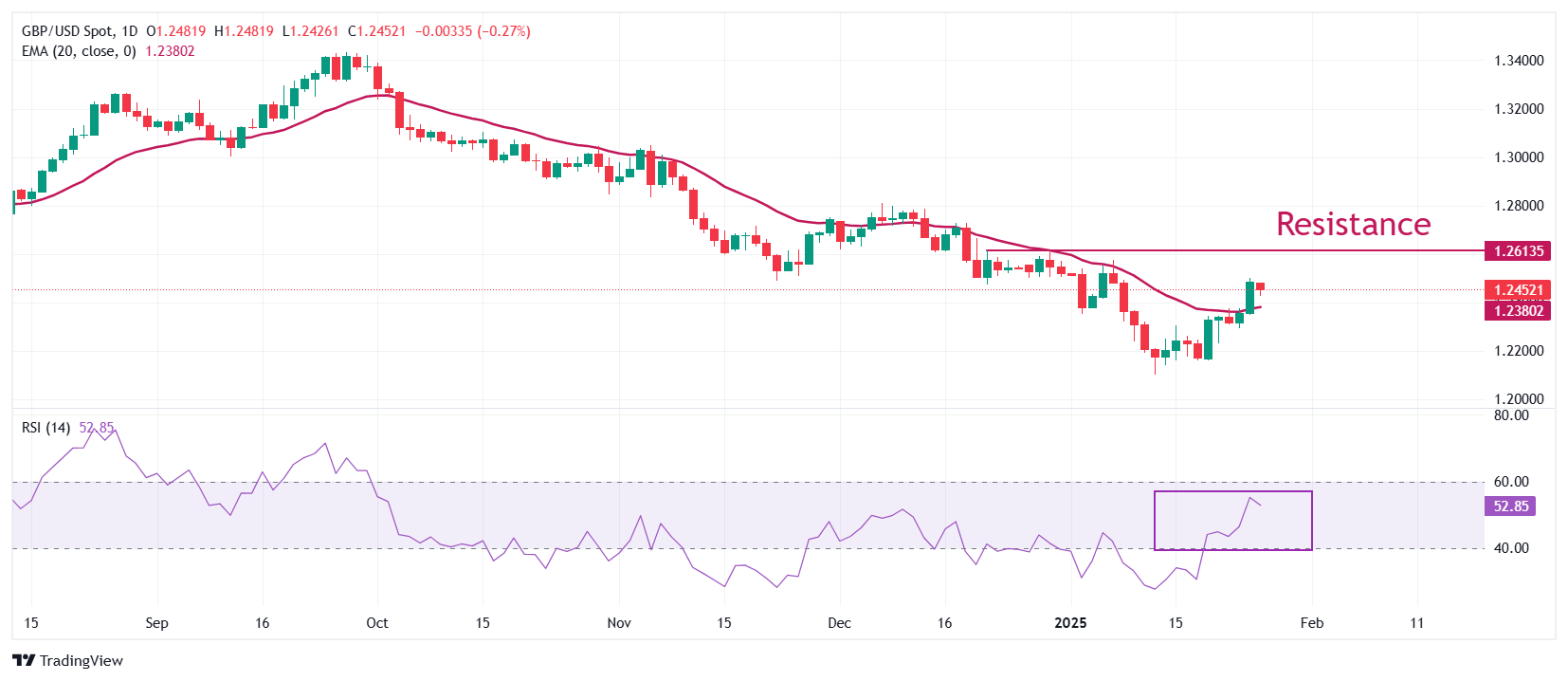
The Pound Sterling revisits the psychological resistance of 1.2500 against the US Dollar. The near-term outlook of the GBP/USD pair remains firm as it holds the 20-day Exponential Moving Average (EMA), which trades around 1.2380.
The 14-day Relative Strength Index (RSI) moves higher above 50.00 from the 20.00-40.00 range, suggesting that the bearish momentum has ended, at least for now.
Looking down, the January 13 low of 1.2100 and the October 2023 low of 1.2050 will act as key support zones for the pair. On the upside, the December 30 high of 1.2607 will act as key resistance.
BoE FAQs
The Bank of England (BoE) decides monetary policy for the United Kingdom. Its primary goal is to achieve ‘price stability’, or a steady inflation rate of 2%. Its tool for achieving this is via the adjustment of base lending rates. The BoE sets the rate at which it lends to commercial banks and banks lend to each other, determining the level of interest rates in the economy overall. This also impacts the value of the Pound Sterling (GBP).
When inflation is above the Bank of England’s target it responds by raising interest rates, making it more expensive for people and businesses to access credit. This is positive for the Pound Sterling because higher interest rates make the UK a more attractive place for global investors to park their money. When inflation falls below target, it is a sign economic growth is slowing, and the BoE will consider lowering interest rates to cheapen credit in the hope businesses will borrow to invest in growth-generating projects – a negative for the Pound Sterling.
In extreme situations, the Bank of England can enact a policy called Quantitative Easing (QE). QE is the process by which the BoE substantially increases the flow of credit in a stuck financial system. QE is a last resort policy when lowering interest rates will not achieve the necessary result. The process of QE involves the BoE printing money to buy assets – usually government or AAA-rated corporate bonds – from banks and other financial institutions. QE usually results in a weaker Pound Sterling.
Quantitative tightening (QT) is the reverse of QE, enacted when the economy is strengthening and inflation starts rising. Whilst in QE the Bank of England (BoE) purchases government and corporate bonds from financial institutions to encourage them to lend; in QT, the BoE stops buying more bonds, and stops reinvesting the principal maturing on the bonds it already holds. It is usually positive for the Pound Sterling.
Author

Sagar Dua
FXStreet
Sagar Dua is associated with the financial markets from his college days. Along with pursuing post-graduation in Commerce in 2014, he started his markets training with chart analysis.

















