Pound Sterling slides to monthly low after surprisingly hot US Inflation data
- The Pound Sterling weakens against the US Dollar after the release of the US CPI report for September.
- US inflation grew at a faster-than-expected pace on a monthly as well as an annual basis.
- In the UK, investors will pay close attention to the monthly GDP data for August on Friday.

The Pound Sterling (GBP) falls to near the monthly low of 1.3000 against the US Dollar (USD) in Thursday’s North American session. The GBP/USD pair weakens after the release of the United States (US) Consumer Price Index (CPI) data, which showed that price pressures were hotter than expected in September.
The annual headline CPI inflation decelerated to 2.4%, the lowest figure since February 2021, from 2.5% in August but grew faster than estimates of 2.3%. Meanwhile, the core CPI – which excludes volatile food and energy prices – rose by 3.3%, faster than expectations and the former release of 3.2%. The month-on-month headline and core CPI rose steadily by 0.2% and 0.3%, respectively.
Market experts see the impact of the hot US inflation data to remain limited on the Federal Reserve’s (Fed) likely interest rate action in the last quarter of the year as policymakers are highly concerned over growing risks to economic growth, with confidence over inflation returning to the bank’s target of 2%. The Federal Open Market Committee (FOMC) minutes for the September meeting, released on Wednesday, showed that a substantial majority of Fed officials voted for a 50 bps rate, pushing interest rates lower to 4.75%-5.00%, to revive the labor market strength.
According to the CME FedWatch tool, traders have priced in a 25 basis points (bps) interest rate cut in each of the remaining two policy meetings this year.
Daily digest market movers: Pound Sterling turns fragile ahead of UK monthly GDP data for August
- The Pound Sterling weakens against its major peers on Thursday. The British currency faces selling pressure as traders brace for the United Kingdom's (UK) monthly Gross Domestic Product (GDP) and the factory data for August, which will be released on Friday.
- The UK economy is estimated to have expanded by 0.2% after remaining flat in July. The monthly Industrial, and Manufacturing production are expected to have grown by 0.2% after contracting in July. Signs of revival in activities in the manufacturing sector would improve the economic outlook, which will have a positive impact on the Pound Sterling.
- Meanwhile, the major trigger for the Pound Sterling will be market expectations for the Bank of England’s (BoE) outlook for the last quarter of the year. The BoE is expected to cut interest rates by 25 bps in one of the remaining two meetings in November or December. Traders have raised bets for rate cuts in November after last week’s speech from BoE Governor Andrew Bailey, in which he guided for an aggressive policy-easing cycle if price pressures ease further.
- BoE officials have remained worried about high inflation in the services sector due to robust wage growth. UK annual service inflation rose sharply to 5.6% in August from 5.2% in July.
British Pound PRICE Today
The table below shows the percentage change of British Pound (GBP) against listed major currencies today. British Pound was the strongest against the Canadian Dollar.
| USD | EUR | GBP | JPY | CAD | AUD | NZD | CHF | |
|---|---|---|---|---|---|---|---|---|
| USD | 0.01% | 0.13% | -0.56% | 0.29% | -0.06% | -0.40% | -0.41% | |
| EUR | -0.01% | 0.12% | -0.57% | 0.28% | -0.06% | -0.36% | -0.43% | |
| GBP | -0.13% | -0.12% | -0.68% | 0.17% | -0.26% | -0.49% | -0.58% | |
| JPY | 0.56% | 0.57% | 0.68% | 0.86% | 0.49% | 0.17% | 0.13% | |
| CAD | -0.29% | -0.28% | -0.17% | -0.86% | -0.37% | -0.65% | -0.74% | |
| AUD | 0.06% | 0.06% | 0.26% | -0.49% | 0.37% | -0.30% | -0.32% | |
| NZD | 0.40% | 0.36% | 0.49% | -0.17% | 0.65% | 0.30% | -0.10% | |
| CHF | 0.41% | 0.43% | 0.58% | -0.13% | 0.74% | 0.32% | 0.10% |
The heat map shows percentage changes of major currencies against each other. The base currency is picked from the left column, while the quote currency is picked from the top row. For example, if you pick the British Pound from the left column and move along the horizontal line to the US Dollar, the percentage change displayed in the box will represent GBP (base)/USD (quote).
Technical Analysis: Pound Sterling slumps to near 1.3000
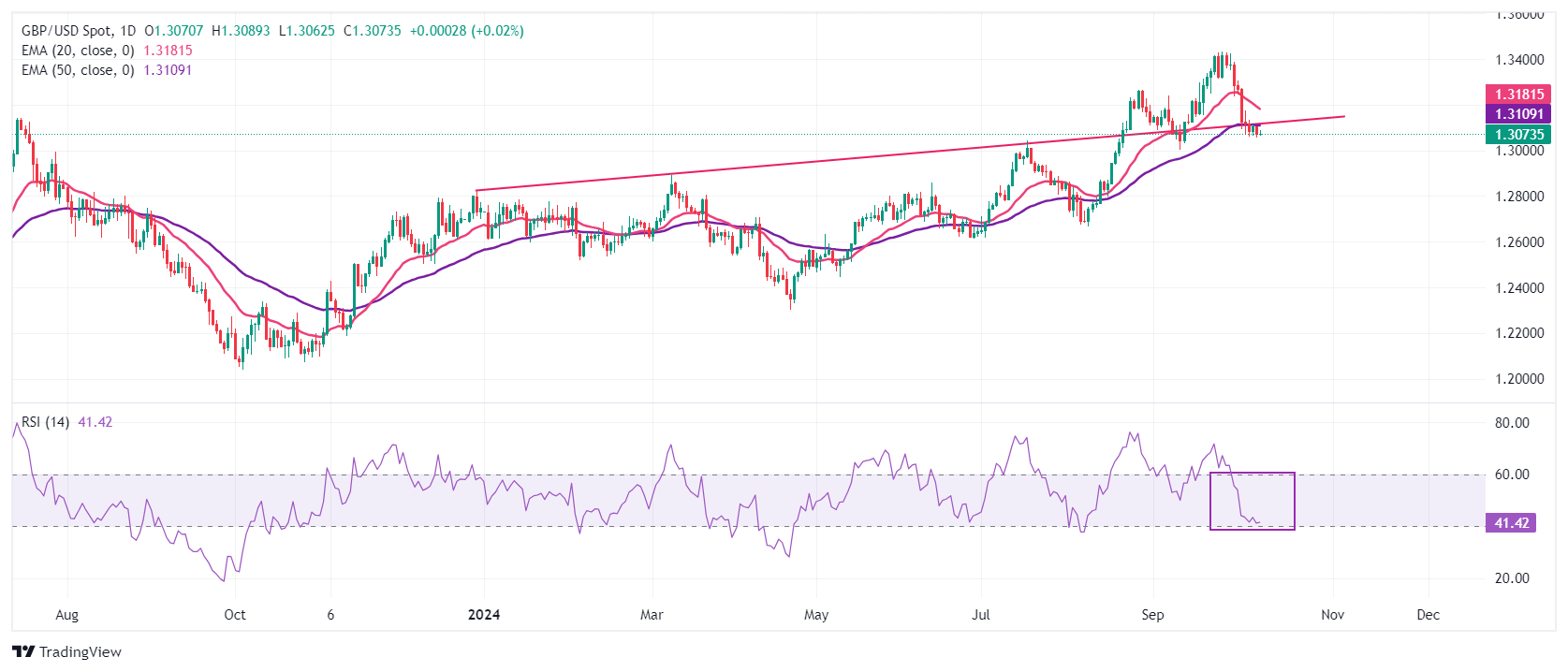
The Pound Sterling drops further to near near 1.3000 against the US Dollar. The outlook of the GBP/USD pair was already vulnerable as it stabilized below the upward-sloping trendline plotted from the 28 December 2023 high of 1.2827. The near-term trend of the Cable is bearish as it trades below the 20- and 50-day Exponential Moving Averages (EMAs), which trade around 1.3180 and 1.3110, respectively.
The 14-day Relative Strength Index (RSI) declines to near 40.00. More downside would appear if the momentum oscillator falls below the above-mentioned level.
Looking up, the round-level resistance of 1.3100 and the 20-day EMA near 1.3180 will be a major barricade for Pound Sterling bulls. On the downside, the Pound Sterling would find support near the psychological figure of 1.3000.
Inflation FAQs
Inflation measures the rise in the price of a representative basket of goods and services. Headline inflation is usually expressed as a percentage change on a month-on-month (MoM) and year-on-year (YoY) basis. Core inflation excludes more volatile elements such as food and fuel which can fluctuate because of geopolitical and seasonal factors. Core inflation is the figure economists focus on and is the level targeted by central banks, which are mandated to keep inflation at a manageable level, usually around 2%.
The Consumer Price Index (CPI) measures the change in prices of a basket of goods and services over a period of time. It is usually expressed as a percentage change on a month-on-month (MoM) and year-on-year (YoY) basis. Core CPI is the figure targeted by central banks as it excludes volatile food and fuel inputs. When Core CPI rises above 2% it usually results in higher interest rates and vice versa when it falls below 2%. Since higher interest rates are positive for a currency, higher inflation usually results in a stronger currency. The opposite is true when inflation falls.
Although it may seem counter-intuitive, high inflation in a country pushes up the value of its currency and vice versa for lower inflation. This is because the central bank will normally raise interest rates to combat the higher inflation, which attract more global capital inflows from investors looking for a lucrative place to park their money.
Formerly, Gold was the asset investors turned to in times of high inflation because it preserved its value, and whilst investors will often still buy Gold for its safe-haven properties in times of extreme market turmoil, this is not the case most of the time. This is because when inflation is high, central banks will put up interest rates to combat it. Higher interest rates are negative for Gold because they increase the opportunity-cost of holding Gold vis-a-vis an interest-bearing asset or placing the money in a cash deposit account. On the flipside, lower inflation tends to be positive for Gold as it brings interest rates down, making the bright metal a more viable investment alternative.
Author

Sagar Dua
FXStreet
Sagar Dua is associated with the financial markets from his college days. Along with pursuing post-graduation in Commerce in 2014, he started his markets training with chart analysis.

















