Pound Sterling cools down on upbeat US Retail Sales and lower jobless claims
- The Pound Sterling surrenders its intraday gains against the US Dollar after upbeat US data.
- US Retail Sales grew strongly by 1% in July and jobless claims surprisingly fell in the week ending August 9.
- The UK GDP growth for the second quarter came in line with estimates of 0.6%

The Pound Sterling (GBP) gives up the majority of its intraday gains against the US Dollar (USD) in Thursday’s North American trading hours. The GBP/USD pair surrenders its entire intraday gains and drops to near the round-level support of 1.2800. The Cable faces selling pressure after the release of the strong United States (US) monthly Retail Sales data for July and lower Initial Jobless Claims for the week ending August 9.
Retail Sales data, a key measure of consumer spending that drives consumer price inflation, returned to expansion and rose at a robust pace of 1% from the estimates of 0.3%. In June, sales at retail stores declined by 0.2%, downwardly revised from a flat performance.
Meanwhile, individuals claiming jobless benefits for the first time came in lower at 227K than estimates of 235K and the prior release of 234K, upwardly revised from 233K. Upbeat economic data has prompted a strong recovery in the US Dollar. The US Dollar Index (DXY), which tracks the Greenback’s value against six major currencies, jumps more than 0.6% to 103.20.
While upbeat Retail Sales and lower jobless claims have indicated that price pressures could rise again and labor market conditions are not as bad as they appeared, they would be insufficient to impact firm speculation for Federal Reserve (Fed) interest-rate cuts in September. The expectations for firm Fed rate-cut prospects rose after the Consumer Price Index (CPI) report on Wednesday showed that inflationary pressures grew moderately, as expected.
The confidence over the Fed reducing interest rates in September was further boosted by dovish interest rate guidance from Atlanta Fed Bank President Raphael Bostic after the release of the inflation data. Bostic told in an interview with the Financial Times (FT) that he is comfortable with rate cuts in September. When asked about the rate-cut size, Bostic said that he is open to half a point if the labor market deteriorates further.
Daily digest market movers: Pound Sterling capitalizes on UK economic resilience
- The Pound Sterling outperforms its major peers, except the Australian Dollar (AUD), in Thursday’s New York session. The British currency gains further as the United Kingdom (UK) Office for National Statistics (ONS) has reported that the economy expanded in line with expectations in the second quarter of this year.
- The flash Gross Domestic Product (GDP) report showed that the UK economy grew by 0.6% and 0.9% on a quarterly and annual basis, respectively. The pace of growth in the second quarter was somewhat slower than the growth rate recorded in the January-March period but still robust. The UK economy flatlined in June compared with the previous month, as expected.
- A decent growth rate and ebbing price pressures are a big relief for Bank of England (BoE) policymakers, who were worried that maintaining higher interest rates for a longer period due to stubborn inflation could escalate the burden on households and the broad economy.
- On Wednesday, the July CPI report showed that the core CPI—which excludes volatile items such as food, energy, alcohol, and tobacco—decelerated at a faster-than-expected pace to 3.3% from the estimates of 3.4% and June’s figure of 3.5%. This decline in core inflation was driven by a sharp drop in price pressures in the service sector as wage growth slowed.
- This fall in inflation has prompted expectations of a sequential interest-rate cut by the BoE in September. Markets priced in a 44% chance of a quarter-point BoE rate cut, up from the 36% registered before the data was released, Reuters reported.
- Apart from the monthly and Q2 GDP, the ONS has also reported factory data for June. The report showed that monthly Industrial and Manufacturing Production grew at a robust pace of 1.1% and 0.8%, respectively, while investors forecasted only marginal growth. On year, Industrial and Manufacturing Production contracted at a slower pace of 1.4% and 1.5%, respectively.
Pound Sterling Price Today:
British Pound PRICE Today
The table below shows the percentage change of British Pound (GBP) against listed major currencies today. British Pound was the strongest against the Japanese Yen.
| USD | EUR | GBP | JPY | CAD | AUD | NZD | CHF | |
|---|---|---|---|---|---|---|---|---|
| USD | 0.33% | -0.17% | 0.98% | -0.07% | -0.37% | 0.00% | 0.57% | |
| EUR | -0.33% | -0.51% | 0.64% | -0.40% | -0.78% | -0.50% | 0.23% | |
| GBP | 0.17% | 0.51% | 1.15% | 0.10% | -0.26% | 0.02% | 0.84% | |
| JPY | -0.98% | -0.64% | -1.15% | -1.06% | -1.36% | -1.11% | -0.32% | |
| CAD | 0.07% | 0.40% | -0.10% | 1.06% | -0.30% | -0.09% | 0.74% | |
| AUD | 0.37% | 0.78% | 0.26% | 1.36% | 0.30% | 0.28% | 1.10% | |
| NZD | -0.01% | 0.50% | -0.02% | 1.11% | 0.09% | -0.28% | 0.82% | |
| CHF | -0.57% | -0.23% | -0.84% | 0.32% | -0.74% | -1.10% | -0.82% |
The heat map shows percentage changes of major currencies against each other. The base currency is picked from the left column, while the quote currency is picked from the top row. For example, if you pick the British Pound from the left column and move along the horizontal line to the US Dollar, the percentage change displayed in the box will represent GBP (base)/USD (quote).
Technical Analysis: Pound Sterling finds cushion near 1.2800
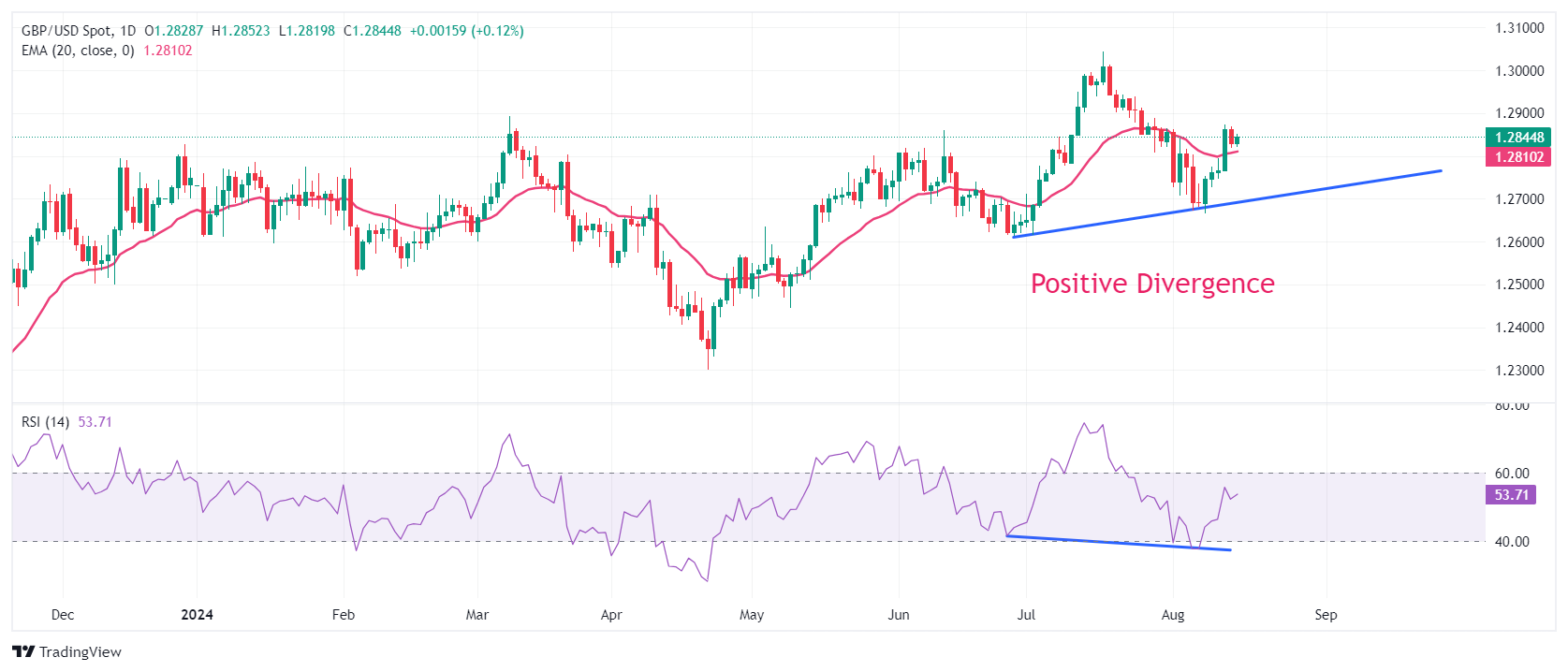
The Pound Sterling remains supported near 1.2800 after failing to recapture a two-week high of 1.2870 against the US Dollar. The GBP/USD pair struggles it hold the 20-day Exponential Moving Average (EMA), which trades around 1.2800.
Earlier, the Cable showed a sharp recovery from a six-week low of 1.2665 after a positive divergence formation on a daily time frame, in which the pair continues to post higher lows while the momentum oscillator makes lower lows. This generally results in a resumption of the uptrend, but it should be confirmed with more indicators.
The 14-day Relative Strength Index (RSI) recovers after finding a cushion near 40.00, exhibiting signs of buying interest at lower levels.
On the upside, the round-level resistance of 1.2900 and the psychological figure of 1.3000 will act as major resistances for the Pound Sterling. Alternatively, the recovery move could falter if the asset breaks below the August 8 low at 1.2665. This would expose the asset to the June 27 low at 1.2613, followed by the April 29 high at 1.2570.
Interest rates FAQs
Interest rates are charged by financial institutions on loans to borrowers and are paid as interest to savers and depositors. They are influenced by base lending rates, which are set by central banks in response to changes in the economy. Central banks normally have a mandate to ensure price stability, which in most cases means targeting a core inflation rate of around 2%. If inflation falls below target the central bank may cut base lending rates, with a view to stimulating lending and boosting the economy. If inflation rises substantially above 2% it normally results in the central bank raising base lending rates in an attempt to lower inflation.
Higher interest rates generally help strengthen a country’s currency as they make it a more attractive place for global investors to park their money.
Higher interest rates overall weigh on the price of Gold because they increase the opportunity cost of holding Gold instead of investing in an interest-bearing asset or placing cash in the bank. If interest rates are high that usually pushes up the price of the US Dollar (USD), and since Gold is priced in Dollars, this has the effect of lowering the price of Gold.
The Fed funds rate is the overnight rate at which US banks lend to each other. It is the oft-quoted headline rate set by the Federal Reserve at its FOMC meetings. It is set as a range, for example 4.75%-5.00%, though the upper limit (in that case 5.00%) is the quoted figure. Market expectations for future Fed funds rate are tracked by the CME FedWatch tool, which shapes how many financial markets behave in anticipation of future Federal Reserve monetary policy decisions.
Author

Sagar Dua
FXStreet
Sagar Dua is associated with the financial markets from his college days. Along with pursuing post-graduation in Commerce in 2014, he started his markets training with chart analysis.