Pound Sterling stays calm ahead of UK employment and inflation data
- The Pound Sterling steadies against its major peers on Monday amid uncertainty ahead of UK employment and inflation data.
- BoE Governor Bailey expects some softness in the labor demand.
- Fed’s Logan reiterates her view of maintaining caution on interest rate cuts.

The Pound Sterling (GBP) trades steady against its major peers at the start of the week as investors turn cautious ahead of the United Kingdom (UK) employment data for three months ending December, which will be released on Tuesday.
Investors will pay close attention to the UK labor market data to know whether business owners are still upset with Chancellor of the Exchequer Rachel Reeves’s announcement of raising employers’ contribution to National Insurance (NI). In the Autumn Budget, Reeves increased employers' social security contributions by 1.2% to 15%, which will come into effect from April.
Since the announcement, the private sector's hiring pace has sharply slowed, indicating dissatisfaction among business owners. In the three months ending November, the economy added 35K workers, significantly lower than the 173K addition seen in the August-October period.
Also, Bank of England (BoE) Governor Andrew Bailey said in an interview with BusinessLive in European trading hours that he sees some softness in the labor market and is confident that the disinflation trend is still on. Bailey said, "the economic context is not really supporting the view that we will get more persistence in inflation."
The UK Office for National Statistics (ONS) is expected to show that the ILO Unemployment Rate accelerated to 4.5% in December from the former reading of 4.4%.
Market participants will also focus on the UK Average Earnings data, which is a key measure of wage growth that has been a major contributor to high inflation in the service sector. Average Earnings (Including and Excluding bonuses) are expected to accelerate at a robust pace to 5.9% compared to the prior release of 5.6%. Hot wage growth measures would boost fears of price pressures remaining stubborn. In February's monetary policy statement, the BoE stated that inflationary pressures could accelerate before resuming its journey to the 2% target due to higher energy prices.
Therefore, soft employment conditions and high inflation expectations due to strong wage growth could stem the risks of stagflation.
Later this week, investors will also focus on the UK Consumer Price Index (CPI) and Retail Sales data for January, which will be released on Wednesday and Friday, respectively.
British Pound PRICE Today
The table below shows the percentage change of British Pound (GBP) against listed major currencies today. British Pound was the strongest against the Swiss Franc.
| USD | EUR | GBP | JPY | CAD | AUD | NZD | CHF | |
|---|---|---|---|---|---|---|---|---|
| USD | 0.18% | -0.05% | -0.51% | 0.08% | -0.24% | -0.27% | 0.18% | |
| EUR | -0.18% | -0.08% | -0.73% | -0.00% | -0.33% | -0.35% | 0.11% | |
| GBP | 0.05% | 0.08% | -0.55% | 0.08% | -0.20% | -0.27% | 0.18% | |
| JPY | 0.51% | 0.73% | 0.55% | 0.60% | 0.32% | 0.47% | 0.68% | |
| CAD | -0.08% | 0.00% | -0.08% | -0.60% | -0.29% | -0.35% | 0.10% | |
| AUD | 0.24% | 0.33% | 0.20% | -0.32% | 0.29% | -0.02% | 0.46% | |
| NZD | 0.27% | 0.35% | 0.27% | -0.47% | 0.35% | 0.02% | 0.45% | |
| CHF | -0.18% | -0.11% | -0.18% | -0.68% | -0.10% | -0.46% | -0.45% |
The heat map shows percentage changes of major currencies against each other. The base currency is picked from the left column, while the quote currency is picked from the top row. For example, if you pick the British Pound from the left column and move along the horizontal line to the US Dollar, the percentage change displayed in the box will represent GBP (base)/USD (quote).
Daily digest market movers: Pound Sterling ranges against US Dollar
- The Pound Sterling ticks higher to near 1.2600 against the US Dollar (USD) in Monday’s North American session. The GBP/USD pair is broadly sideways while the US Dollar Index (DXY) struggles to hold the immediate support of 106.70, which is over a two-month low.
- The US Dollar remains on the back foot amid an improvement in market mood. Last week, market sentiment became favorable for risky assets due to a delay in United States (US) President Donald Trump's imposition of reciprocal tariffs, which is unlikely to come into effect before April 1. This scenario diminished fears of an immediate global trade war, as investors anticipated President Trump would announce reciprocal levies on Thursday.
- Last week, the US CPI and the Producer Price Index (PPI) data for January came in hotter than expected. Dallas Federal Reserve Bank President Lorie Logan reiterated on Friday that the central bank should remain cautious on interest rates. "I think we're in a good position right now to watch the data over the coming months and taking our time to really go look at the data and see how these potential changes are to evolve," Logan said. She also added that the central bank is also keeping an eye on the geopolitics and economic policies of President Donald Trump.
Technical Analysis: Pound Sterling aims to stabilize above 1.2600
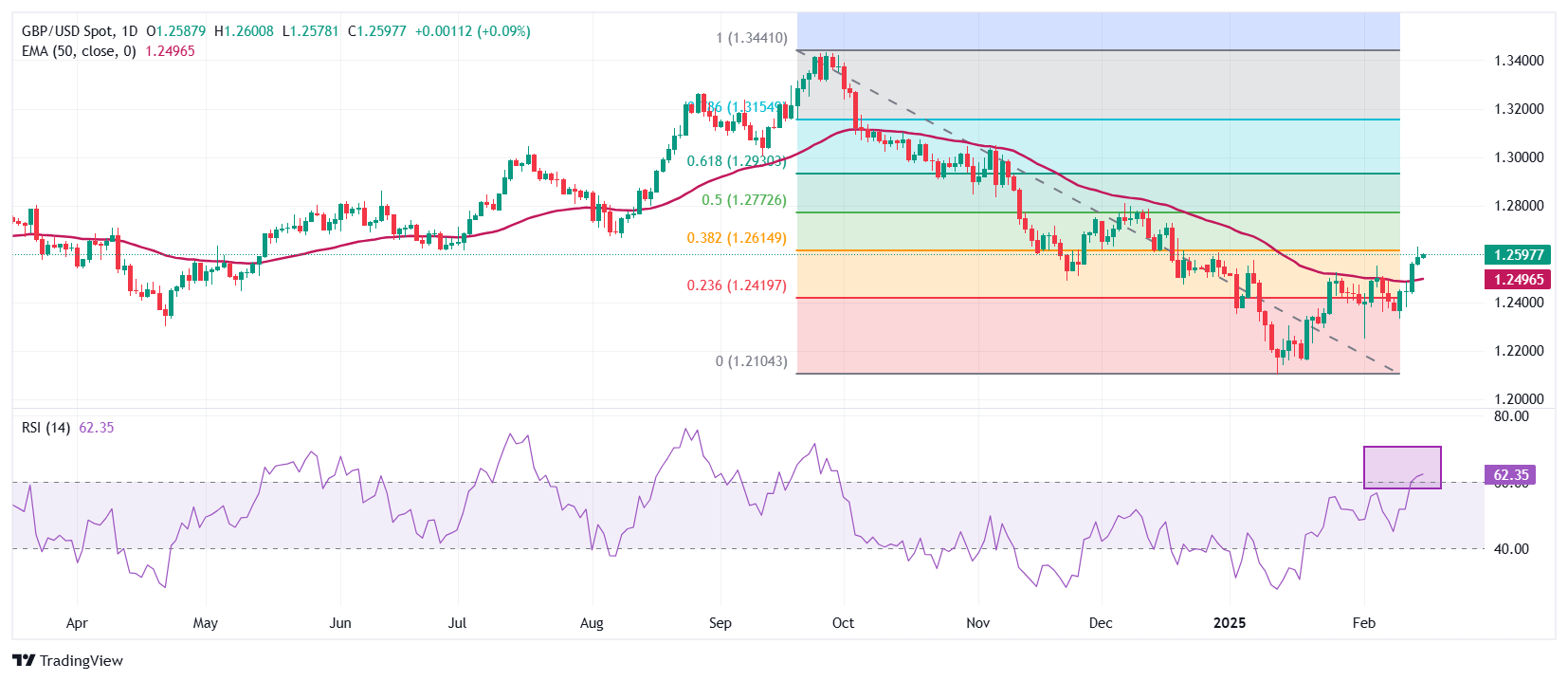
The Pound Sterling trades inside Friday’s trading range but aims to break decisively above the 38.2% Fibonacci retracement around 1.2620. The near-term outlook of the GBP/USD pair has turned bullish as it holds above the 50-day Exponential Moving Average (EMA), which stands at around 1.2500.
The 14-day Relative Strength Index (RSI) advances above 60.00. A bullish momentum would activate if the RSI (14) sustains above that level.
Looking down, the February 3 low of 1.2250 will act as a key support zone for the pair. On the upside, the 50% Fibonacci retracement at 1.2767 will act as a key resistance zone.
Economic Indicator
ILO Unemployment Rate (3M)
The ILO Unemployment Rate released by the UK Office for National Statistics is the number of unemployed workers divided by the total civilian labor force. It is a leading indicator for the UK Economy. If the rate goes up, it indicates a lack of expansion within the UK labor market. As a result, a rise leads to a weakening of the UK economy. Generally, a decrease of the figure is seen as bullish for the Pound Sterling (GBP), while an increase is seen as bearish.
Read more.Next release: Tue Feb 18, 2025 07:00
Frequency: Monthly
Consensus: 4.5%
Previous: 4.4%
Source: Office for National Statistics
The Unemployment Rate is the broadest indicator of Britain’s labor market. The figure is highlighted by the broad media, beyond the financial sector, giving the publication a more significant impact despite its late publication. It is released around six weeks after the month ends. While the Bank of England is tasked with maintaining price stability, there is a substantial inverse correlation between unemployment and inflation. A higher than expected figure tends to be GBP-bearish.
Author

Sagar Dua
FXStreet
Sagar Dua is associated with the financial markets from his college days. Along with pursuing post-graduation in Commerce in 2014, he started his markets training with chart analysis.