Pound Sterling outperforms US Dollar despite concerns over Trump's tariff agenda
- The Pound Sterling gains sharply against the US Dollar despite investors remaining cautious on US President Trump’s tariff agenda.
- President Trump is poised to impose 25% tariffs on all imports from Canada and Mexico.
- BoE’s Dhingra favors a swift unwinding of policy restrictiveness to boost consumption.

The Pound Sterling (GBP) climbs to near 1.2675 against the US Dollar (USD) in Tuesday’s North American session. The GBP/USD pair strengthens as the US Dollar Index (DXY), which tracks the Greenback’s value against six major currencies, slumps to near 106.30 after failing to hold the recovery move from the 10-week low, which it showed on Monday.
The Greenback faces selling pressure despite renewed fears of a global trade war after United States (US) President Donald Trump said that tariffs on its North American peers would proceed as planned.
“The tariffs are going forward on time, on schedule,” Trump said from the White House during a joint press conference with French President Emmanuel Macron.
On February 5, President Trump postponed his plans to impose 25% tariffs on Canada and Mexico for a month after they agreed for criminal enforcement at borders to restrict the flow of fentanyl and undocumented individuals into the US.
Going forward, investors will focus on the US Durable Goods Orders and the Personal Consumption Expenditures Price Index (PCE) data for January, which will be released on Thursday and Friday, respectively. Investors will pay close attention to the US PCE inflation data as it will influence market speculation about the Federal Reserve’s (Fed) monetary policy outlook.
Until now, Fed officials have supported keeping interest rates in their current range of 4.25%-4.50% until they gauge the impact of Trump’s economic agenda on inflation and the economic outlook.
On Monday, Chicago Fed Bank President Austan Goolsbee said in an interview with Chicago public TV station WTTW that the central bank needs ‘more clarity’ on the total impact of Trump’s policies before going back to cutting interest rates.
Daily digest market movers: Pound Sterling gains as traders see moderate BoE policy easing cycle
- The Pound Sterling strengthens against its major peers on Tuesday, while investors look for fresh cues about the likely monetary policy action by the Bank of England (BoE) this year. In the policy meeting earlier this month, the BoE reduced its key borrowing rates by 25 basis points (bps) to 4.5% and guided a gradual policy easing stance.
- However, BoE Monetary Policy Committee (MPC) member Swati Dhingra favored a quick monetary expansion cycle due to the weak demand environment in her speech at Birkbeck on Monday. "I know 'gradual' has been interpreted in the media as 25 basis points (bps) per quarter, but cutting interest rates at this pace for the remainder of 2025 would still leave monetary policy in an undesirable restrictive position at the end of the year,” Dhingra said. She also warned that “consumption weakness is just not going away”, which is why she is favoring to “reduce the level of monetary policy restriction”.
- It is worth noting that Dhingra voted for a 50 bps interest rate reduction in the last monetary policy, along with policymaker Catherine Mann. Other MPC members were in favor of a quarter-to-a-percent cut in interest rates.
- Meanwhile, market participants have priced in two more interest rate cuts of 25 bps by the BoE this year, which are expected to come after March’s policy meeting.
British Pound PRICE Today
The table below shows the percentage change of British Pound (GBP) against listed major currencies today. British Pound was the strongest against the New Zealand Dollar.
| USD | EUR | GBP | JPY | CAD | AUD | NZD | CHF | |
|---|---|---|---|---|---|---|---|---|
| USD | -0.38% | -0.39% | -0.06% | -0.04% | -0.03% | 0.09% | -0.38% | |
| EUR | 0.38% | -0.01% | 0.35% | 0.34% | 0.35% | 0.47% | -0.01% | |
| GBP | 0.39% | 0.01% | 0.32% | 0.35% | 0.36% | 0.48% | 0.00% | |
| JPY | 0.06% | -0.35% | -0.32% | 0.03% | 0.04% | 0.14% | -0.32% | |
| CAD | 0.04% | -0.34% | -0.35% | -0.03% | 0.01% | 0.13% | -0.34% | |
| AUD | 0.03% | -0.35% | -0.36% | -0.04% | -0.01% | 0.11% | -0.35% | |
| NZD | -0.09% | -0.47% | -0.48% | -0.14% | -0.13% | -0.11% | -0.47% | |
| CHF | 0.38% | 0.00% | -0.00% | 0.32% | 0.34% | 0.35% | 0.47% |
The heat map shows percentage changes of major currencies against each other. The base currency is picked from the left column, while the quote currency is picked from the top row. For example, if you pick the British Pound from the left column and move along the horizontal line to the US Dollar, the percentage change displayed in the box will represent GBP (base)/USD (quote).
Technical Analysis: Pound Sterling holds above 38.2% Fibo retracement
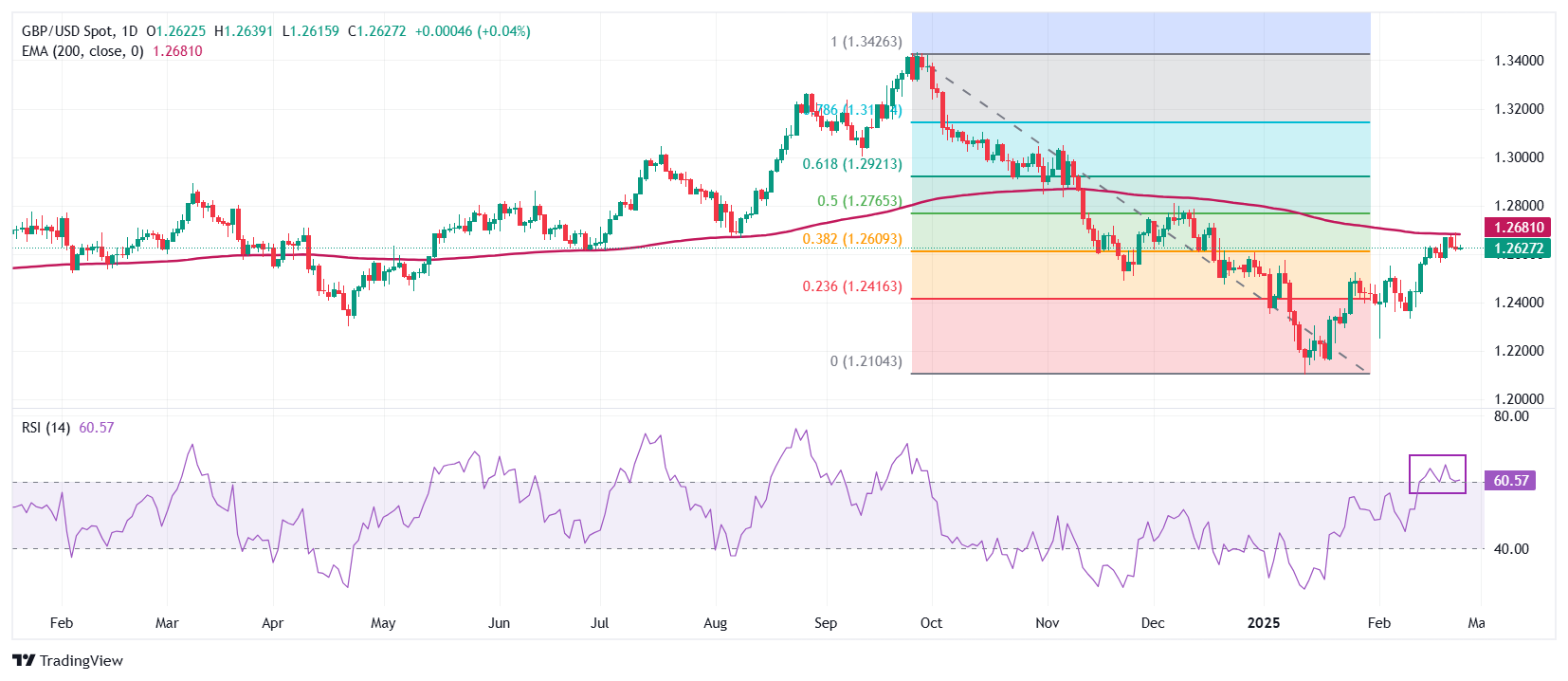
The Pound Sterling rises to near 1.2670 against the US Dollar in Tuesday’s North American session. The GBP/USD pair gains ground above the 38.2% Fibonacci retracement from the end-September high to the mid-January low downtrend around 1.2620. However, the 200-day Exponential Moving Average (EMA) continues to be a major hurdle around 1.2680
The 14-day Relative Strength Index (RSI) oscillates above 60.00. The bullish momentum remains intact if the RSI (14) holds above that level.
Looking down, the February 11 low of 1.2333 will act as a key support zone for the pair. On the upside, the 50% and 61.8% Fibonacci retracement at 1.2767 and 1.2927, respectively, will act as key resistance zones.
BoE FAQs
The Bank of England (BoE) decides monetary policy for the United Kingdom. Its primary goal is to achieve ‘price stability’, or a steady inflation rate of 2%. Its tool for achieving this is via the adjustment of base lending rates. The BoE sets the rate at which it lends to commercial banks and banks lend to each other, determining the level of interest rates in the economy overall. This also impacts the value of the Pound Sterling (GBP).
When inflation is above the Bank of England’s target it responds by raising interest rates, making it more expensive for people and businesses to access credit. This is positive for the Pound Sterling because higher interest rates make the UK a more attractive place for global investors to park their money. When inflation falls below target, it is a sign economic growth is slowing, and the BoE will consider lowering interest rates to cheapen credit in the hope businesses will borrow to invest in growth-generating projects – a negative for the Pound Sterling.
In extreme situations, the Bank of England can enact a policy called Quantitative Easing (QE). QE is the process by which the BoE substantially increases the flow of credit in a stuck financial system. QE is a last resort policy when lowering interest rates will not achieve the necessary result. The process of QE involves the BoE printing money to buy assets – usually government or AAA-rated corporate bonds – from banks and other financial institutions. QE usually results in a weaker Pound Sterling.
Quantitative tightening (QT) is the reverse of QE, enacted when the economy is strengthening and inflation starts rising. Whilst in QE the Bank of England (BoE) purchases government and corporate bonds from financial institutions to encourage them to lend; in QT, the BoE stops buying more bonds, and stops reinvesting the principal maturing on the bonds it already holds. It is usually positive for the Pound Sterling.
Author

Sagar Dua
FXStreet
Sagar Dua is associated with the financial markets from his college days. Along with pursuing post-graduation in Commerce in 2014, he started his markets training with chart analysis.

















