Pound Sterling underperforms as UK Retail Sales, PMI rose moderately
- The Pound Sterling faces selling pressure against its major peers as the UK Retail Sales rose at a slower-than-expected pace.
- The UK signs a Free Trade Agreement deal with India, which was a part of the Labour Party’s manifesto.
- Investors await key US data and the Fed’s monetary policy decision next week.

The Pound Sterling (GBP) weakens against its major peers on Friday as the United Kingdom (UK) Office for National Statistics (ONS) has reported that Retail Sales grew at a slower-than-projected pace in June.
The report showed that Retail Sales, a key measure of consumer spending, rose 0.9% month-over-month, slower than estimates 1.2%. In May, the consumer spending measure declined by 2.7%. On year, the Retail Sales grew by 1.7%, missing estimates of 1.8% by a slight margin.
Strong demand for automotive fuel and higher sales receipts at departmental stores led to higher Retail Sales. However, sales at other non-food stores declined significantly.
Meanwhile, a slowdown in the UK private sector activity due to global trade uncertainty and a moderate hiring trend is expected to keep the Pound Sterling on the back foot. Flash UK S&P Global Purchasing Managers Index (PMI) data for July, released on Thursday, showed that the overall business activity expanded moderately, with the Composite PMI at 51.0, lower than estimates of 51.9 and 52.0 in June.
Going forward, market expectations for the Bank of England’s (BoE) interest rate decision in the August meeting will be a key driver for the British currency.
On the fiscal front, the UK signed a free trade deal with India on Thursday. UK Prime Minister Keir Starmer hailed the Free Trade Agreement (FTA) with India, stating that the deal will allow London to explore opportunities in many areas, such as liquor, textiles, and automobiles. An FTA with India was also a part of the Labour Party’s manifesto.
British Pound PRICE Today
The table below shows the percentage change of British Pound (GBP) against listed major currencies today. British Pound was the weakest against the US Dollar.
| USD | EUR | GBP | JPY | CAD | AUD | NZD | CHF | |
|---|---|---|---|---|---|---|---|---|
| USD | 0.04% | 0.38% | 0.50% | 0.29% | 0.43% | 0.30% | 0.07% | |
| EUR | -0.04% | 0.37% | 0.45% | 0.27% | 0.31% | 0.26% | 0.02% | |
| GBP | -0.38% | -0.37% | 0.10% | -0.12% | -0.07% | -0.08% | -0.34% | |
| JPY | -0.50% | -0.45% | -0.10% | -0.22% | -0.13% | -0.19% | -0.43% | |
| CAD | -0.29% | -0.27% | 0.12% | 0.22% | 0.19% | 0.02% | -0.25% | |
| AUD | -0.43% | -0.31% | 0.07% | 0.13% | -0.19% | -0.04% | -0.25% | |
| NZD | -0.30% | -0.26% | 0.08% | 0.19% | -0.02% | 0.04% | -0.24% | |
| CHF | -0.07% | -0.02% | 0.34% | 0.43% | 0.25% | 0.25% | 0.24% |
The heat map shows percentage changes of major currencies against each other. The base currency is picked from the left column, while the quote currency is picked from the top row. For example, if you pick the British Pound from the left column and move along the horizontal line to the US Dollar, the percentage change displayed in the box will represent GBP (base)/USD (quote).
Pound Sterling slumps against US Dollar, focus shifts to Fed policy
- The Pound Sterling slides to near 1.3440 against the US Dollar (USD) during the European trading session on Friday. The GBP/USD pair declines as the US Dollar gains ground on expectations that the United States (US) will close a trade pact with the European Union (EU) soon. A report from the Financial Times (FT) showed on Wednesday that both economies are expected to reach a tariff deal. The scenario is favorable for the US Dollar and US assets, given that the EU is one of the key trading partners of Washington.
- Meanwhile, Washington's increasing number of deals with its key trading partners is diminishing concerns that US President Donald Trump’s tariff policy will hit the economy significantly. This week, Trump also announced a trade agreement with Japan in which he slashed the baseline and automobile tariff rate to 15%.
- However, fears regarding tariffs accelerating inflation continue to persist. The latest US Consumer Price Index (CPI) report showed that the impact of tariffs has started feeding into prices. For fresh cues on inflation, investors will focus on Personal Consumption Expenditures Price Index (PCE) data for June and the second quarter of the year, which will be published next week.
- Going forward, the major trigger for the US Dollar will be the Federal Reserve’s (Fed) monetary policy announcement on Wednesday. According to the CME FedWatch tool, the Fed is certain to leave interest rates unchanged in the range of 4.25%-4.50%. As traders are confident that the Fed will keep borrowing rates steady, investors will pay close attention to the monetary policy statement and Fed Chair Jerome Powell’s press conference for fresh cues on the interest rate and the inflation outlook.
- In Friday’s session, investors will focus on the US Durable Goods Orders data for June, which will be published at 12:30 GMT. Economists expect fresh orders for durable goods to have declined by 10.8%.
Technical Analysis: Pound Sterling faces pressure near 1.3600
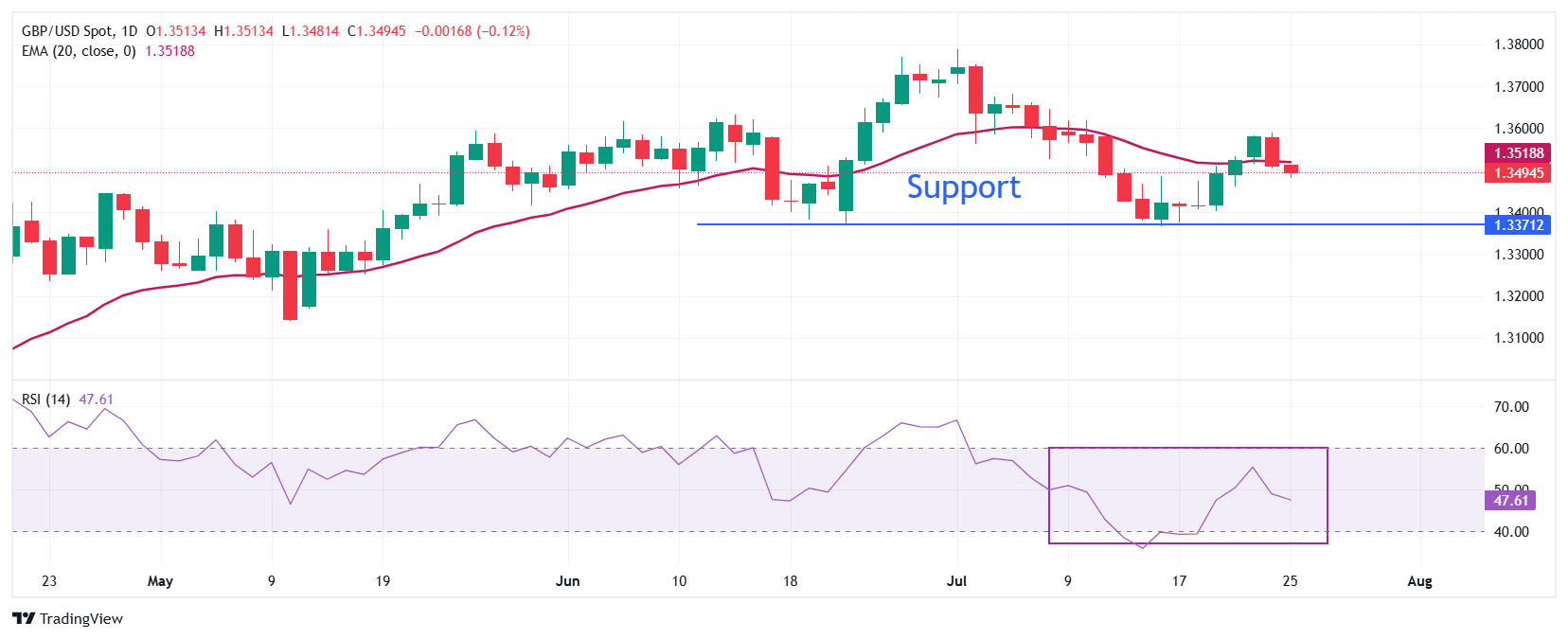
The Pound Sterling extends its correction to near 1.3480 against the US Dollar on Friday, after failing to break above 1.3600 the previous day. The GBP/USD pair returns below the 20-day Exponential Moving Average (EMA) after a pullback move, suggesting that the near-term trend remains bearish.
The 14-day Relative Strength Index (RSI) wobbles inside the 40.00-60.00 range, indicating a sideways trend.
Looking down, the May 12 low of 1.3140 will act as a key support zone. On the upside, the July 1 high around 1.3790 will act as a key barrier.
Fed FAQs
Monetary policy in the US is shaped by the Federal Reserve (Fed). The Fed has two mandates: to achieve price stability and foster full employment. Its primary tool to achieve these goals is by adjusting interest rates. When prices are rising too quickly and inflation is above the Fed’s 2% target, it raises interest rates, increasing borrowing costs throughout the economy. This results in a stronger US Dollar (USD) as it makes the US a more attractive place for international investors to park their money. When inflation falls below 2% or the Unemployment Rate is too high, the Fed may lower interest rates to encourage borrowing, which weighs on the Greenback.
The Federal Reserve (Fed) holds eight policy meetings a year, where the Federal Open Market Committee (FOMC) assesses economic conditions and makes monetary policy decisions. The FOMC is attended by twelve Fed officials – the seven members of the Board of Governors, the president of the Federal Reserve Bank of New York, and four of the remaining eleven regional Reserve Bank presidents, who serve one-year terms on a rotating basis.
In extreme situations, the Federal Reserve may resort to a policy named Quantitative Easing (QE). QE is the process by which the Fed substantially increases the flow of credit in a stuck financial system. It is a non-standard policy measure used during crises or when inflation is extremely low. It was the Fed’s weapon of choice during the Great Financial Crisis in 2008. It involves the Fed printing more Dollars and using them to buy high grade bonds from financial institutions. QE usually weakens the US Dollar.
Quantitative tightening (QT) is the reverse process of QE, whereby the Federal Reserve stops buying bonds from financial institutions and does not reinvest the principal from the bonds it holds maturing, to purchase new bonds. It is usually positive for the value of the US Dollar.
Author

Sagar Dua
FXStreet
Sagar Dua is associated with the financial markets from his college days. Along with pursuing post-graduation in Commerce in 2014, he started his markets training with chart analysis.