Pound Sterling underperforms as UK job market deteriorates further
- The Pound Sterling underperforms its major peers as UK employment data came in weaker than projected.
- The UK ILO Unemployment Rate rose to 5% in the three months ending in September.
- The US Senate advances government spending bills to the House of Representatives.

The Pound Sterling (GBP) falls sharply against its major currency peers on Tuesday. The British currency weakens as the United Kingdom (UK) labour market data for the three months ending September has signaled that job market conditions have deteriorated further.
The Office for National Statistics (ONS) has reported that employers laid off 22K workers, compared to a fresh addition of 91K recorded in the three months ending in August. This is the first time the overall labour force has seen a reduction in employees since the three months ending in March 2024.
Additionally, the ILO Unemployment Rate has accelerated to 5%, faster than estimates of 4.9% and the prior reading of 4.8%. This is the highest level seen since March 2021.
Signs of a weakening job market are expected to prompt expectations of an interest rate cut by the Bank of England (BoE) at its December policy meeting.
This week, BoE dovish expectations for the December meeting have already accelerated as the central bank eliminated “careful” from their “gradual monetary easing guidance”, while announcing the Monetary Policy Statement last Thursday.
Meanwhile, Average Hourly Earnings Excluding Bonuses, a key measure of wage growth, rose at a moderate pace of 4.6% on an annualized basis, as expected, compared to a 4.7% growth seen in the three months ending August. In the same period, Average Earnings Including Bonuses rose at a slower pace of 4.8%, compared to estimates of 4.9% and the prior reading of 5%.
Pound Sterling Price Today
The table below shows the percentage change of British Pound (GBP) against listed major currencies today. British Pound was the weakest against the Swiss Franc.
| USD | EUR | GBP | JPY | CAD | AUD | NZD | CHF | |
|---|---|---|---|---|---|---|---|---|
| USD | 0.02% | 0.41% | 0.22% | 0.10% | 0.28% | 0.01% | -0.18% | |
| EUR | -0.02% | 0.39% | 0.20% | 0.08% | 0.26% | -0.00% | -0.20% | |
| GBP | -0.41% | -0.39% | -0.18% | -0.31% | -0.15% | -0.39% | -0.58% | |
| JPY | -0.22% | -0.20% | 0.18% | -0.10% | 0.06% | -0.22% | -0.40% | |
| CAD | -0.10% | -0.08% | 0.31% | 0.10% | 0.19% | -0.09% | -0.28% | |
| AUD | -0.28% | -0.26% | 0.15% | -0.06% | -0.19% | -0.26% | -0.49% | |
| NZD | -0.01% | 0.00% | 0.39% | 0.22% | 0.09% | 0.26% | -0.19% | |
| CHF | 0.18% | 0.20% | 0.58% | 0.40% | 0.28% | 0.49% | 0.19% |
The heat map shows percentage changes of major currencies against each other. The base currency is picked from the left column, while the quote currency is picked from the top row. For example, if you pick the British Pound from the left column and move along the horizontal line to the US Dollar, the percentage change displayed in the box will represent GBP (base)/USD (quote).
Pound Sterling snaps four-day winning streak against US Dollar
- The Pound Sterling snaps its four-day winning streak and slumps to near 1.3120 against the US Dollar (USD) during the European trading session on Tuesday. The GBP/USD faces intense selling pressure after the release of the weaker-than-projected UK employment data.
- Meanwhile, the US Dollar trades broadly stable as the United States (US) Senate advances the government funding bill to the Republican-controlled House of Representatives. According to a Reuters report, House Speaker Mike Johnson has stated that the bill will be passed by Wednesday.
- At the press time, the US Dollar Index (DXY), which tracks the Greenback’s value against six major currencies, trades flat around 99.60.
- Meanwhile, investors await fresh cues on whether the Federal Reserve (Fed) will cut interest rates again this year. According to the CME FedWatch tool, the probability of the Fed cutting interest rates by 25 basis points (bps) to the 3.50%-3.75% range in the December meeting is 62.4%.
- It won't be challenging for investors to gauge the Fed’s interest rate expectations as federal agencies will start releasing economic data, which was halted due to the government shutdown.
- Going forward, the major trigger for the GBP/USD pair will be the United Kingdom (UK) Gross Domestic Product (GDP) data for September, as well as the preliminary reading of the GDP for the third quarter of the year, which will be published on Thursday. Economists expect the UK's Q3 GDP to have grown 0.2%, slower than the 0.3% expansion seen in the second quarter.
Technical Analysis: Pound Sterling sees more downside below 1.3000
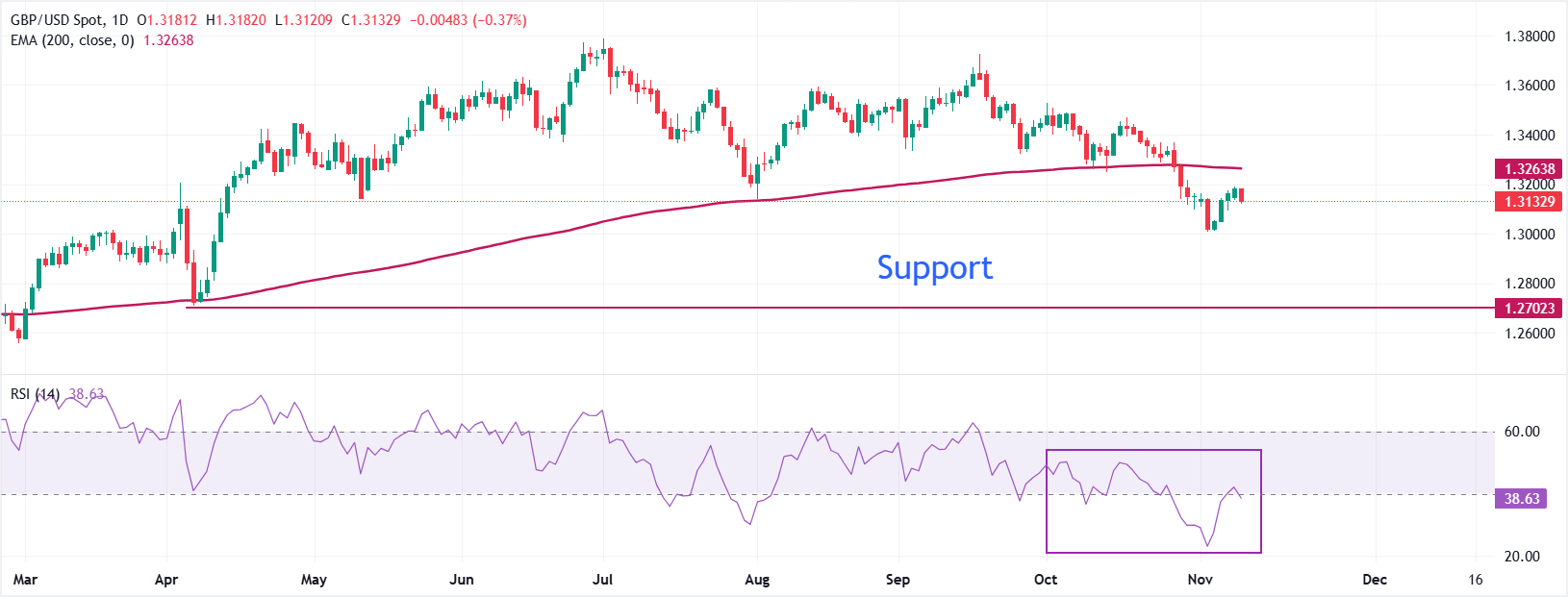
The Pound Sterling declines to near 1.3130 against the US Dollar on Tuesday. The overall trend of the pair remains bearish as it trades below the 200-day Exponential Moving Average (EMA), which is around 1.3264.
The 14-day Relative Strength Index (RSI) struggles to return above 40.00. A fresh bearish momentum would emerge if the RSI resumes its downside journey.
Looking down, the April low near 1.2700 will act as a key support zone. On the upside, the October 28 high around 1.3370 will act as a key barrier.
Employment FAQs
Labor market conditions are a key element to assess the health of an economy and thus a key driver for currency valuation. High employment, or low unemployment, has positive implications for consumer spending and thus economic growth, boosting the value of the local currency. Moreover, a very tight labor market – a situation in which there is a shortage of workers to fill open positions – can also have implications on inflation levels and thus monetary policy as low labor supply and high demand leads to higher wages.
The pace at which salaries are growing in an economy is key for policymakers. High wage growth means that households have more money to spend, usually leading to price increases in consumer goods. In contrast to more volatile sources of inflation such as energy prices, wage growth is seen as a key component of underlying and persisting inflation as salary increases are unlikely to be undone. Central banks around the world pay close attention to wage growth data when deciding on monetary policy.
The weight that each central bank assigns to labor market conditions depends on its objectives. Some central banks explicitly have mandates related to the labor market beyond controlling inflation levels. The US Federal Reserve (Fed), for example, has the dual mandate of promoting maximum employment and stable prices. Meanwhile, the European Central Bank’s (ECB) sole mandate is to keep inflation under control. Still, and despite whatever mandates they have, labor market conditions are an important factor for policymakers given its significance as a gauge of the health of the economy and their direct relationship to inflation.
Author

Sagar Dua
FXStreet
Sagar Dua is associated with the financial markets from his college days. Along with pursuing post-graduation in Commerce in 2014, he started his markets training with chart analysis.