Pound Sterling rises as UK economy comes out of shallow recession
- The Pound Sterling moves higher to 1.2540 on upbeat UK Q1 GDP and March factory data.
- UK’s Q1 GDP growth suggests that the technical recession in 2023 was shallow.
- Easing US labor market conditions weigh on the US Dollar.

The Pound Sterling (GBP) extends its upside to 1.2540 in Friday’s early New York session as the United Kingdom (UK) Office for National Statistics (ONS) posted strong preliminary Q1 Gross Domestic Product (GDP) numbers. The agency showed that the economy expanded at a strong rate of 0.6% against expectations of 0.4% after contracting by 0.3% in the last quarter of 2023.
Strong UK GDP growth has suggested that the technical recession observed in the second half of 2023 was shallow. Annually, the UK Q1 GDP expanded by 0.2%, the same pace at which it was contracted earlier. Investors anticipated a stagnant growth on a year-over-year basis. Meanwhile, the monthly GDP growth for March was 0.4%, stronger than the consensus of 0.1% and the prior reading of 0.2%, upwardly revised from 0.1%.
Upbeat GDP growth would allow the Bank of England (BoE) to achieve a ‘soft landing’. BoE Governor Andrew Bailey commented in the press conference after the monetary policy statement that the central bank is confident that inflation will return to target in the coming months. A soft landing is a scenario in which the central bank achieves the price stability without triggering a recession.
In the early American session, BoE's Chief Economist Huw Pill said he sees inflation coming down but has suggested that the central bank should focus on persistent components of inflation and not on the headline rate. Pill didn't provide any timeframe for rate cuts but said the Monetary Policy Committee (MPC) has sent a relatively clear signal that the bank rate can be cut when there is sufficient evidence of a downward path in persistent components of inflation.
Daily digest market movers: Pound Sterling rises on multiple tailwinds
- The Pound Sterling rises sharply to 1.2540 against the US Dollar (USD) due to upbeat preliminary Q1 GDP growth and strong factory data. Apart from the upbeat Q1 GDP data, the UK ONS showed that monthly Industrial Production rose by 0.2% in March against expectations of a decline of 0.5%. Annually, the Industrial Production grew at a higher pace of 0.5% from the estimates of 0.3%.
- Monthly Manufacturing Production surprisingly grew by 0.3% as economists anticipated a contraction of 0.4%. Annually, this indicator increased at a stronger pace of 2.3% against expectations of 1.8%.
- The situation of strong US factory data and easing inflationary pressures is favorable for the Bank of England to bring down interest rates from their current levels of 5.25%. On Thursday, the BoE kept interest rates steady for the sixth straight meeting. However, the overall message from the central bank suggested that the BoE is gradually moving to policy normalization.
- Out of the nine-members-led MPC, BoE policymaker Swati Dhingra and Deputy Governor Dave Ramsden voted for a 25 basis points (bps) rate cut to 5%. Financial markets were divided over Ramsden’s vote as he supported a neutral stance on interest rates in the policy meeting in March. But his commentary in April suggested that he is confident about inflation returning to the 2% target sooner.
- Also, the commentary from Andrew Bailey on interest rates was more dovish than expected. Bailey didn't rule out speculation for BoE reducing interest rates from June. He said, "A June bank rate cut is not ruled out or planned". For the entire year, Bailey said, "It's possible we will need to cut rates more than currently priced into market rates."
- Meanwhile, the US Dollar Index (DXY) has rebounded slightly after a sharp fall to near the crucial support of 105.00. The US Dollar is still under pressure as higher-than-expected individuals claiming jobless benefits for the week ending May 3 deepened concerns over United States labor market strength. The US Department of Labor showed that Initial Jobless Claims were the highest since November 10 week, showing 231K against the consensus of 210K and the prior reading of 209K.
- Going forward, investors will shift focus to the UK’s labor market data for three months ending March and the US Consumer Price Index (CPI) data for April, which will be published next week.
Technical Analysis: Pound Sterling holds onto gains above 1.2500
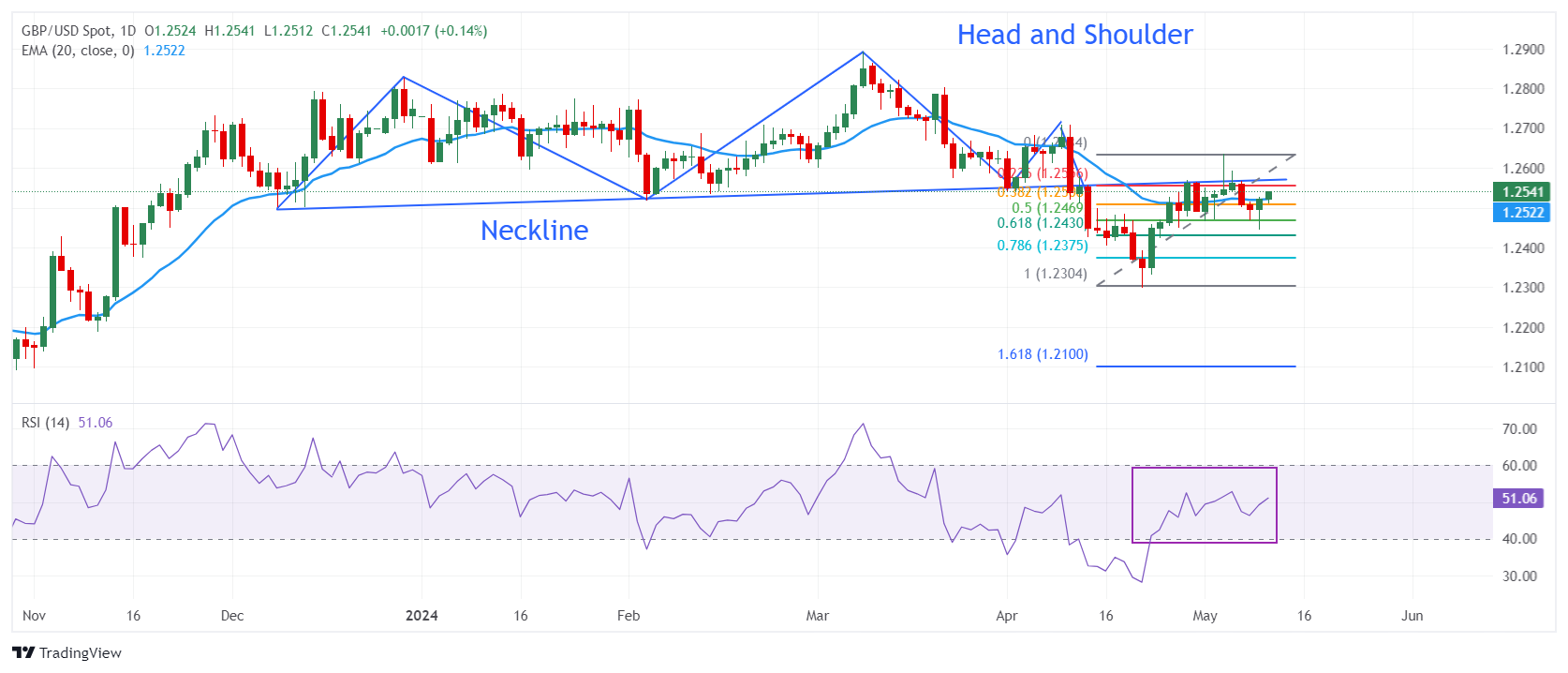
The Pound Sterling advances to 1.2540 due to multiple tailwinds. The GBP/USD pair recovered sharply from 50% Fibonacci retracement (plotted from April 22 low of 1.2299 to May 3 high of 1.2634) near 1.2470. The pair returns above the 20-day Exponential Moving Average (EMA), which trades around 1.2520.
The asset is still below the neckline of the Head and Shoulder (H&S) chart pattern on the daily timeframe. On April 12, the Cable fell sharply after breaking below the neckline of the H&S pattern plotted from December 8 low around 1.2500.
The 14-period Relative Strength Index (RSI) oscillates in the 40.00-60.00 range, suggesting indecisiveness among market participants.
BoE FAQs
The Bank of England (BoE) decides monetary policy for the United Kingdom. Its primary goal is to achieve ‘price stability’, or a steady inflation rate of 2%. Its tool for achieving this is via the adjustment of base lending rates. The BoE sets the rate at which it lends to commercial banks and banks lend to each other, determining the level of interest rates in the economy overall. This also impacts the value of the Pound Sterling (GBP).
When inflation is above the Bank of England’s target it responds by raising interest rates, making it more expensive for people and businesses to access credit. This is positive for the Pound Sterling because higher interest rates make the UK a more attractive place for global investors to park their money. When inflation falls below target, it is a sign economic growth is slowing, and the BoE will consider lowering interest rates to cheapen credit in the hope businesses will borrow to invest in growth-generating projects – a negative for the Pound Sterling.
In extreme situations, the Bank of England can enact a policy called Quantitative Easing (QE). QE is the process by which the BoE substantially increases the flow of credit in a stuck financial system. QE is a last resort policy when lowering interest rates will not achieve the necessary result. The process of QE involves the BoE printing money to buy assets – usually government or AAA-rated corporate bonds – from banks and other financial institutions. QE usually results in a weaker Pound Sterling.
Quantitative tightening (QT) is the reverse of QE, enacted when the economy is strengthening and inflation starts rising. Whilst in QE the Bank of England (BoE) purchases government and corporate bonds from financial institutions to encourage them to lend; in QT, the BoE stops buying more bonds, and stops reinvesting the principal maturing on the bonds it already holds. It is usually positive for the Pound Sterling.
Author
Sagar Dua
FXStreet
Sagar Dua is associated with the financial markets from his college days. Along with pursuing post-graduation in Commerce in 2014, he started his markets training with chart analysis.

















