Pound Sterling recovers against USD as Trump suspends tariffs on North American peers
- The Pound Sterling recovers above 1.2400 against the US Dollar as investors worry that a trade war between the US and China could intensify.
- China retaliates to US President Trump’s tariffs and announces levies on various imports from the US.
- This week, investors will keenly focus on the BoE’s policy decision and the US NFP data.

The Pound Sterling (GBP) rebounds from its intraday low of 1.2380 against the US Dollar (USD) in Tuesday’s European session, but is still 0.2% down to near 1.2430. The GBP/USD pair bounces back as the US Dollar struggles for a firm footing, following United States (US) President Donald Trump’s decision to pause the 25% tariff imposition on Canada and Mexico for 30 days.
President Trump agreed to a 30-day pause in return for concessions on border and crime enforcement with the two neighboring countries, Reuters reported. The announcement led to a sharp sell-off in the US Dollar (USD). The US Dollar Index (DXY), which tracks the Greenback’s value against six major currencies, trades cautiously near 108.50.
The delay of tariff orders by the US on its North American peers has resulted in a big relief for risk-perceived assets across the globe. However, Trump is still on with his decision of a 10% levy on China and has also threatened to go beyond. Such a scenario would limit the risk appetite of investors. In retaliation, China has also slapped tariffs on imports from the US. The Chinese finance ministry said that it would impose levies of 15% on coal and Liquefied Natural Gas (LNG) and 10% on crude oil, farm equipment, and some autos, according to a Reuters report.
Going forward, the next trigger for the US Dollar will be the US Nonfarm Payrolls (NFP) data for January, which will be released on Friday. The official employment data is expected to significantly influence market expectations for how long the Federal Reserve (Fed) will keep its waiting mode on interest rates. Fed Chair Jerome Powell stated last week that only “real progress in inflation or at least some weakness in the labor market” could force us to make some adjustments in the monetary policy stance.
In Tuesday’s session, investors will focus on the JOLTS Job Openings data for December, which will be published at 15:00 GMT. Economists expect that employers posted 8 million fresh job offers, marginally lower than almost 8.10 million in November.
Daily digest market movers: Pound Sterling drops as investors await BoE's policy decision
- The Pound Sterling underperforms against its major peers, except safe-haven assets, on Tuesday as investors await the Bank of England’s (BoE) monetary policy decision, which will be announced on Thursday.
- According to money market expectations, traders have priced in an 81 basis points (bps) interest rate reduction this year, suggesting there will be more than three 25 bps interest rate cuts by December. The first is seen coming this week, which will push borrowing rates lower to 4.50%.
- Meanwhile, yields on 30-year United Kingdom (UK) gilt have declined to near 5.04%, the lowest level seen in almost two weeks, in anticipation that US President Trump won’t pick a lethal trade fight with Britain. Over the weekend, Trump’s comments indicated that he is not sure about imposing tariffs on the UK and he was sure that a deal could be made as Prime Minister Keir Starmer has been "very nice".
- UK gilt yields had a strong run from November 29 to January 13 as investors were worried about the economic outlook on the back of potential tariff hikes from the US.
British Pound PRICE Today
The table below shows the percentage change of the British Pound (GBP) against listed major currencies today. British Pound was the strongest against the Japanese Yen.
| USD | EUR | GBP | JPY | CAD | AUD | NZD | CHF | |
|---|---|---|---|---|---|---|---|---|
| USD | -0.44% | -0.21% | 0.36% | -1.28% | -0.52% | -0.38% | -0.40% | |
| EUR | 0.44% | 0.23% | 0.79% | -0.85% | -0.08% | 0.05% | 0.03% | |
| GBP | 0.21% | -0.23% | 0.56% | -1.07% | -0.30% | -0.17% | -0.19% | |
| JPY | -0.36% | -0.79% | -0.56% | -1.63% | -0.87% | -0.74% | -0.76% | |
| CAD | 1.28% | 0.85% | 1.07% | 1.63% | 0.77% | 0.91% | 0.89% | |
| AUD | 0.52% | 0.08% | 0.30% | 0.87% | -0.77% | 0.14% | 0.14% | |
| NZD | 0.38% | -0.05% | 0.17% | 0.74% | -0.91% | -0.14% | -0.02% | |
| CHF | 0.40% | -0.03% | 0.19% | 0.76% | -0.89% | -0.14% | 0.02% |
The heat map shows percentage changes of major currencies against each other. The base currency is picked from the left column, while the quote currency is picked from the top row. For example, if you pick the British Pound from the left column and move along the horizontal line to the US Dollar, the percentage change displayed in the box will represent GBP (base)/USD (quote).
Technical Analysis: Pound Sterling returns above 20-day EMA
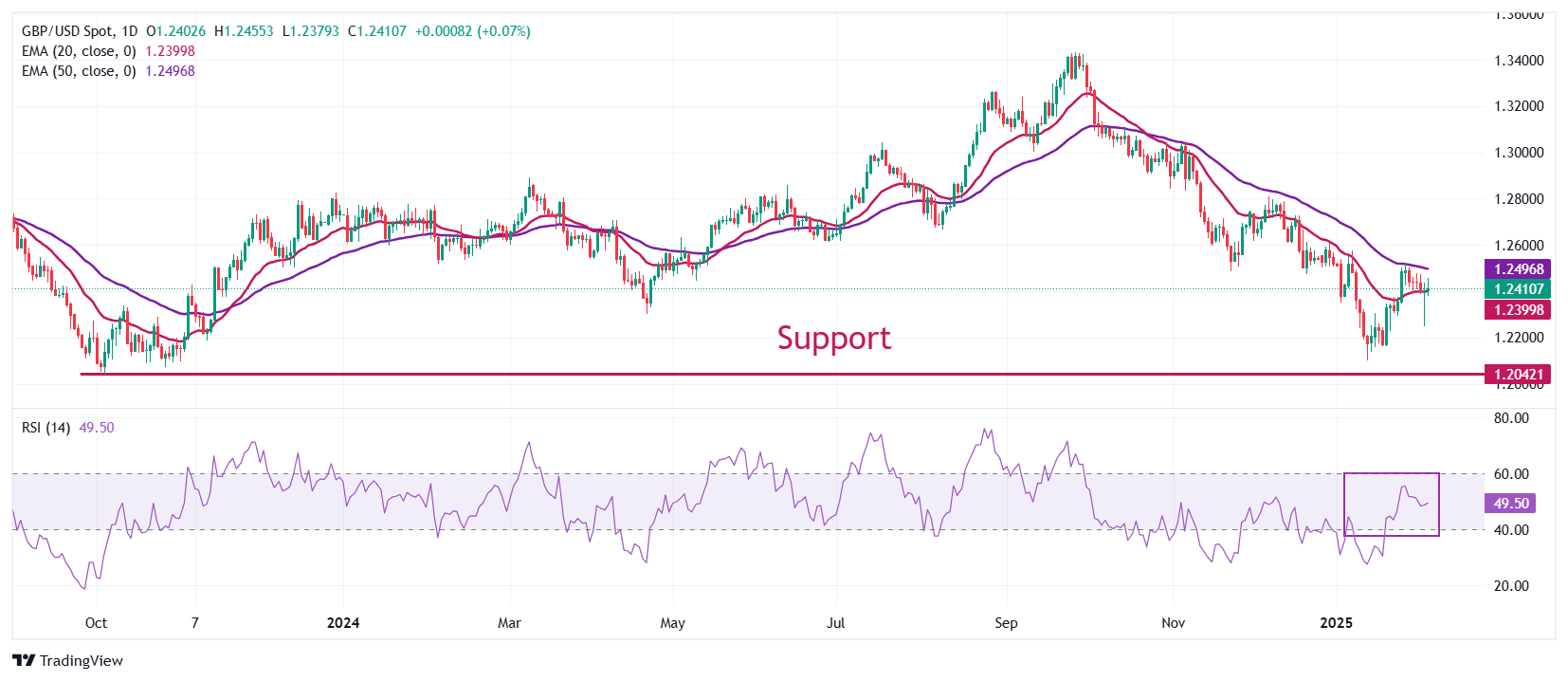
The Pound Sterling strives to gain firm footing above 1.2400 on Tuesday. The GBP/USD pair returns above the 20-day Exponential Moving Average (EMA), which trades around 1.2400. However, the near-term outlook for Cable remains uncertain as the 50-day EMA continues to be a barrier for the Pound Sterling bulls, hovering around 1.2500.
The 14-day Relative Strength Index (RSI) oscillates inside the 40.00-60.00 range, suggesting a sideways trend.
Looking down, the January 13 low of 1.2100 and the October 2023 low of 1.2050 will act as key support zones for the pair. On the upside, the December 30 high of 1.2607 will act as key resistance.
Economic Indicator
BoE Interest Rate Decision
The Bank of England (BoE) announces its interest rate decision at the end of its eight scheduled meetings per year. If the BoE is hawkish about the inflationary outlook of the economy and raises interest rates it is usually bullish for the Pound Sterling (GBP). Likewise, if the BoE adopts a dovish view on the UK economy and keeps interest rates unchanged, or cuts them, it is seen as bearish for GBP.
Read more.Next release: Thu Feb 06, 2025 12:00
Frequency: Irregular
Consensus: 4.5%
Previous: 4.75%
Source: Bank of England
Author

Sagar Dua
FXStreet
Sagar Dua is associated with the financial markets from his college days. Along with pursuing post-graduation in Commerce in 2014, he started his markets training with chart analysis.