Pound Sterling flattens against USD ahead of US Job Openings data, Fed policy
- The Pound Sterling trades mixed against its currency peers as its outlook remains uncertain amid firm BoE dovish bets.
- BoE’s Taylor said he expects inflation to return to the 2% target in the near term.
- Investors widely expect the Fed to cut interest rates on Wednesday.

The Pound Sterling (GBP) continues to trade in a tight range above 1.3300 against the US Dollar (USD) during the European session on Tuesday. The GBP/USD pair trades sideways as investors await the Federal Reserve’s (Fed) monetary policy announcement on Wednesday.
At the press time, the US Dollar Index (DXY), which tracks the Greenback’s value against six major currencies, trades flat inside Monday’s trading range around 99.00.
The Fed is almost certain to cut interest rates by 25 basis points (bps) to 3.50%-3.75% amid a slowdown in the United States (US) labour demand. Assuming that the Fed will loosen monetary conditions, the major driver for the US Dollar will be the Fed’s monetary policy statement, the dot plot, and Chairman Jerome Powell’s press conference to get cues on the interest rate outlook.
It is likely that the Fed will perform a delicate balancing act as inflationary pressures have remained well above the 2% target, and the job market has slowed down, partly due to the growing acceptance of Artificial Intelligence (AI) across industries.
Investors will also focus on the Fed’s economic projections report to know where policymakers collectively see the Federal Fund Rates heading in the medium and longer term. The report will also include fresh estimates for inflation, growth, and the jobless rate.
Investors expect BoE to cut interest rates next week
- The Pound Sterling trades mixed against its major peers on Tuesday, facing pressure as traders remain increasingly confident that the Bank of England (BoE) will cut interest rates by 25 basis points (bps) to 3.75% at its monetary policy meeting next week.
- BoE dovish expectations have been prompted by weakening United Kingdom (UK) labor market conditions and a slowdown in inflation. The latest survey by accountants KPMG and the Recruitment and Employment Confederation showed on Monday that permanent job placements remained weak last month in the run-up to Chancellor of the Exchequer Rachel Reeves’ budget on November 26 amid fears of possible tax increases, Reuters reported.
- On Monday, BoE external member Alan Taylor stated that inflation could return to the 2% target in the near term as both wage and services inflation have slowed down recently. “We’ve got our foot on the brake a little bit still, but I see us achieving the inflation target, as we should, in the near term,” Taylor said.
- For more cues on the UK interest rate outlook, investors will focus on BoE Governor Andrew Bailey’s speech, which is scheduled for Wednesday. This week, investors will also focus on the Gross Domestic Product (GDP) data for October, which will be released on Friday.
- In Tuesday’s session, the GBP/USD pair will be influenced by the JOLTS Job Openings data for October, which will be published at 15:00 GMT. The data is expected to show that US employers posted 7.2 million fresh jobs in that period.
Pound Sterling Price Today
The table below shows the percentage change of British Pound (GBP) against listed major currencies today. British Pound was the strongest against the Japanese Yen.
| USD | EUR | GBP | JPY | CAD | AUD | NZD | CHF | |
|---|---|---|---|---|---|---|---|---|
| USD | -0.05% | -0.04% | 0.12% | -0.10% | -0.20% | -0.21% | -0.06% | |
| EUR | 0.05% | 0.01% | 0.16% | -0.04% | -0.15% | -0.16% | -0.00% | |
| GBP | 0.04% | -0.01% | 0.17% | -0.05% | -0.16% | -0.17% | -0.01% | |
| JPY | -0.12% | -0.16% | -0.17% | -0.22% | -0.32% | -0.35% | -0.18% | |
| CAD | 0.10% | 0.04% | 0.05% | 0.22% | -0.11% | -0.13% | 0.04% | |
| AUD | 0.20% | 0.15% | 0.16% | 0.32% | 0.11% | -0.01% | 0.14% | |
| NZD | 0.21% | 0.16% | 0.17% | 0.35% | 0.13% | 0.01% | 0.16% | |
| CHF | 0.06% | 0.00% | 0.01% | 0.18% | -0.04% | -0.14% | -0.16% |
The heat map shows percentage changes of major currencies against each other. The base currency is picked from the left column, while the quote currency is picked from the top row. For example, if you pick the British Pound from the left column and move along the horizontal line to the US Dollar, the percentage change displayed in the box will represent GBP (base)/USD (quote).
Technical Analysis: Pound Sterling wobbles above 1.3300
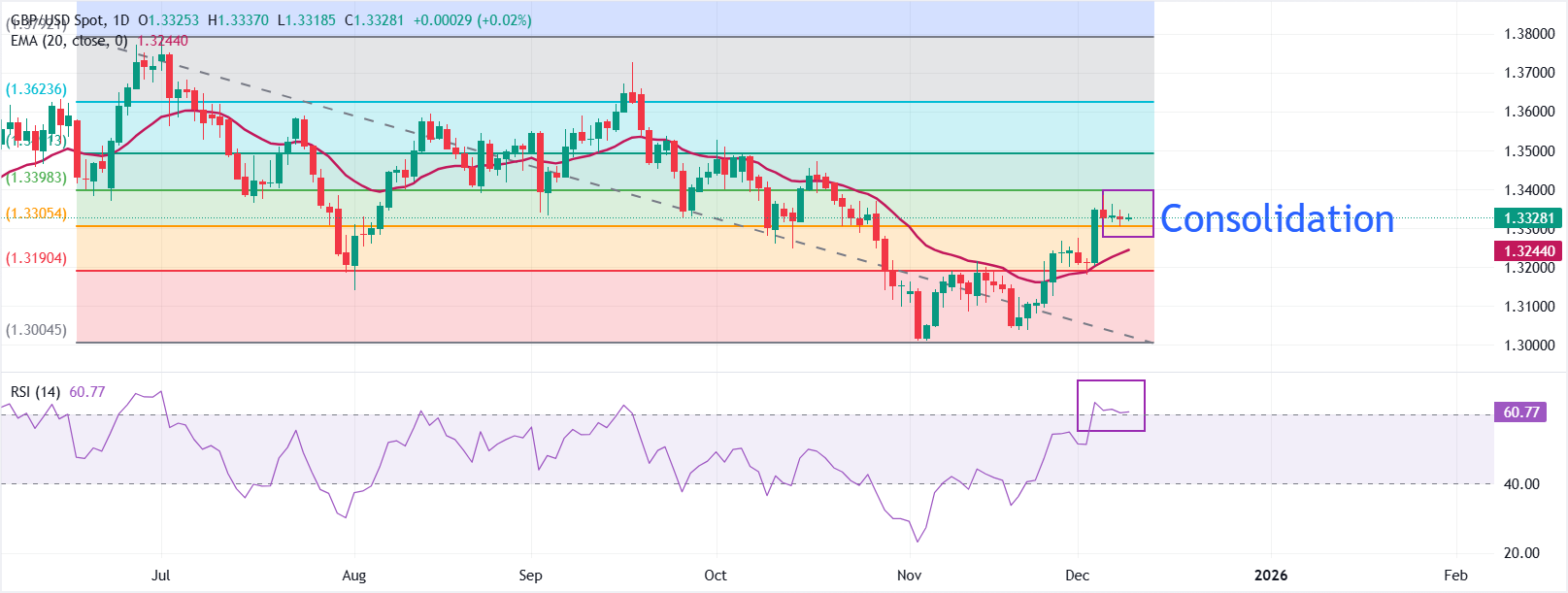
The Pound Sterling wobbles in a tight range above 1.3300 against the US Dollar on Tuesday. The pair holds above a rising 20-day Exponential Moving Average (EMA) at 1.3244, maintaining a positive near-term bias. The 20-day EMA has sloped higher in recent sessions, and dips remain shallow.
The 14-day Relative Strength Index (RSI) at around 61 reflects bullish momentum, hints at an uptrend in the near term as the oscillator is far from overbought levels.
Momentum remains supportive while price stays above the rising 20-day EMA. A daily close above the 50% Fibonacci retracement at 1.3402 would reinforce the bullish tone and open room towards the October 17 high of 1.3471. Conversely, failure to breach that barrier would keep the pair consolidating, with pullbacks leaning toward the 38.2% Fibonacci area around 1.3305.
Economic Indicator
JOLTS Job Openings
JOLTS Job Openings is a survey done by the US Bureau of Labor Statistics to help measure job vacancies. It collects data from employers including retailers, manufacturers and different offices each month.
Read more.Next release: Tue Dec 09, 2025 15:00
Frequency: Monthly
Consensus: 7.2M
Previous: 7.227M
Source: US Bureau of Labor Statistics
Author

Sagar Dua
FXStreet
Sagar Dua is associated with the financial markets from his college days. Along with pursuing post-graduation in Commerce in 2014, he started his markets training with chart analysis.
















