Pound Sterling ticks up as UK inflation accelerates more than expected
- The Pound Sterling ticks up against its major peers as UK inflation grew at a faster-than-expected pace in June.
- Investors shift their focus to the UK labor market data for the three-months ending May.
- The US CPI report showed that Trump’s tariffs have started feeding into consumer prices.

The Pound Sterling (GBP) attracts bids against its major peers on Wednesday after the release of a hotter-than-projected United Kingdom (UK) Consumer Price Index (CPI) data for June.
The Office for National Statistics (ONS) reported that headline inflation rose to 3.6% on year, the highest level seen since January 2024. Economists expected the inflation data to have grown steadily by 3.4%. The core CPI – which excludes volatile items such as food, energy alcohol and tobacco – rose 3.7%, a faster pace than expectations and the prior reading of 3.5%. On month, the headline CPI grew by 0.3%, which was also faster than expectations and the former reading of 0.2%.
Meanwhile, inflation in the services sector, an indicator that is closely tracked by Bank of England (BoE) officials, rose steadily by 4.7%.
Signs of accelerating price pressures should encourage the BoE to argue in favor of maintaining a restrictive monetary policy stance. However, the UK central bank might need to perform a delicate balancing act while discussing on interest rates in the August monetary policy meeting amid escalating price pressures and cooling labor market conditions.
Hotter-than-expected UK inflation data is expected to force markets to reassess bets supporting interest rate cuts by the BoE in the remainder of the year. Before the UK CPI data, traders were increasingly confident that the central bank will reduce interest rates in the policy meeting next month.
For fresh cues on the state of the UK labor market, investors await the job data for the three-months ending May, which will be released on Thursday.
The increase of employers’ contribution to social security schemes by Chancellor of the Exchequer Rachel Reeves has led to a slowdown in hiring. The latest survey from Recruitment and Employment Confederation trade body and accountants KPMG has signaled that the availability of individuals for job has increased significantly.
British Pound PRICE Today
The table below shows the percentage change of British Pound (GBP) against listed major currencies today. British Pound was the strongest against the New Zealand Dollar.
| USD | EUR | GBP | JPY | CAD | AUD | NZD | CHF | |
|---|---|---|---|---|---|---|---|---|
| USD | -0.08% | -0.11% | -0.09% | 0.02% | -0.07% | 0.17% | 0.09% | |
| EUR | 0.08% | -0.02% | -0.03% | 0.10% | -0.04% | 0.20% | 0.18% | |
| GBP | 0.11% | 0.02% | 0.00% | 0.14% | 0.01% | 0.22% | 0.20% | |
| JPY | 0.09% | 0.03% | 0.00% | 0.10% | 0.07% | 0.23% | 0.22% | |
| CAD | -0.02% | -0.10% | -0.14% | -0.10% | -0.10% | 0.04% | 0.06% | |
| AUD | 0.07% | 0.04% | -0.01% | -0.07% | 0.10% | 0.21% | 0.20% | |
| NZD | -0.17% | -0.20% | -0.22% | -0.23% | -0.04% | -0.21% | -0.02% | |
| CHF | -0.09% | -0.18% | -0.20% | -0.22% | -0.06% | -0.20% | 0.02% |
The heat map shows percentage changes of major currencies against each other. The base currency is picked from the left column, while the quote currency is picked from the top row. For example, if you pick the British Pound from the left column and move along the horizontal line to the US Dollar, the percentage change displayed in the box will represent GBP (base)/USD (quote).
Daily digest market movers: Pound Sterling edges higher against US Dollar
- The Pound Sterling (GBP) snaps an eight-day losing streak against the US Dollar (USD) and rebounds to near 1.3400 during the European trading session after the release of the hot UK CPI report. The recovery move in the GBP/USD pair occurred despite an also firm US Dollar, buoyed by signs that the tariff policy announced by United States (US) President Donald Trump has started feeding into prices.
- The US CPI report showed on Tuesday that producers have started passing the impact of Trump’s tariffs to consumers. According to the report, prices of product categories such as household furnishings, recreation, and apparel increased, which led the headline CPI to accelerate to 2.7% on year, as expected, faster than the prior reading of 2.4%.
- Market experts have warned that price pressures could rise further as the impact of tariffs , which will become effective on August 1, is still to be fed into the economy. Such a scenario could allow Federal Reserve (Fed) to demand more time to get clarity about the overall impact of tariff-driven inflation before making any monetary policy adjustments. “If the recent tariffs threatened for August 1 go into effect, it will take a few months for that additional boost to inflation to be felt in goods prices and will keep the Fed on the sideline unless the labor market takes a sudden turn for the worse,” analysts at Oxford Economics said, Reuters reported.
- Signs of price pressures accelerating in the near term have also forced traders to pare Fed dovish bets. According to the CME FedWatch tool, the probability that the Fed will cut interest rates in the September meeting has fallen to 55.5% from the 64.7% seen a week ago. In the policy meeting later this month, markets are almost fully pricing in that the Fed will leave interest rates steady in the range of 4.25%-4.50%.
- President Trump has imposed additional levies on 22 nations, notably Japan, South Korea, the European Union (EU), and North American peers for failing to strike a trade deal during the 90-day tariff pause. Meanwhile, Washington has closed deals with the United Kingdom (UK), Vietnam, Indonesia, and a limited pact with China. Trump expressed confidence on Tuesday that he is close to striking trade deals with five or six countries soon, out of which one could be India.
Technical Analysis: Pound Sterling aims to return above 1.3400
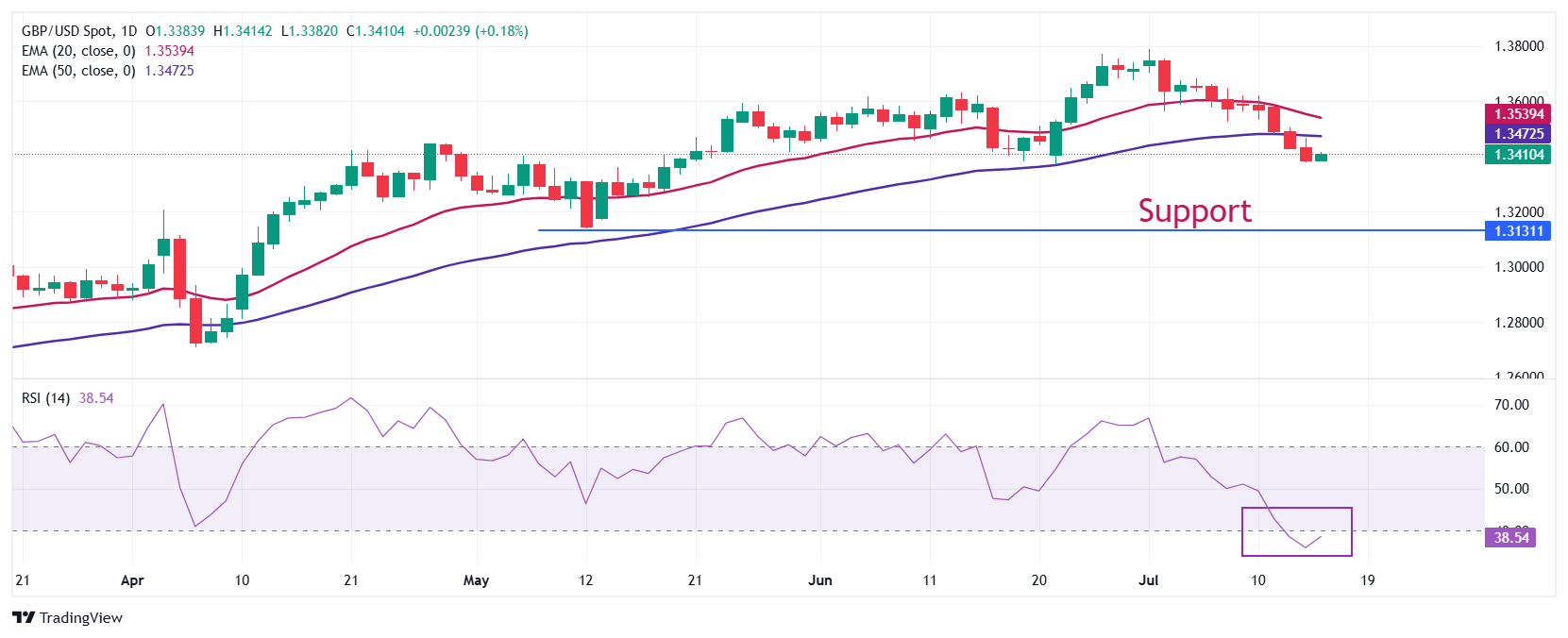
The Pound Sterling bounces back to near 1.3400 against the US Dollar on Wednesday after revisiting an over seven-week low around 1.3370 the previous day. The near-term trend of the GBP/USD pair has turned bearish as it trades below the 20-day and 50-day Exponential Moving Averages (EMAs)at around 1.3540 and 1.3470, respectively.
The 14-day Relative Strength Index (RSI) falls below 40.00. A fresh bearish momentum would emerge if the RSI stays below the same.
Looking down, the May 12 low of 1.3140 will act as a key support zone. On the upside, the July 11 high around 1.3585 will act as a key barrier.
Inflation FAQs
Inflation measures the rise in the price of a representative basket of goods and services. Headline inflation is usually expressed as a percentage change on a month-on-month (MoM) and year-on-year (YoY) basis. Core inflation excludes more volatile elements such as food and fuel which can fluctuate because of geopolitical and seasonal factors. Core inflation is the figure economists focus on and is the level targeted by central banks, which are mandated to keep inflation at a manageable level, usually around 2%.
The Consumer Price Index (CPI) measures the change in prices of a basket of goods and services over a period of time. It is usually expressed as a percentage change on a month-on-month (MoM) and year-on-year (YoY) basis. Core CPI is the figure targeted by central banks as it excludes volatile food and fuel inputs. When Core CPI rises above 2% it usually results in higher interest rates and vice versa when it falls below 2%. Since higher interest rates are positive for a currency, higher inflation usually results in a stronger currency. The opposite is true when inflation falls.
Although it may seem counter-intuitive, high inflation in a country pushes up the value of its currency and vice versa for lower inflation. This is because the central bank will normally raise interest rates to combat the higher inflation, which attract more global capital inflows from investors looking for a lucrative place to park their money.
Formerly, Gold was the asset investors turned to in times of high inflation because it preserved its value, and whilst investors will often still buy Gold for its safe-haven properties in times of extreme market turmoil, this is not the case most of the time. This is because when inflation is high, central banks will put up interest rates to combat it. Higher interest rates are negative for Gold because they increase the opportunity-cost of holding Gold vis-a-vis an interest-bearing asset or placing the money in a cash deposit account. On the flipside, lower inflation tends to be positive for Gold as it brings interest rates down, making the bright metal a more viable investment alternative.
Author

Sagar Dua
FXStreet
Sagar Dua is associated with the financial markets from his college days. Along with pursuing post-graduation in Commerce in 2014, he started his markets training with chart analysis.

















