Pound Sterling rallies against US Dollar on Ukraine peace plan
- The Pound Sterling surges to near 1.2700 against the US Dollar due to positive developments in the Russia-Ukraine peace truce.
- Fears of US President Trump’s tariffs on Canada, Mexico, and China loom large.
- The BoE is expected to follow a careful and gradual policy-easing approach.

The Pound Sterling (GBP) gains ground against the US Dollar (USD) after a two-day correction and rebounds strongly to near 1.2700 in North American trading hours on Monday. The GBP/USD pair bounces back as the risk premium of the US Dollar diminishes on optimism over a peace truce between Russia and Ukraine. The US Dollar Index (DXY), which tracks the Greenback’s value against six major currencies, falls to near 107.25 from an over two-week high of 107.65 posted on Friday.
However, investors should be cautious about betting big against the US Dollar due to looming tariff fears. United States (US) President Donald Trump is poised to slap tariffs on Canada, Mexico, and China for failing to restrict the flow of fentanyl into the US.
US Commerce Secretary Howard Lutnick confirmed over the weekend that the President’s plans of imposing tariffs on Canada and Mexico on Tuesday are on. However, his comments indicated that there is room for negotiation over the degree of tariffs.
US President Trump threatened to impose a 25% levy on Canada and Mexico and an additional 10% on China. Trump also slapped 10% tariffs on China in the first week of February.
This week, investors will pay close attention to a slew of US economic data, notably on the Nonfarm Payrolls (NFP) data for February, which will be released on Friday. The labor market data will influence market expectations for the Federal Reserve’s (Fed) monetary policy outlook. The Fed is expected to keep interest rates steady in the March and May policy meetings, and there is a 77% chance that it will cut them in June, according to the CME FedWatch tool.
In Monday’s session, investors will focus on the US ISM and revised S&P Global Manufacturing Purchasing Managers Index (PMI) data for February, which will be published during North American trading hours. The ISM Manufacturing PMI is estimated to have grown at a marginally slower pace of 50.8 from 50.9 in January.
Daily digest market movers: Pound Sterling gains as Ukraine peace plan increases investors' risk appetite
- The Pound Sterling trades higher against its major peers, except the Euro, at the start of the week due to a potential Russia-Ukraine peace truce. Over the weekend, United Kingdom (UK) Prime Minister Keir Starmer said European leaders agreed to present a peace plan to Washington. The meeting between European leaders and Starmer was also attended by Ukrainian President Volodymyr Zelenskyy, potentially a big positive step towards ending the three-year-long war in Ukraine. Technically, signs of easing geopolitical tensions improve demand for risky assets.
- Additionally, firm expectations that the Bank of England (BoE) will follow a moderate policy-easing cycle and a likely healthy trade deal between the US and the UK have kept the British currency on the frontfoot. On Friday, BoE Deputy Governor Dave Ramsden said that the central bank should keep a “careful and gradual” approach to the monetary policy expansion amid uncertainty over the labor market and global trade.
- Ramsden warned that inflationary pressures are still elevated due to persistent wage growth. “I no longer think that risks to hitting the 2% inflation target sustainably in the medium term are to the downside,” Ramsden said. Meanwhile, trades have fully priced in two interest rate cuts this year.
- The meeting between US President Trump and UK Prime Minister Starmer on Thursday didn’t end with a trade deal, but Trump was confident that an agreement could be made "pretty quickly" where tariffs “wouldn't be necessary".
Technical Analysis: Pound Sterling reclaims 1.2700
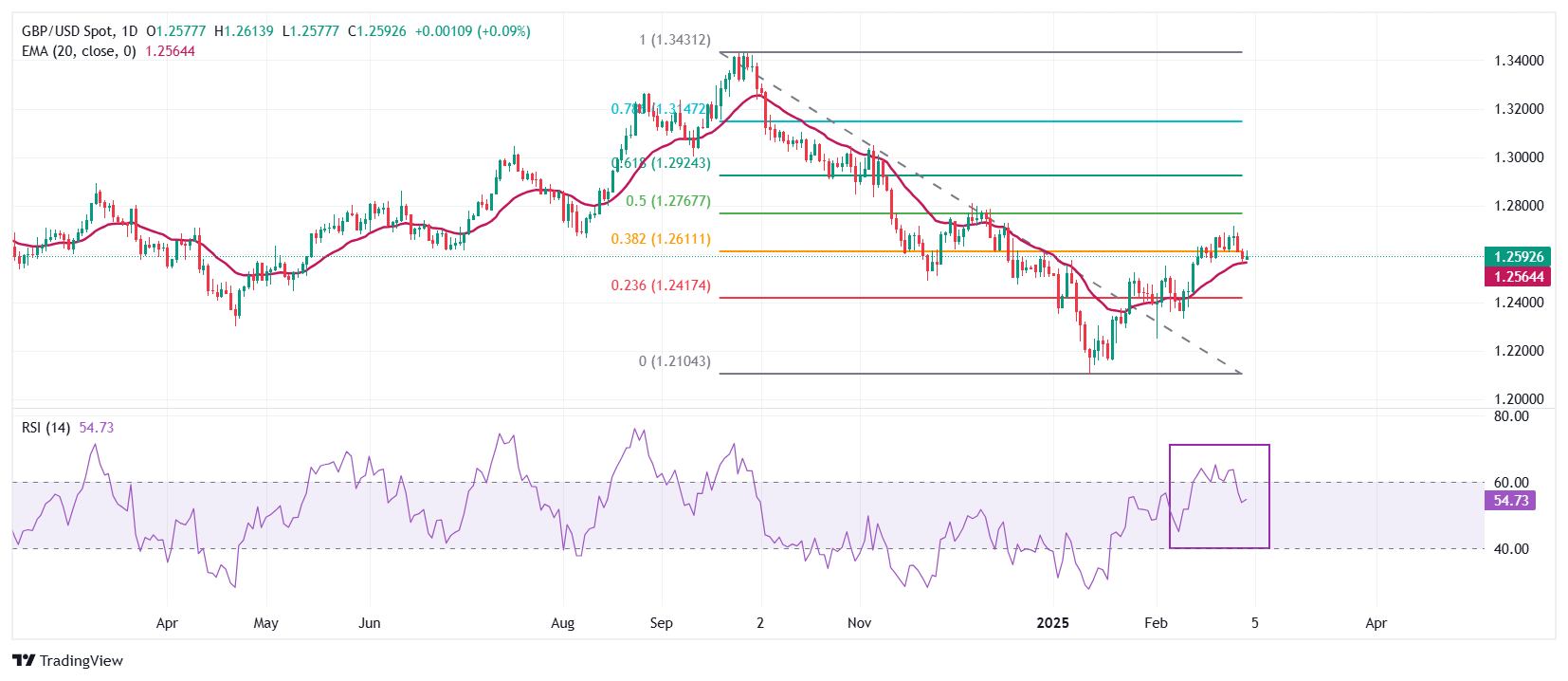
The Pound Sterling soars to near 1.2700 against the US Dollar on Monday. The GBP/USD pair finds buying interest after a mean-reversion move to the 20-day Exponential Moving Average (EMA) near 1.2560.
The 14-day Relative Strength Index (RSI) falls back within the 40.00-60.00 range, suggesting that the bullish momentum has concluded for now. However, the positive bias remains intact.
Looking down, the February 11 low of 1.2333 will act as a key support zone for the pair. On the upside, the 50% Fibonacci retracement at 1.2765 will act as a key resistance zone.
Tariffs FAQs
Tariffs are customs duties levied on certain merchandise imports or a category of products. Tariffs are designed to help local producers and manufacturers be more competitive in the market by providing a price advantage over similar goods that can be imported. Tariffs are widely used as tools of protectionism, along with trade barriers and import quotas.
Although tariffs and taxes both generate government revenue to fund public goods and services, they have several distinctions. Tariffs are prepaid at the port of entry, while taxes are paid at the time of purchase. Taxes are imposed on individual taxpayers and businesses, while tariffs are paid by importers.
There are two schools of thought among economists regarding the usage of tariffs. While some argue that tariffs are necessary to protect domestic industries and address trade imbalances, others see them as a harmful tool that could potentially drive prices higher over the long term and lead to a damaging trade war by encouraging tit-for-tat tariffs.
During the run-up to the presidential election in November 2024, Donald Trump made it clear that he intends to use tariffs to support the US economy and American producers. In 2024, Mexico, China and Canada accounted for 42% of total US imports. In this period, Mexico stood out as the top exporter with $466.6 billion, according to the US Census Bureau. Hence, Trump wants to focus on these three nations when imposing tariffs. He also plans to use the revenue generated through tariffs to lower personal income taxes.
Author

Sagar Dua
FXStreet
Sagar Dua is associated with the financial markets from his college days. Along with pursuing post-graduation in Commerce in 2014, he started his markets training with chart analysis.