Pound Sterling drops as recession in UK seems likely
- Pound Sterling eyes support near 1.2740 as the near-term demand is bullish due to upbeat market mood
- High inflation and recession fears in the UK may complicate the idea of BoE remaining a laggard in cutting rates.
- The economic calendar is light due to the festive season.

The Pound Sterling (GBP) fell vertically from fresh four-month high but is looking to recover as investors hope that the Bank of England (BoE) may maintain a restrictive monetary policy stance, knowing that inflation in the United Kingdom economy is highest in comaprison with other Group of Seven economies. The GBP/USD pair struggles to continue winning streak as the risk-appetite of the market participants has reduced despite early rate cut expectations from the Federal Reserve (Fed).
BoE policymakers are expected to face enormous difficulties as price pressures in the United Kingdom are high in comparison with other Group of Seven economies and the economy is on the verge of a technical recession due to deteriorating demand in domestic and overseas markets. The BoE could be forced to turn dovish due to economic shrinkage.
Daily Digest Market Movers: Pound Sterling eyes an intermediate cushion
- Pound Sterling fails to hold gains as investors worry about deepening fears of a recession in the UK economy.
- The demand for the Pound Sterling is fading as the Bank of England may not be the laggard in reducing borrowing costs.
- The expectations of a technical recession in the UK economy deepened after the Office for National Statistics (ONS) revised in a slight contraction in Q3 Gross Domestic Product (GDP) by 0.1%, escalating the need for early rate cut discussions.
- Chances for unwinding of BoE’s tight monetary policy stance would escalate if the UK economy shrinks in the last quarter of 2024.
- The BoE reported in its latest projections that the economy would remain stagnant in the last quarter.
- UK Finance Minister Jeremy Hunt said last week there is a reasonable chance that if we stick to the course, the administration would be able to bring inflation down and the central bank would start cutting interest rates.
- Meanwhile, the underlying inflation in the UK economy is still highest in comparison with other Group of Seven economies, which would keep BoE policymakers on toes.
- The UK core Consumer Price Index (CPI) has softened to 5.1% but is still more than double the required rate of 2% due to robust wage growth.
- BoE policymakers may divide on whether to keep restrictive monetary policy stance for a longer period or to start unwinding higher interest rates.
- On the US Dollar front, the US Dollar Index (DXY) finds cushion near 100.60, but broader demand is still weak.
- The overall market mood is still upbeat as investors lean towards expectations of early rate cuts by the Federal Reserve.
- The Fed is expected to start lowering borrowing costs from March as price pressures in the United States economy are clearly in a downtrend.
- This week, action in the FX domain has clearly indicated that markets are confident about early rate cuts by the Fed. The US Dollar may continue to face pressure despite thin trading volume and light economic docket.
- Meanwhile, the US Department of Labor has reported that individuals claiming jobless benefits for the first time were higher at 218K gaianst expectations of 210K and the former reading of 205K.
Technical Analysis: Pound Sterling drops below 1.2800
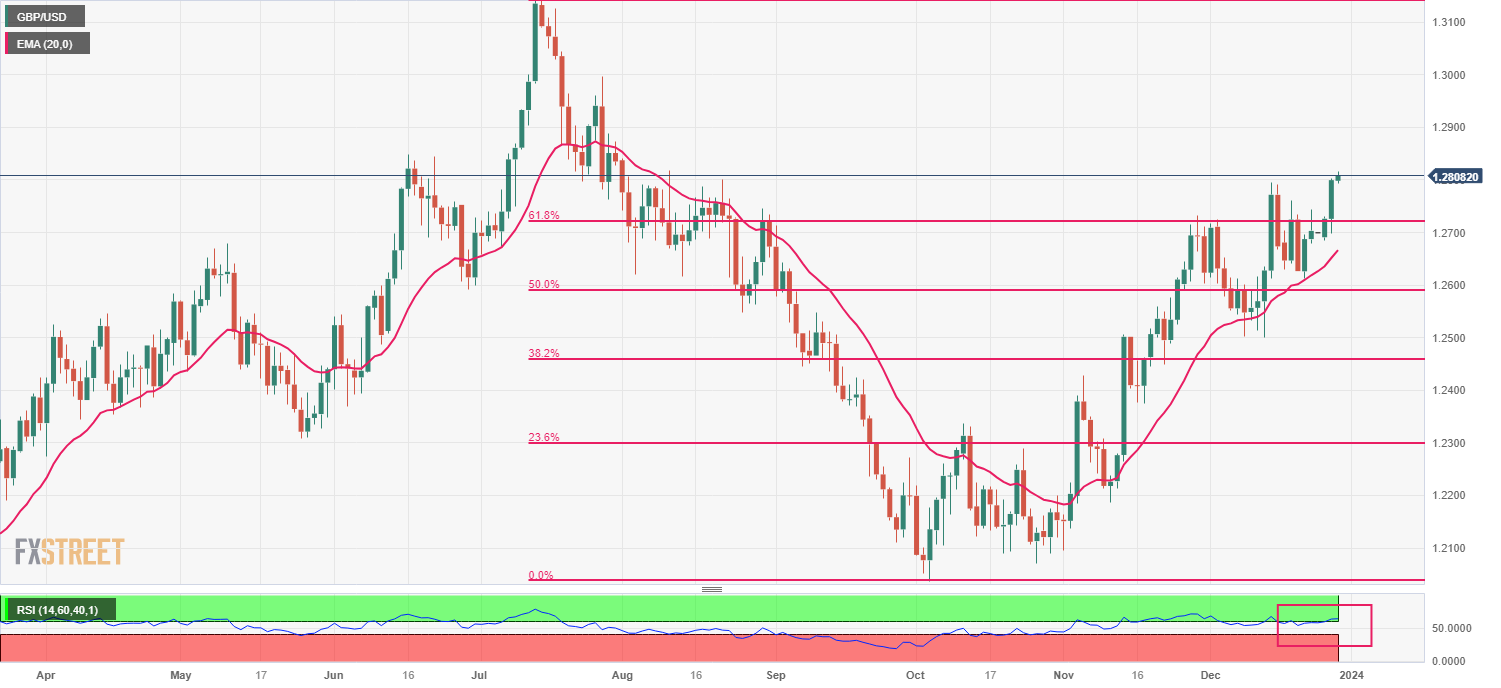
Pound Sterling failed to achieve a firm footing above 1.2800 as the risk appetite of the market participants as dropped. The Cable aims stability above the 61.8% Fibonacci retracement (plotted from July 14 high at 1.3142 to October 4 low at 1.2037) at 1.2740. The upward-sloping 20-day Exponential Moving Average (EMA) at 1.2670 continues to support the Pound Sterling bulls.
The Relative Strength Index (RSI) (14) has climbed above 60. Sustainability above aforementioned levels would trigger a bullish momentum.
Pound Sterling FAQs
What is the Pound Sterling?
The Pound Sterling (GBP) is the oldest currency in the world (886 AD) and the official currency of the United Kingdom. It is the fourth most traded unit for foreign exchange (FX) in the world, accounting for 12% of all transactions, averaging $630 billion a day, according to 2022 data.
Its key trading pairs are GBP/USD, aka ‘Cable’, which accounts for 11% of FX, GBP/JPY, or the ‘Dragon’ as it is known by traders (3%), and EUR/GBP (2%). The Pound Sterling is issued by the Bank of England (BoE).
How do the decisions of the Bank of England impact on the Pound Sterling?
The single most important factor influencing the value of the Pound Sterling is monetary policy decided by the Bank of England. The BoE bases its decisions on whether it has achieved its primary goal of “price stability” – a steady inflation rate of around 2%. Its primary tool for achieving this is the adjustment of interest rates.
When inflation is too high, the BoE will try to rein it in by raising interest rates, making it more expensive for people and businesses to access credit. This is generally positive for GBP, as higher interest rates make the UK a more attractive place for global investors to park their money.
When inflation falls too low it is a sign economic growth is slowing. In this scenario, the BoE will consider lowering interest rates to cheapen credit so businesses will borrow more to invest in growth-generating projects.
How does economic data influence the value of the Pound?
Data releases gauge the health of the economy and can impact the value of the Pound Sterling. Indicators such as GDP, Manufacturing and Services PMIs, and employment can all influence the direction of the GBP.
A strong economy is good for Sterling. Not only does it attract more foreign investment but it may encourage the BoE to put up interest rates, which will directly strengthen GBP. Otherwise, if economic data is weak, the Pound Sterling is likely to fall.
How does the Trade Balance impact the Pound?
Another significant data release for the Pound Sterling is the Trade Balance. This indicator measures the difference between what a country earns from its exports and what it spends on imports over a given period.
If a country produces highly sought-after exports, its currency will benefit purely from the extra demand created from foreign buyers seeking to purchase these goods. Therefore, a positive net Trade Balance strengthens a currency and vice versa for a negative balance.
Author

Sagar Dua
FXStreet
Sagar Dua is associated with the financial markets from his college days. Along with pursuing post-graduation in Commerce in 2014, he started his markets training with chart analysis.