Pound Sterling trades higher amid Spring Bank Holiday
- The Pound Sterling refreshes a three-year high near 1.3600 against the US Dollar due to US President Trump’s ever-changing tariff announcements on the EU.
- Trump threatens to impose 25% duties on Apple for not manufacturing in the US.
- Traders see the BoE reducing interest rates just once in the remainder of the year.

The Pound Sterling (GBP) outperforms its other peers, except antipodeans, at the start of the week. The British currency gains as financial market participants reassess expectations for the Bank of England’s (BoE) monetary policy outlook after the release of the stronger-than-projected growth in the UK Consumer Price Index (CPI) and Retail Sales data for April.
Last week, the UK CPI report showed that the headline inflation rose at a robust pace of 3.5% on year against 2.6% growth seen in April. In the same period, inflation in the services sector, which is closely tracked by BoE officials, accelerated to 5.4% from the prior release of 4.7%. Meanwhile, Retail Sales grew strongly by 1.2% on month, compared to estimates of 0.2% and 0.1% growth seen in March. Theoretically, hot inflation and strong Retail Sales data discourage BoE officials from lowering interest rates, a scenario that is favorable for the Pound Sterling.
According to a report from Reuters, the futures market shows traders see UK rates falling by around 38 basis points (bps) by the end of this year, which would imply one 25 bps interest rate cut and a roughly 50/50 chance of a second.
Daily digest market movers: Pound Sterling gains higher against US Dollar
- The Pound Sterling posts a fresh three-year high near 1.3600 against the US Dollar (USD) at the start of the week, amid holidays in the United Kingdom (UK) and the United States (US) markets on account of the Spring Bank Holiday and Memorial Day, respectively. The GBP/USD pair has extended the upside as the US Dollar slides further after “ever-changing” tariff announcements by US President Donald Trump on imports from the European Union (EU) have renewed concerns over its safe-haven appeal.
- The US Dollar Index (DXY), which tracks the Greenback’s value against six major currencies, attracts bids near the monthly low of 98.70 posted earlier in the day. Still, the USD Index is marginally down to near 99.00.
- During the weekend, Trump suspended 50% tariffs on the EU until July 9, which were expected to become effective from June 1. His decision came after discussions with European Commission President Ursula von der Leyen. "We had a very nice call, and I agreed to move it," Trump affirmed and added, "She said we will rapidly get together and see if we can work something out," Reuters reported.
- On Friday, the US President imposed 50% flat tariffs on imports from the old continent after Brussels sent a not-so-good trade proposal to Washington. US Treasury Secretary Scott Bessent also warned that the EU is “not negotiating in good faith” in an interview with Fox News.
- Though the decision by US President Trump to postpone additional import duties has provided relief to European and the US markets, investors continue to doubt the credibility of the Greenback. During European trading hours, S&P 500 futures are up over 1%.
- Another reason behind weakness in the US Dollar is Donald Trump’s 25% tariff threat to Apple and other smartphone manufacturers for not manufacturing in the US. Investors see the event as an assault by the administration on the autonomy of the private sector, potentially dampening business confidence.
- Meanwhile, Federal Reserve (Fed) officials continue to warn about potential stagflation risks in the wake of new economic policies announced by Washington. “There’s no question that the shock of tariffs is stagflationary,” Minneapolis Federal Reserve President Neel Kashkari said in an interview with Bloomberg TV earlier in the day. Kashkari guided that any monetary policy adjustment is unlikely, at least before September, as officials seek more clarity on how new policies will influence the economic outlook. “Uncertainty is something that is top of the mind for the Fed and US businesses, and we’re trying to navigate where inflation and the labor market are going,” he added.
US Dollar PRICE Today
The table below shows the percentage change of US Dollar (USD) against listed major currencies today. US Dollar was the weakest against the New Zealand Dollar.
| USD | EUR | GBP | JPY | CAD | AUD | NZD | CHF | |
|---|---|---|---|---|---|---|---|---|
| USD | -0.14% | -0.30% | 0.24% | -0.00% | -0.23% | -0.45% | 0.04% | |
| EUR | 0.14% | -0.15% | 0.42% | 0.14% | -0.09% | -0.30% | 0.19% | |
| GBP | 0.30% | 0.15% | 0.25% | 0.29% | 0.06% | -0.15% | 0.35% | |
| JPY | -0.24% | -0.42% | -0.25% | -0.24% | -0.47% | -0.74% | -0.20% | |
| CAD | 0.00% | -0.14% | -0.29% | 0.24% | -0.21% | -0.44% | 0.06% | |
| AUD | 0.23% | 0.09% | -0.06% | 0.47% | 0.21% | -0.26% | 0.33% | |
| NZD | 0.45% | 0.30% | 0.15% | 0.74% | 0.44% | 0.26% | 0.51% | |
| CHF | -0.04% | -0.19% | -0.35% | 0.20% | -0.06% | -0.33% | -0.51% |
The heat map shows percentage changes of major currencies against each other. The base currency is picked from the left column, while the quote currency is picked from the top row. For example, if you pick the US Dollar from the left column and move along the horizontal line to the Japanese Yen, the percentage change displayed in the box will represent USD (base)/JPY (quote).
Technical Analysis: Pound Sterling stays above 1.3500
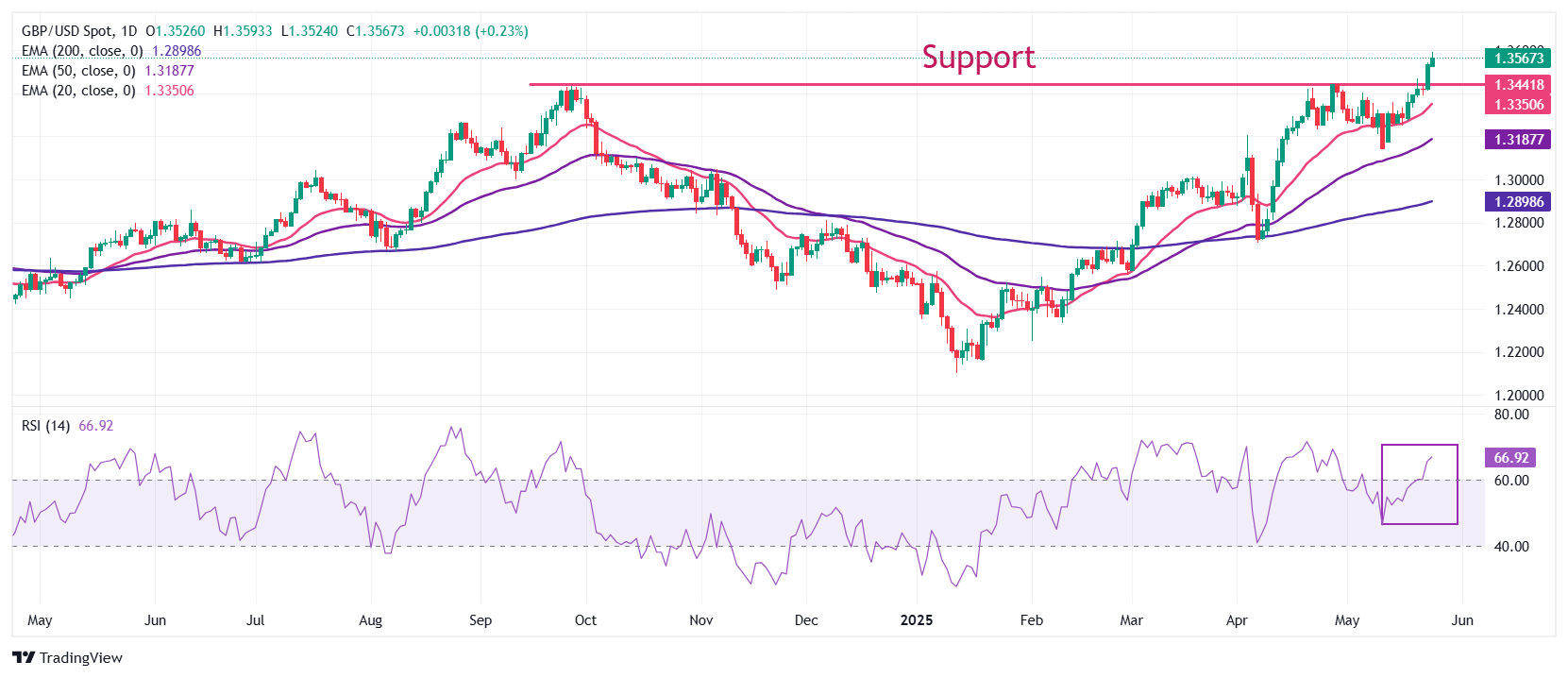
The Pound Sterling posts a fresh three-year high around 1.3600 against the US Dollar on Monday. The near-term trend of the GBP/USD pair remains bullish as all short-to-long-term Exponential Moving Averages (EMAs) are sloping higher.
The 14-day Relative Strength Index (RSI) rises to near 67.00, indicating a strong bullish momentum.
On the upside, the 13 January 2022 high of 1.3750 will be a key hurdle for the pair. Looking down, the April 28 high of 1.3445 will act as a major support area.
Risk sentiment FAQs
In the world of financial jargon the two widely used terms “risk-on” and “risk off'' refer to the level of risk that investors are willing to stomach during the period referenced. In a “risk-on” market, investors are optimistic about the future and more willing to buy risky assets. In a “risk-off” market investors start to ‘play it safe’ because they are worried about the future, and therefore buy less risky assets that are more certain of bringing a return, even if it is relatively modest.
Typically, during periods of “risk-on”, stock markets will rise, most commodities – except Gold – will also gain in value, since they benefit from a positive growth outlook. The currencies of nations that are heavy commodity exporters strengthen because of increased demand, and Cryptocurrencies rise. In a “risk-off” market, Bonds go up – especially major government Bonds – Gold shines, and safe-haven currencies such as the Japanese Yen, Swiss Franc and US Dollar all benefit.
The Australian Dollar (AUD), the Canadian Dollar (CAD), the New Zealand Dollar (NZD) and minor FX like the Ruble (RUB) and the South African Rand (ZAR), all tend to rise in markets that are “risk-on”. This is because the economies of these currencies are heavily reliant on commodity exports for growth, and commodities tend to rise in price during risk-on periods. This is because investors foresee greater demand for raw materials in the future due to heightened economic activity.
The major currencies that tend to rise during periods of “risk-off” are the US Dollar (USD), the Japanese Yen (JPY) and the Swiss Franc (CHF). The US Dollar, because it is the world’s reserve currency, and because in times of crisis investors buy US government debt, which is seen as safe because the largest economy in the world is unlikely to default. The Yen, from increased demand for Japanese government bonds, because a high proportion are held by domestic investors who are unlikely to dump them – even in a crisis. The Swiss Franc, because strict Swiss banking laws offer investors enhanced capital protection.
Author

Sagar Dua
FXStreet
Sagar Dua is associated with the financial markets from his college days. Along with pursuing post-graduation in Commerce in 2014, he started his markets training with chart analysis.