Pound Sterling retreats as higher US Services Price Paid renewes persistent inflation fears
- The Pound Sterling surrenders intraday gains after higher US Services Prices Paid renewed fears of persistent price pressures.
- The negative impact of weak labor demand and slower wage growth is offset by higher US Services Price Paid.
- Investors see the BoE starting to reduce interest rates from the September meeting.

The Pound Sterling (GBP) reverses gains after rallying to the round-level resistance of 1.2600 against the US Dollar (USD) in Friday’s early New York session. The GBP/USD pair falls as the US Dollar recovers losses recorded after the release of the United States Nonfarm Payrolls (NFP) report for April, which showed that labor demand was weak and wage growth slowed more than expected.
The US Dollar rebounds as the Service Prices Paid advanced to 59.2 from 53.4, suggesting the price pressures have accelerated further in April, which could negatively influence Federal Reserve (Fed) rate cut expectations, which are currently anticipated from the September meeting.
Meanwhile, the US ISM Services Purchasing Managers Index (PMI), which represents the service sector that accounts for two-thirds of the economy, fell to 49.4. The Services PMI falls below the 50.0 threshold, which separates expansion from contraction. Investors forecasted the Services PMI to improve to 52.0 from 51.4 in March.
Earlier, the US NFP report showed that nonfarm employers recruited 175K workers in April, lower than the consensus of 243K and the former reading of 315K, upwardly revised from 303K. The Unemployment Rate rises to 3.9% from 3.8% in March. The Average Hourly Earnings data, which provides a fresh inflation outlook softened to 3.9% from the estimates of 4.0% and the prior reading of 4.1% on a year-on-year basis. Monthly figures grew at a slower pace of 0.2%, which were expected to rise steadily by 0.3%.
Daily digest market movers: Pound Sterling retreats as US Dollar rebounds
- The Pound Sterling retreats from 1.2600 against the US Dollar as persistent US inflation pressures offset weak US NFP data. The US Dollar Index (DXY) rebounds after hitting a fresh three-week low around 104.50, which was weighed down by easing labor market conditions combined with weak Q1 Nonfarm Productivity data and Fed’s less hawkish guidance on interest rates than feared. The Q1 Nonfarm Productivity data, which reflects hourly output per worker, grew at a significantly slower pace of 0.3% from expectations of 0.8% and a strong reading of 3.5% in the last quarter of 2023.
- On Wednesday, investors observed that the Fed remains leaning towards easing restrictive policy this year after listening to the monetary policy statement and Fed Chair Jerome Powell’s press conference. Jerome Powell acknowledged that progress in disinflation has stalled but remains hopeful that rate cuts are eventual this year. The Fed also slowed the pace of tapering the balance sheet. The Fed said that starting on June 1 it will reduce the cap on Treasury securities it allows to mature and not be replaced to $25 billion from its current cap of up to $60 billion per month, Reuters reported.
- Meanwhile, expectations that the Bank of England (BoE) will start reducing interest rates later than what was anticipated earlier has also strengthened the GBP/USD pair. Financial markets see the BoE reducing interest rates from the September meeting, more or less in line with expectations of the US Federal Reserve making a similar move. Earlier, investors were divided between the June or August meeting.
- The speculation about the BoE pivoting to interest rate cuts has been postponed as investors remain worried about strong wage growth in the United Kingdom, which is feeding the core Consumer Price Index (CPI), the central bank’s preferred inflation measure.
- For the headline inflation, BoE Governor Andrew Bailey said he is confident that it will return to the desired rate of 2%. The next BoE’s monetary policy decisionich will be announced on May 9, and markets expect the bank to hold interest rates steady at 5.25%. Investors will keenly focus on whether Andrew Bailey sticks to its statement that expectations for two or three rate cuts are reasonable this year, as stated in March’s policy meeting.
Technical Analysis: Pound Sterling falls back from 1.2600
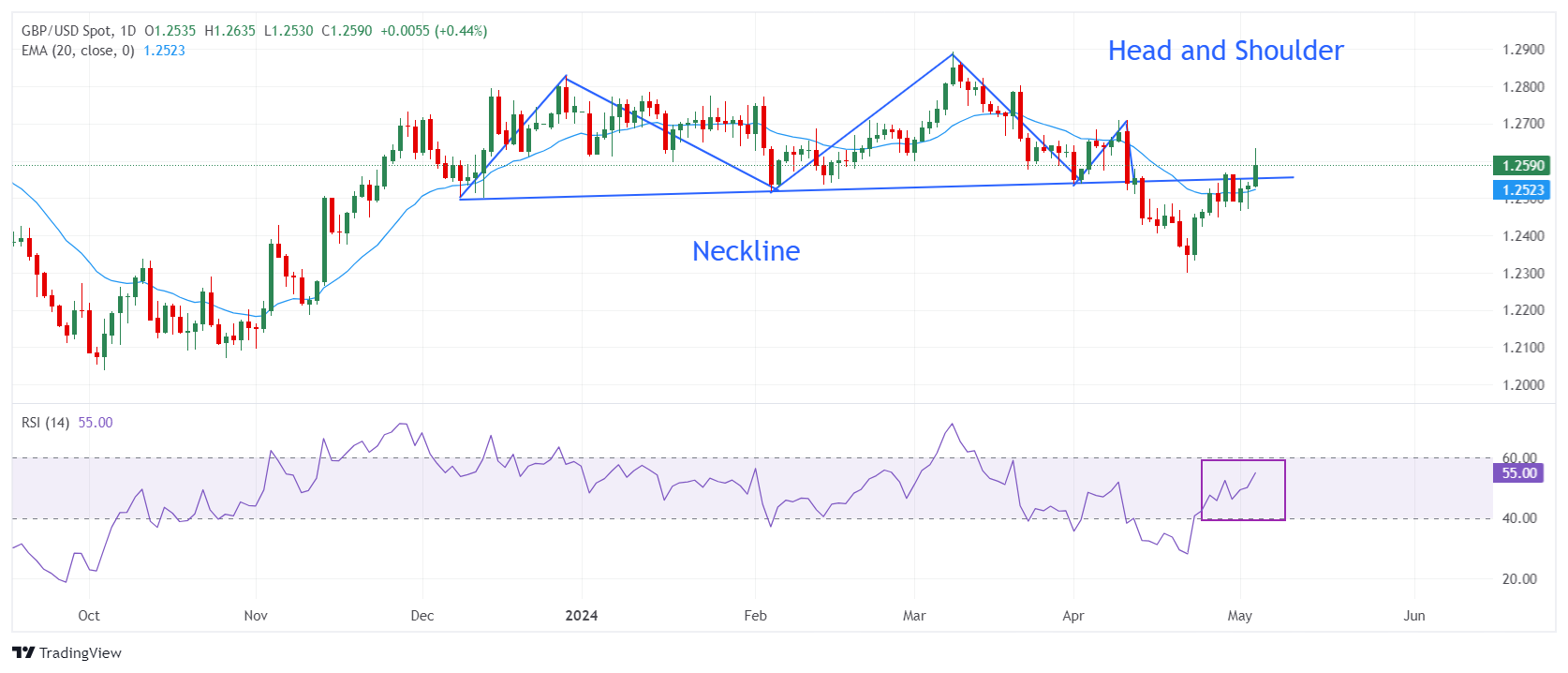
The Pound Sterling struggle to sustain its winning spell for the third trading day on Friday. The GBP/USD pair falls sharply from 1.2600 but holds gains above the psychological support of 1.2500. The near-term outlook of the Cable is upbeat as it holds above the 20-day Exponential Moving Average (EMA), which trades around 1.2520.
The pair rises above the neckline of the Head and Shoulder pattern. On April 12, Cable witnessed an intense sell-off after breaking below the neckline of the H&S pattern plotted from December 8 low around 1.2500.
The 14-period Relative Strength Index (RSI) oscillates in the 40.00-60.00 range, suggesting indecisiveness among market participants.
Pound Sterling FAQs
The Pound Sterling (GBP) is the oldest currency in the world (886 AD) and the official currency of the United Kingdom. It is the fourth most traded unit for foreign exchange (FX) in the world, accounting for 12% of all transactions, averaging $630 billion a day, according to 2022 data. Its key trading pairs are GBP/USD, aka ‘Cable’, which accounts for 11% of FX, GBP/JPY, or the ‘Dragon’ as it is known by traders (3%), and EUR/GBP (2%). The Pound Sterling is issued by the Bank of England (BoE).
The single most important factor influencing the value of the Pound Sterling is monetary policy decided by the Bank of England. The BoE bases its decisions on whether it has achieved its primary goal of “price stability” – a steady inflation rate of around 2%. Its primary tool for achieving this is the adjustment of interest rates. When inflation is too high, the BoE will try to rein it in by raising interest rates, making it more expensive for people and businesses to access credit. This is generally positive for GBP, as higher interest rates make the UK a more attractive place for global investors to park their money. When inflation falls too low it is a sign economic growth is slowing. In this scenario, the BoE will consider lowering interest rates to cheapen credit so businesses will borrow more to invest in growth-generating projects.
Data releases gauge the health of the economy and can impact the value of the Pound Sterling. Indicators such as GDP, Manufacturing and Services PMIs, and employment can all influence the direction of the GBP. A strong economy is good for Sterling. Not only does it attract more foreign investment but it may encourage the BoE to put up interest rates, which will directly strengthen GBP. Otherwise, if economic data is weak, the Pound Sterling is likely to fall.
Another significant data release for the Pound Sterling is the Trade Balance. This indicator measures the difference between what a country earns from its exports and what it spends on imports over a given period. If a country produces highly sought-after exports, its currency will benefit purely from the extra demand created from foreign buyers seeking to purchase these goods. Therefore, a positive net Trade Balance strengthens a currency and vice versa for a negative balance.
Author

Sagar Dua
FXStreet
Sagar Dua is associated with the financial markets from his college days. Along with pursuing post-graduation in Commerce in 2014, he started his markets training with chart analysis.