Pound Sterling outperforms US Dollar as US NFP, wage growth miss estimates
- The Pound Sterling strengthens against the US Dollar to near 1.2940 as US labor demand misses estimates.
- US President Trump exempted tariffs on the import of goods compliant with the USMCA act till April 2.
- BoE’s Catherine Mann believes that a gradual policy-easing approach is unfavorable amid heightened geopolitical uncertainty.

The Pound Sterling (GBP) refreshes an almost four-month high near 1.2940 against the US Dollar (USD) in the North American trading session on Friday. The GBP/USD pair strengthens as the US Dollar slides further after the United States (US) labor market data for February misses estimates. The Nonfarm Payrolls (NFP) report showed the economy added 151K fresh workers, slightly lower than estimates of 160k but higher than 125k recorded in January, revised down from 143K. The Unemployment Rate came in higher at 4.1%, compared to expectations and the former release of 4%.
US Average Hourly Earnings data, a key measure of wage growth, rose at a slower pace of 4% year-over-year, against estimates of 4.1%. In January, the wage growth measure grew by 3.9%, downwardly revised from 4.1%. On month, Average Hourly Earnings rose by 0.3%, as expected, slower than the 0.4% growth seen in January, revised lower from 0.5%.
Signs of mildly soft labor demand and slower wage growth momentum are expected to weigh on market expectations that the Federal Reserve (Fed) will keep interest rates in the current range of 4.25%-4.50% for longer. According to the CME FedWatch tool, the central bank is almost certain to keep borrowing rates unchanged in the March meeting, but there is a 50% chance that it could cut them in May.
On Thursday, Atlanta Fed Bank President Raphael Bostic said at an event hosted by the Birmingham Business Journal that interest rates should stay in their current range before late spring or summer amid uncertainty over the economic outlook due to US President Donald Trump’s economic agenda. Bostic warned that Trump’s tariffs could fuel inflationary pressures.
Daily digest market movers: Pound Sterling remains higher as investors ignore BoE Mann's argument against gradual policy-easing
- The Pound Sterling trades higher against its major peers on Friday while Bank of England (BoE) Monetary Policy Committee (MPC) member Catherine Mann argued against the adaptation of a “gradual and cautious” approach to monetary policy easing in her speech at a Reserve Bank of New Zealand (RBNZ) research conference on Thursday.
- Catherine Mann rebutted the need for a moderate monetary expansion approach, as favored by a majority of BoE officials in the February monetary policy meeting and testimony before Parliament’s treasury committee on Wednesday, amid significant volatility in global markets. Mann said that the founding premise for a gradualist approach to monetary policy is “no longer valid” due to “substantial volatility” coming from financial markets, especially from “cross-border spillovers”.
- On Wednesday, a slew of BoE officials, including Governor Andrew Bailey, endorsed a gradual path for “removing monetary policy restrictiveness” as the inflation persistence is less likely to fade “on its own accord”.
- On the geopolitical front, US President Trump has reprieved a significant number of products from tariffs imported from Canada and Mexico that come under the umbrella of the United States-Mexico-Canada Agreement (USMCA) till April 2, the same day when he is expected to impose reciprocal tariffs. On Wednesday, Trump relaxed levies on automobiles coming from Canada and Mexico after discussing with the big three US carmakers.
Technical Analysis: Pound Sterling aims to break above 61.8% Fibo retracement at 1.2930
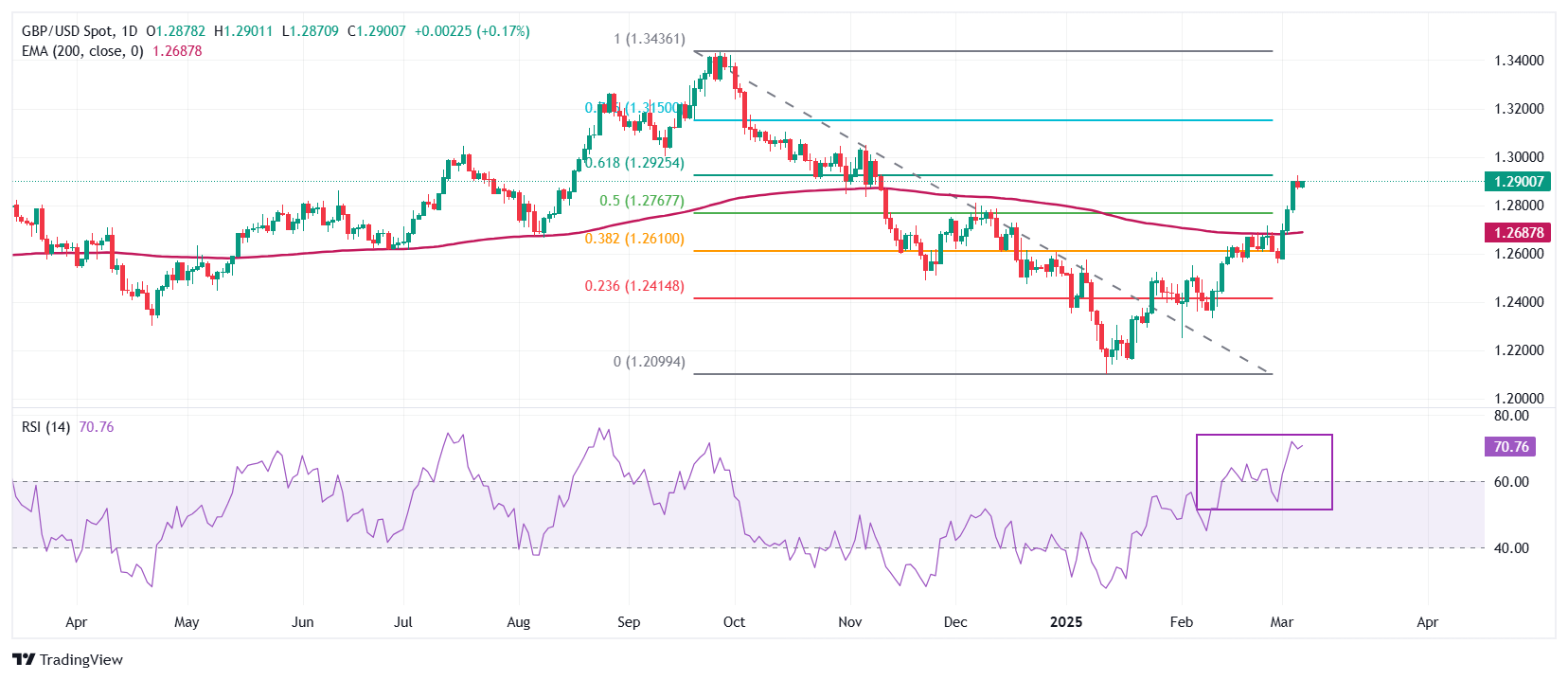
The Pound Sterling gathers strength to break above the 61.8% Fibonacci retracement plotted from the late September high to mid-January low around 1.2930 on Friday. The long-term outlook of the GBP/USD pair has turned bullish as it holds above the 200-day Exponential Moving Average (EMA), which is around 1.2688.
The 14-day Relative Strength Index (RSI) climbs above 60.00, suggesting a strong bullish momentum.
Looking down, the 50% Fibo retracement at 1.2767 and the 38.2% Fibo retracement at 1.2608 will act as key support zones for the pair. On the upside, the psychological 1.3000 level will act as a key resistance zone.
Economic Indicator
Nonfarm Payrolls
The Nonfarm Payrolls release presents the number of new jobs created in the US during the previous month in all non-agricultural businesses; it is released by the US Bureau of Labor Statistics (BLS). The monthly changes in payrolls can be extremely volatile. The number is also subject to strong reviews, which can also trigger volatility in the Forex board. Generally speaking, a high reading is seen as bullish for the US Dollar (USD), while a low reading is seen as bearish, although previous months' reviews and the Unemployment Rate are as relevant as the headline figure. The market's reaction, therefore, depends on how the market assesses all the data contained in the BLS report as a whole.
Read more.Last release: Fri Mar 07, 2025 13:30
Frequency: Monthly
Actual: 151K
Consensus: 160K
Previous: 143K
Source: US Bureau of Labor Statistics
America’s monthly jobs report is considered the most important economic indicator for forex traders. Released on the first Friday following the reported month, the change in the number of positions is closely correlated with the overall performance of the economy and is monitored by policymakers. Full employment is one of the Federal Reserve’s mandates and it considers developments in the labor market when setting its policies, thus impacting currencies. Despite several leading indicators shaping estimates, Nonfarm Payrolls tend to surprise markets and trigger substantial volatility. Actual figures beating the consensus tend to be USD bullish.
Author

Sagar Dua
FXStreet
Sagar Dua is associated with the financial markets from his college days. Along with pursuing post-graduation in Commerce in 2014, he started his markets training with chart analysis.
















