Pound Sterling trades firmly as Fed rate cut in September looks likely
- The Pound Sterling exhibits strength against the US Dollar near 1.3300 as soft US NFP data on Friday boosted Fed dovish bets.
- The US economy added 73K fresh workers in July, lower than estimates of 110K.
- Investors expect the BoE to cut interest rates on Thursday.

The Pound Sterling (GBP) holds onto Friday’s gains around 1.3300 against the US Dollar (USD) during the European trading session on Monday. The GBP/USD pair shows strength as the US Dollar (USD) licks its wounds following the sharp decline registered on Friday after the release of the United States (US) Nonfarm Payrolls (NFP) data for July.
At the time of writing, the US Dollar Index (DXY), which tracks the Greenback’s value against six major currencies, trades close to Friday’s low of around 98.60.
The US NFP report showed that labor market conditions have cooled down significantly. According to the report, the economy created fresh 73K jobs, significantly lower than expectations of 110K. Also, employment figures for June and May were revised down sharply. The Unemployment Rate accelerated to 4.2%, as expected, from the previous 4.1%.
Cooling labor market conditions have paved the way for interest rate cuts by the Federal Reserve (Fed) in the September policy meeting. According to the CME FedWatch tool, the probability of the Fed cutting interest rates next month has increased to 80.8% from the 41.2% seen on Thursday, a day before the release of the NFP data.
Meanwhile, the sudden resignation of Fed Governor Adriana Kugler has also increased hopes that the Fed could resume its monetary-easing cycle from September. Market experts believe that decisions from the new Governor appointed by US President Trump to replace Kugler will be biased towards his economic agenda.
"Kugler’s resignation allows the president to further shape the FOMC (Federal Open Market Committee) in his own image,” analysts at Harris Financial Group said, Reuters reports.
US Dollar PRICE Today
The table below shows the percentage change of US Dollar (USD) against listed major currencies today. US Dollar was the weakest against the New Zealand Dollar.
| USD | EUR | GBP | JPY | CAD | AUD | NZD | CHF | |
|---|---|---|---|---|---|---|---|---|
| USD | 0.16% | -0.13% | 0.18% | -0.01% | -0.02% | -0.14% | 0.27% | |
| EUR | -0.16% | -0.24% | 0.03% | -0.16% | -0.31% | -0.30% | 0.10% | |
| GBP | 0.13% | 0.24% | 0.27% | 0.08% | -0.08% | -0.07% | 0.34% | |
| JPY | -0.18% | -0.03% | -0.27% | -0.19% | -0.35% | -0.32% | 0.26% | |
| CAD | 0.00% | 0.16% | -0.08% | 0.19% | -0.17% | -0.13% | 0.26% | |
| AUD | 0.02% | 0.31% | 0.08% | 0.35% | 0.17% | 0.01% | 0.42% | |
| NZD | 0.14% | 0.30% | 0.07% | 0.32% | 0.13% | -0.01% | 0.39% | |
| CHF | -0.27% | -0.10% | -0.34% | -0.26% | -0.26% | -0.42% | -0.39% |
The heat map shows percentage changes of major currencies against each other. The base currency is picked from the left column, while the quote currency is picked from the top row. For example, if you pick the US Dollar from the left column and move along the horizontal line to the Japanese Yen, the percentage change displayed in the box will represent USD (base)/JPY (quote).
Daily digest market movers: Pound Sterling trades mixed, focus shifts to BoE's policy
- The Pound Sterling demonstrates a mixed performance against its major peers at the start of the week. Investors brace for a volatile week for the British currency as the Bank of England (BoE) is scheduled to announce its monetary policy decision on Thursday.
- Traders are almost fully pricing in a 25 basis points (bps) interest rate reduction by the BoE this week, according to a report from Reuters. The BoE is seen performing a delicate balancing act while guiding the interest rate outlook amid escalating price pressures and cooling labor market conditions.
- Employment data for the three-months ending May and the Consumer Price Index (CPI) data for June showed a slower hiring trend and a higher-than-expected increase in headline and core inflation.
- This week, investors will also focus on the revised S&P Composite and Services PMI data for July, which are scheduled to be released on Tuesday. The preliminary estimates showed that the Composite PMI stood at 51.0, signaling that the economy grew at a moderate pace.
- On Tuesday, investors will also focus on the US revised S&P Global and ISM Services PMI data for July. The ISM Services PMI is seen ticking up to 51.5 from 50.8 in June.
- Meanwhile, US President Trump's firing of Bureau of Labor Statistics (BLS) Commissioner Erika McEntarfer has raised doubts over the credibility of the US data among investors. On Friday, Trump fired McEntarfer after the release of the NFP report for "faking job numbers".
Technical Analysis: Pound Sterling stays below 20-day EMA
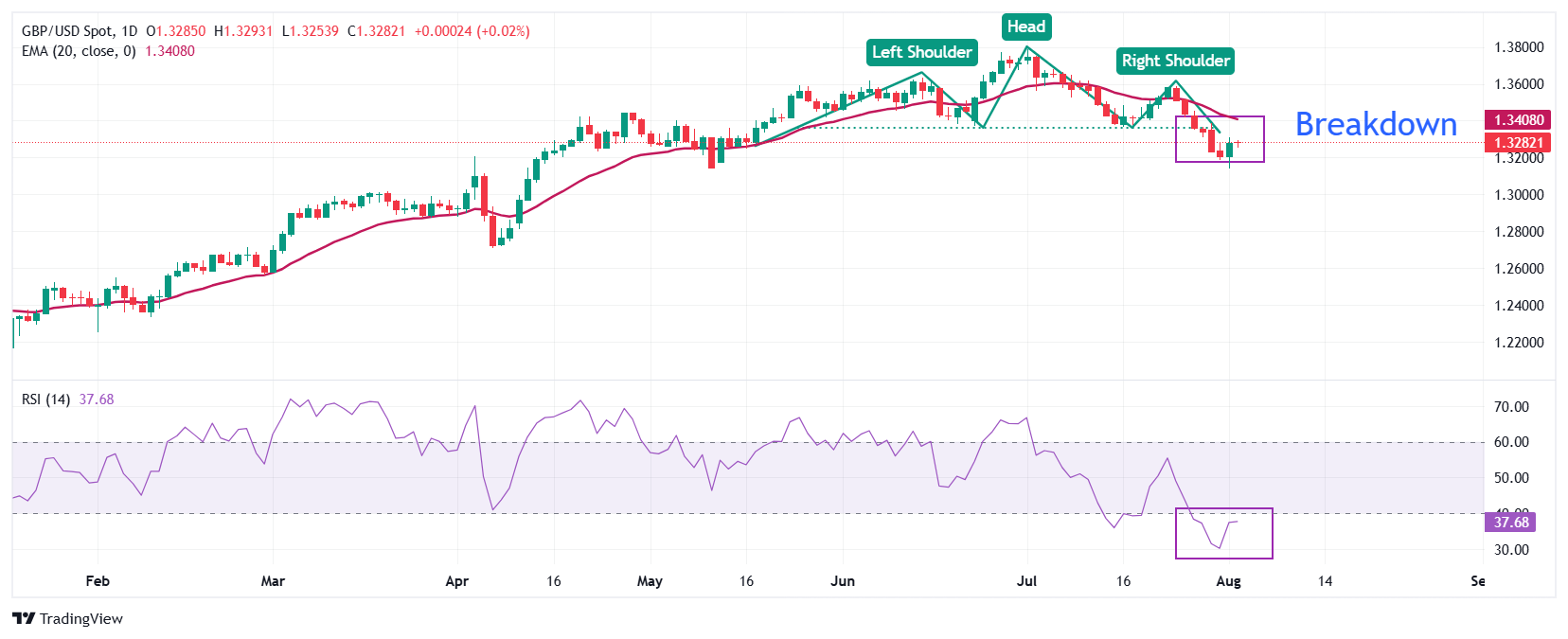
The Pound Sterling holds near 1.3300 against the US Dollar on Monday. However, the outlook of the pair remains bearish as the breakdown from the Head and Shoulders (H&S) chart pattern remains intact and the 20-day Exponential Moving Average (EMA) slopes downwards to near 1.3400. The neckline of the H&S pattern is plotted around 1.3360.
The 14-day Relative Strength Index (RSI) oscillates below 40.00, almost reaching oversold levels, indicating that the bearish momentum is intact.
Looking down, the May 12 low of 1.3140 will act as a key support zone. On the upside, the July 30 high near 1.3385 will act as a key barrier.
Economic Indicator
BoE Interest Rate Decision
The Bank of England (BoE) announces its interest rate decision at the end of its eight scheduled meetings per year. If the BoE is hawkish about the inflationary outlook of the economy and raises interest rates it is usually bullish for the Pound Sterling (GBP). Likewise, if the BoE adopts a dovish view on the UK economy and keeps interest rates unchanged, or cuts them, it is seen as bearish for GBP.
Read more.Next release: Thu Aug 07, 2025 11:00
Frequency: Irregular
Consensus: 4%
Previous: 4.25%
Source: Bank of England
Author

Sagar Dua
FXStreet
Sagar Dua is associated with the financial markets from his college days. Along with pursuing post-graduation in Commerce in 2014, he started his markets training with chart analysis.














