Pound Sterling outperforms US Dollar as US inflation cools down
- The Pound Sterling jumps to near 1.3350 against the US Dollar as the Greenback suffers after soft US inflation data for April.
- The US headline CPI grew by 2.3%, the lowest level in over four years.
- Investors await the flash Q1 UK GDP data scheduled for Thursday for further cues about the health of the economy.

The Pound Sterling (GBP) gains further to near 1.3350 against the US Dollar (USD) in Wednesday’s North American session. The GBP/USD pair extends Tuesday's recovery move as the US Dollar retraces further after the release of the softer-than-expected United States (US) Consumer Price Index (CPI) data for April on Tuesday.
US headline inflation fell to 2.3% year-on-year, the lowest level seen since February 2021. The core CPI – which excludes volatile food and energy prices – grew steadily by 2.8%, as expected. On month, both headline and core CPI grew at a slower pace of 0.2%.
Technically, signs of cooling inflationary pressures should lead traders to support bets of an interest-rate cut by the Federal Reserve (Fed). However, market expectations for the Fed to leave interest rates steady in the July meeting have not diverged even an inch from the levels seen on Monday, a day prior to the release of US inflation data.
According to the CME FedWatch tool, the probability for the Fed to keep interest rates in the current range of 4.25%-4.50% in July remained steady at 61.4%. However, it is up significantly from 29.8% seen last week after the US and China announced a substantial reduction in tariffs.
Investors have taken the agreement with China as a favorable event for the US economic outlook, forcing them to delay expectations for interest rate cuts and offsetting the effects of declining inflation. Meanwhile, US President Donald Trump continues to endorse the need for rate cuts, strengthening his argument in the wake of falling prices of significant goods.
"No Inflation, and Prices of Gasoline, Energy, Groceries, and practically everything else, are DOWN!!! THE FED must lower the RATE, like Europe and China have done," Trump said on Truth Social. Trump criticized Fed Chair Jerome Powell for not lowering interest rates: "What is wrong with Too Late Powell? Not fair to America, which is ready to blossom? Just let it all happen, it will be a beautiful thing!” Trump added.
Daily digest market movers: Pound Sterling trades mixed ahead of UK Q1 GDP
- The Pound Sterling demonstrates a mixed performance against its major peers on Wednesday as investors reassess market expectations for the Bank of England’s (BoE) monetary policy outlook for the remainder of the year after the release of the labor market data for the three months ending March on Tuesday.
- The data showed lower job growth, a higher Unemployment Rate, and slowing wage growth. It seems that businesses lightened their hiring process ahead of an increase in employers’ contributions to social security schemes that came into effect in April.
- Meanwhile, moderate growth in Average Earnings data is expected to provide relief to BoE officials. Policymakers pay close attention to the wage growth data as it is a major driver of inflation in the services sector, a key factor behind persistent United Kingdom (UK) price pressures.
- Despite increasing hopes of cooling price pressures, BoE Chief Economist Huw Pill warned on Tuesday that inflation could continue to prove stronger-than-expected, which might strengthen the need to maintain interest rates higher. “I remain concerned that we have seen a sort of structural change in price and wage-setting behaviour, maybe driven by the type of things that were involved in models of the inflation process from the ’70s and ’80s," Pill said in a conference at the London School of Economics, Reuters reported.
- Going forward, the major trigger for the Pound Sterling will be the preliminary UK Q1 Gross Domestic Product (GDP) and factory data, which will be released on Thursday. The UK economy is expected to have expanded by 0.6% in the first quarter of the year, faster than the 0.1% growth seen in the last quarter of 2024.
Technical Analysis: Pound Sterling stays above 1.3300
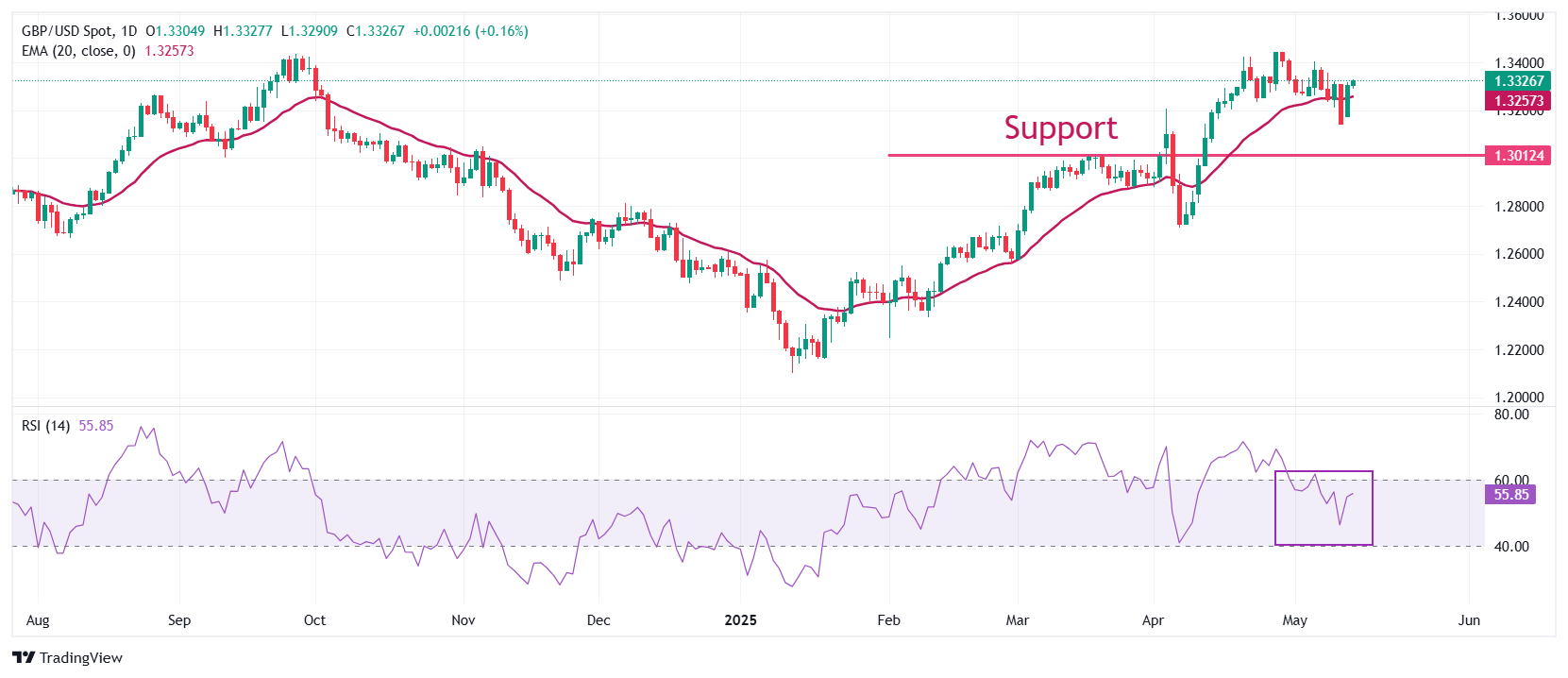
The Pound Sterling gains to near 1.3350 against the US Dollar on Wednesday. The GBP/USD pair returns above the 20-day Exponential Moving Average (EMA), which trades around 1.3255, suggesting that the trend has turned bullish again.
The 14-day Relative Strength Index (RSI) oscillates inside the 40.00-60.00 range. A fresh bullish momentum would appear if the RSI breaks above 60.00.
On the upside, the three-year high of 1.3445 will be a key hurdle for the pair. Looking down, the psychological level of 1.3000 will act as a major support area.
BoE FAQs
The Bank of England (BoE) decides monetary policy for the United Kingdom. Its primary goal is to achieve ‘price stability’, or a steady inflation rate of 2%. Its tool for achieving this is via the adjustment of base lending rates. The BoE sets the rate at which it lends to commercial banks and banks lend to each other, determining the level of interest rates in the economy overall. This also impacts the value of the Pound Sterling (GBP).
When inflation is above the Bank of England’s target it responds by raising interest rates, making it more expensive for people and businesses to access credit. This is positive for the Pound Sterling because higher interest rates make the UK a more attractive place for global investors to park their money. When inflation falls below target, it is a sign economic growth is slowing, and the BoE will consider lowering interest rates to cheapen credit in the hope businesses will borrow to invest in growth-generating projects – a negative for the Pound Sterling.
In extreme situations, the Bank of England can enact a policy called Quantitative Easing (QE). QE is the process by which the BoE substantially increases the flow of credit in a stuck financial system. QE is a last resort policy when lowering interest rates will not achieve the necessary result. The process of QE involves the BoE printing money to buy assets – usually government or AAA-rated corporate bonds – from banks and other financial institutions. QE usually results in a weaker Pound Sterling.
Quantitative tightening (QT) is the reverse of QE, enacted when the economy is strengthening and inflation starts rising. Whilst in QE the Bank of England (BoE) purchases government and corporate bonds from financial institutions to encourage them to lend; in QT, the BoE stops buying more bonds, and stops reinvesting the principal maturing on the bonds it already holds. It is usually positive for the Pound Sterling.
Author

Sagar Dua
FXStreet
Sagar Dua is associated with the financial markets from his college days. Along with pursuing post-graduation in Commerce in 2014, he started his markets training with chart analysis.