Pound Sterling corrects below 1.3200 against US Dollar after upbeat US Q2 GDP
- The Pound Sterling declines to near 1.3150 against the US Dollar after the US Q2 GDP upwardly revised to 3%.
- Traders focus on US core PCE inflation data for July as it can influence market speculation about the Fed’s rate cut size.
- Investors see the BoE delivering one more interest rate cut this year.

The Pound Sterling (GBP) weakens against the US Dollar (USD) and declines below the key support of 1.3200 in Thursday’s New York session. The GBP/USD pair slumps as the US Dollar (USD) extends its Wednesday's recovery move on an upbeat second estimate of the United States (US) Q2 Gross Domestic Product (GDP) data. The US Dollar Index (DXY), which tracks the Greenback’s value against six major currencies, rises further to near 101.40.
The revised US Q2 GDP report showed that the US economy expanded at a faster pace of 3% against a preliminary estimate of 2.8% on an annualized basis. An upbeat US GDP report has diminished recession fears, prompted after the Nonfarm Payrolls (NFP) report for July showed that labor demand slowed sharply and the Unemployment Rate rose significantly.
Meanwhile, US Initial Jobless Claims for the week ending August 23 came in at 231K, close to estimates of 232K, and the former release of 233K, upwardly revised from 232K.
However, the Greenback will likely struggle to hold to its recent rebound as the Federal Reserve (Fed) is almost certain to begin reducing interest rates from the September meeting. While traders are split over whether the Fed will start the policy-easing spell with a 25 or a 50-basis-points (bps) cut, the rate reduction is fully priced in.
Firm speculation for the Fed to start cutting interest rates from September is driven by Fed Chair Jerome Powell’s dovish commentary on interest rates at the Jackson Hole (JH) Symposium held last week. Powell said that “the time has come for policy to adjust,” highlighting that the US central bank is now more worried about downside risks to the labor market as inflation looks on track to return to the desired rate of 2%.
Going forward, investors will focus on the United States (US) Personal Consumption Expenditure Price Index (PCE) report for July, which will be published on Friday. The PCE report is expected to show that year-on-year core inflation rose at a faster pace of 2.7% from 2.6% in June, with monthly figures growing steadily by 0.2%. The inflation data could significantly influence market speculation for the Federal Reserve’s (Fed) September monetary policy decision.
Daily digest market movers: Pound Sterling falls sharply against US Dollar
- The Pound Sterling delivers a mixed performance against its major peers in North American trading hours. The British currency is weaker against Asia-Pacific currencies and strongest against European currencies on Thursday. The Euro faces the heat of rising European Central Bank (ECB) September rate cuts bets, which are prompted by slowing inflation in Spain and six important states of Germany.
- The British currency remains broadly firm as the Bank of England (BoE) is expected to follow a gradual policy-easing cycle, given that the victory over the United Kingdom (UK) inflation isn’t certain.
- BoE Governor Andrew Bailey signaled in his speech at the JH Symposium on Friday that the second-round effects of inflationary pressures would be smaller than expected, but also said that the UK central bank should not rush for more interest rate cuts, Reuters reported. The BoE would "be careful not to cut interest rates too quickly or by too much," Bailey said.
- BoE officials have been reluctant to offer a preset rate-cut path as inflation in the service sector has remained higher due to wage pressures. Going forward, the Pound Sterling will be guided by market expectations for BoE rate cuts for the remainder of the year amid the absence of top-tier economic data this week. Markets expect the BoE to cut its borrowing rates one more time this year.
British Pound PRICE Today
The table below shows the percentage change of British Pound (GBP) against listed major currencies today. British Pound was the strongest against the Swiss Franc.
| USD | EUR | GBP | JPY | CAD | AUD | NZD | CHF | |
|---|---|---|---|---|---|---|---|---|
| USD | 0.31% | 0.23% | 0.58% | -0.03% | -0.20% | -0.20% | 0.52% | |
| EUR | -0.31% | -0.09% | 0.26% | -0.36% | -0.52% | -0.52% | 0.21% | |
| GBP | -0.23% | 0.09% | 0.34% | -0.26% | -0.43% | -0.42% | 0.35% | |
| JPY | -0.58% | -0.26% | -0.34% | -0.59% | -0.78% | -0.80% | -0.02% | |
| CAD | 0.03% | 0.36% | 0.26% | 0.59% | -0.17% | -0.17% | 0.60% | |
| AUD | 0.20% | 0.52% | 0.43% | 0.78% | 0.17% | 0.03% | 0.78% | |
| NZD | 0.20% | 0.52% | 0.42% | 0.80% | 0.17% | -0.03% | 0.76% | |
| CHF | -0.52% | -0.21% | -0.35% | 0.02% | -0.60% | -0.78% | -0.76% |
The heat map shows percentage changes of major currencies against each other. The base currency is picked from the left column, while the quote currency is picked from the top row. For example, if you pick the British Pound from the left column and move along the horizontal line to the US Dollar, the percentage change displayed in the box will represent GBP (base)/USD (quote).
Technical Analysis: Pound Sterling falls below 1.3200
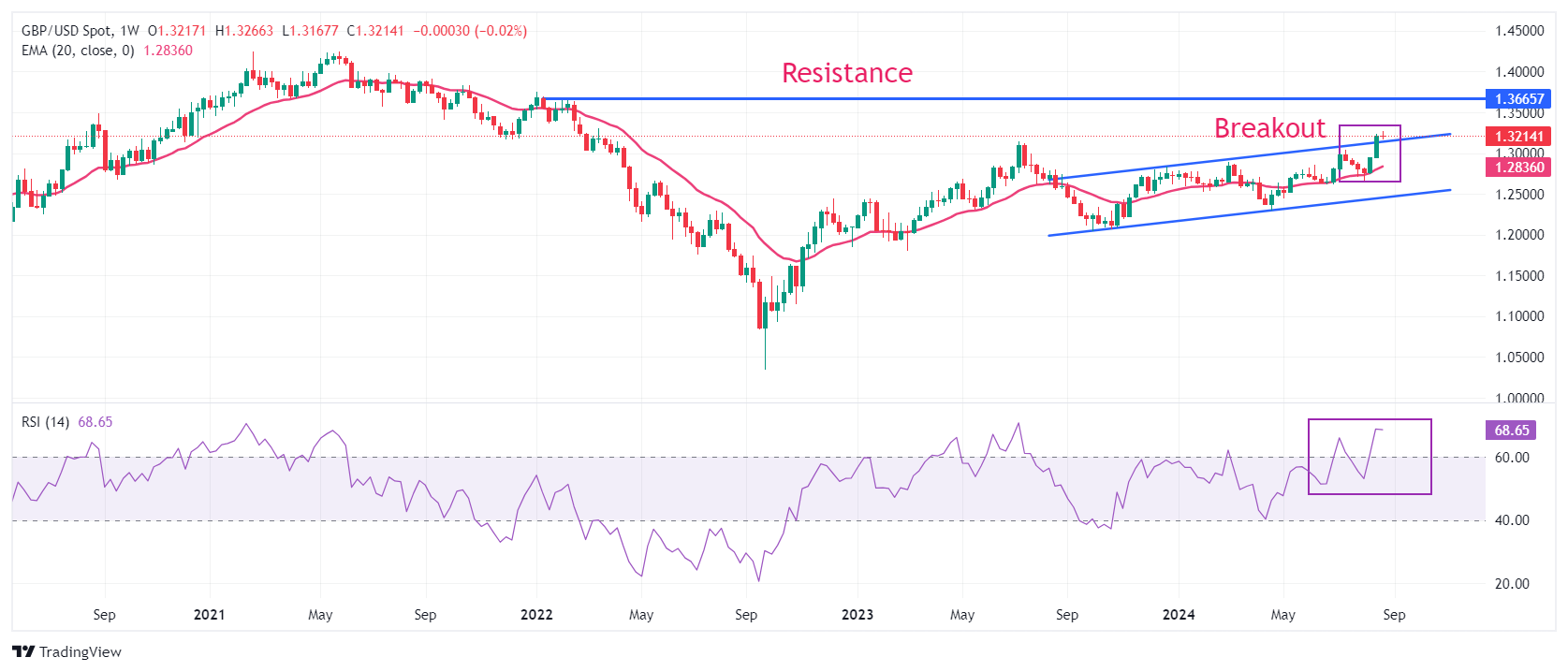
The Pound Sterling drops below the immediate support of 1.3200 against the US Dollar. The near-term appeal of the GBP/USD pair remains firm as it clings the breakout of the Rising Channel chart formation on the weekly time frame. If bullish momentum resumes, the Cable is expected to extend its upside towards the psychological resistance of 1.3500 and the February 4, 2022, high of 1.3640 after breaking above a fresh two-and-a-half-year high of 1.3266 against the US Dollar.
The upward-sloping 20-week Exponential Moving Average (EMA) near 1.3000 suggests a strong upside trend.
The 14-period Relative Strength Index (RSI) oscillates in the bullish range of 60.00-80.00, suggesting a strong upside momentum. Still, it has reached overbought levels at around 70.00, increasing the chances of a corrective pullback. On the downside, the psychological level of 1.3000 will be the crucial support for the Pound Sterling bulls.
Interest rates FAQs
Interest rates are charged by financial institutions on loans to borrowers and are paid as interest to savers and depositors. They are influenced by base lending rates, which are set by central banks in response to changes in the economy. Central banks normally have a mandate to ensure price stability, which in most cases means targeting a core inflation rate of around 2%. If inflation falls below target the central bank may cut base lending rates, with a view to stimulating lending and boosting the economy. If inflation rises substantially above 2% it normally results in the central bank raising base lending rates in an attempt to lower inflation.
Higher interest rates generally help strengthen a country’s currency as they make it a more attractive place for global investors to park their money.
Higher interest rates overall weigh on the price of Gold because they increase the opportunity cost of holding Gold instead of investing in an interest-bearing asset or placing cash in the bank. If interest rates are high that usually pushes up the price of the US Dollar (USD), and since Gold is priced in Dollars, this has the effect of lowering the price of Gold.
The Fed funds rate is the overnight rate at which US banks lend to each other. It is the oft-quoted headline rate set by the Federal Reserve at its FOMC meetings. It is set as a range, for example 4.75%-5.00%, though the upper limit (in that case 5.00%) is the quoted figure. Market expectations for future Fed funds rate are tracked by the CME FedWatch tool, which shapes how many financial markets behave in anticipation of future Federal Reserve monetary policy decisions.
Author

Sagar Dua
FXStreet
Sagar Dua is associated with the financial markets from his college days. Along with pursuing post-graduation in Commerce in 2014, he started his markets training with chart analysis.