Pound Sterling gains further against US Dollar on higher US Initial Jobless Claims
- The Pound Sterling outperforms the US Dollar on cheerful market mood.
- The FOMC minutes showed on Wednesday that officials are worried about deepening upside risks to inflation.
- Investors await the UK Retail Sales report for January and the preliminary S&P Global UK/US PMI data for February, scheduled for Friday.

The Pound Sterling (GBP) moves higher slightly above 1.2600 against the US Dollar (USD) in Thursday’s North American session. The GBP/USD pair gains as the market sentiment is slightly favorable for risk-perceived currencies, with investors gaining confidence over the potential Russia-Ukraine truce has also improved the market mood.
United States (US) President Donald Trump has confirmed that he will hold more talks on a Russia-Ukraine peace deal after discussing the issue with Russian diplomats in Saudi Arabia without including Ukraine and Europe. However, Ukraine has said that it won’t agree to a deal that would be made on its behalf.
Meanwhile, higher-than-expected Initial Jobless Claims for the week ending February 14 have further weighed on the US Dollar. Individuals claiming jobless benefits for the first time came in higher at 219K than estimates of 215K.
However, the outlook for the US Dollar still seems upbeat on the monetary policy front. The Federal Open Market Committee (FOMC) minutes for the January meeting showed on Wednesday that officials are expected to keep interest rates in the current range of 4.25%-4.50% for longer.
Fed policymakers were more concerned about the upside risks to inflation due to Trump’s potential tariff policies than risks to the labor market. The FOMC Minutes also indicated that business owners plan to pass on the impact of higher input costs to consumers. Even though tariffs on critical imports would boost local production, those products won’t be competitive in terms of manufacturing cost, given the higher United States (US) labor costs compared to those of its trading partners.
Such a scenario will boost inflationary pressures and prevent Federal Reserve (Fed) officials from continuing the monetary expansion cycle sooner, which started in September 2024.
On the global trade front, Donald Trump announced that a trade deal with China is “possible.” His comments were optimistic even though he announced 10% tariffs on all imports from the Asian country earlier this month. On Tuesday, Trump also announced that he is planning to impose 25% tariffs on imports of foreign cars, pharmaceuticals and semiconductors. There is no detailed plan for all tariff threats, which he has announced till now.
Daily digest market movers: Pound Sterling trades cautiously as BoE Bailey sees sluggish UK economic outlook
- The Pound Sterling trades with caution against its major peers, with investors remaining concerned over the United Kingdom’s (UK) economic outlook. Bank of England (BoE) Governor Andrew Bailey warned this week that the economic growth is expected to remain sluggish and sees the labor market softening.
- The British currency attempted to gain ground after the release of a hotter-than-expected UK Consumer Price Index (CPI) report for January on Wednesday but failed to do so. Governor Bailey had already cautioned that a short-term uptick in inflation is expected due to volatile energy prices, but that won’t be persistent.
- Year-on-year headline CPI rose by 3%, faster than estimates of 2.8% and the December reading of 2.5%. In the same period, the core CPI – which excludes volatile components of food, energy, alcohol, and tobacco – grew by 3.7%, as expected, faster than the former reading of 3.2%.
- Though the acceleration in inflationary pressures should be temporary, it will not allow the BoE to ease monetary policy further. The central bank reduced its borrowing rates by 25 basis points (bps) to 4.5% in its policy meeting, which took place on February 6 but guided a cautious policy easing outlook.
- Going forward, investors will focus on the UK Retail Sales data for January, and the flash S&P Global UK/US Purchasing Managers Index (PMI) report for February, which will be released on Friday.
British Pound PRICE Today
The table below shows the percentage change of British Pound (GBP) against listed major currencies today. British Pound was the strongest against the US Dollar.
| USD | EUR | GBP | JPY | CAD | AUD | NZD | CHF | |
|---|---|---|---|---|---|---|---|---|
| USD | -0.21% | -0.21% | -0.89% | -0.14% | -0.44% | -0.52% | -0.24% | |
| EUR | 0.21% | 0.00% | -0.69% | 0.07% | -0.24% | -0.31% | -0.05% | |
| GBP | 0.21% | -0.00% | -0.68% | 0.07% | -0.25% | -0.32% | -0.03% | |
| JPY | 0.89% | 0.69% | 0.68% | 0.75% | 0.45% | 0.33% | 0.65% | |
| CAD | 0.14% | -0.07% | -0.07% | -0.75% | -0.30% | -0.39% | -0.10% | |
| AUD | 0.44% | 0.24% | 0.25% | -0.45% | 0.30% | -0.08% | 0.20% | |
| NZD | 0.52% | 0.31% | 0.32% | -0.33% | 0.39% | 0.08% | 0.28% | |
| CHF | 0.24% | 0.05% | 0.03% | -0.65% | 0.10% | -0.20% | -0.28% |
The heat map shows percentage changes of major currencies against each other. The base currency is picked from the left column, while the quote currency is picked from the top row. For example, if you pick the British Pound from the left column and move along the horizontal line to the US Dollar, the percentage change displayed in the box will represent GBP (base)/USD (quote).
Technical Analysis: Pound Sterling sees more upside above100-day EMA
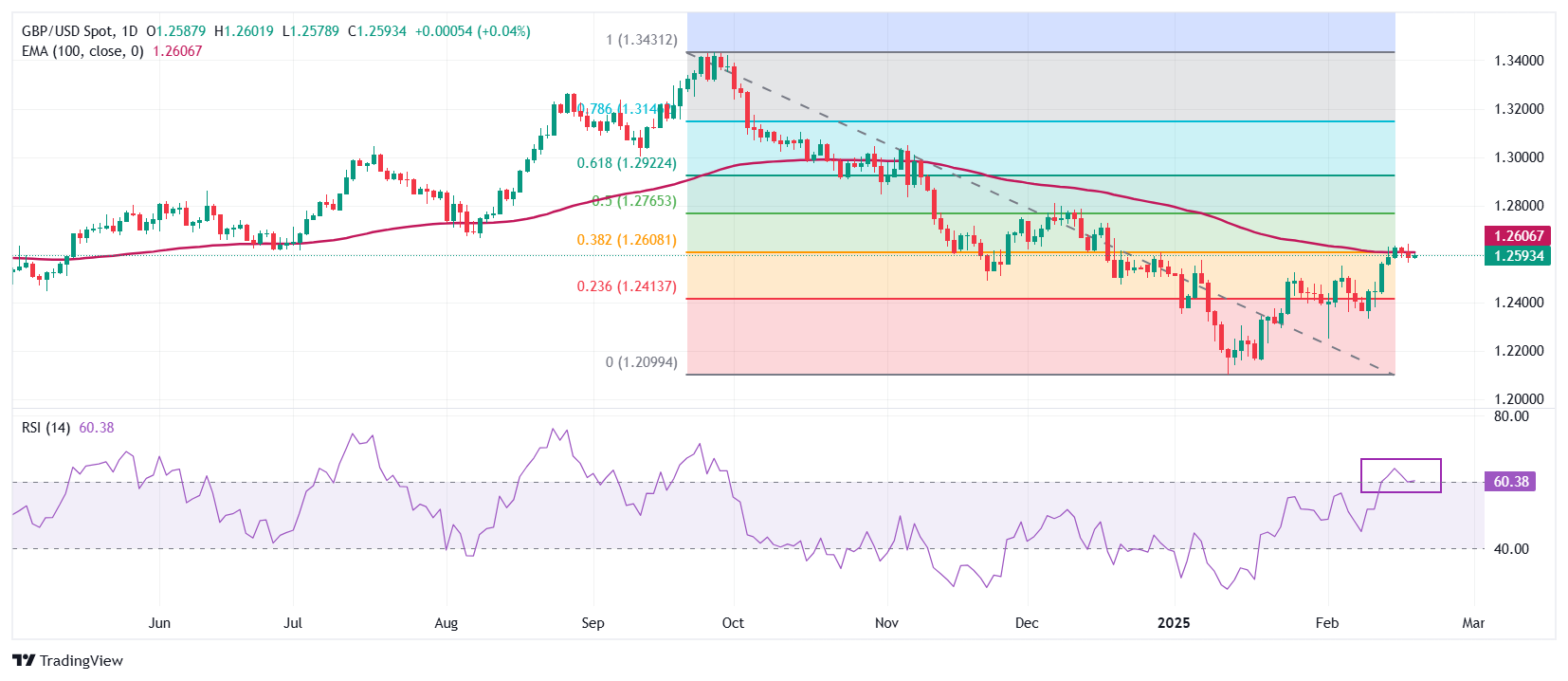
The Pound Sterling advances to near 1.2620 against the US Dollar in North American trading hours on Thursday. The GBP/USD pair strives to break above the 38.2% Fibonacci retracement from the end-September high to the mid-January low downtrend, which coincides with the 100-day Exponential Moving Average (EMA), around 1.2620.
The 14-day Relative Strength Index (RSI) struggles to hold above 60.00. The bullish momentum would fizzle out if the RSI (14) fails to sustain above that level.
Looking down, the February 3 low of 1.2250 will act as a key support zone for the pair. On the upside, the 50% Fibonacci retracement at 1.2767 will act as a key resistance zone.
Economic Indicator
Initial Jobless Claims
The Initial Jobless Claims released by the US Department of Labor is a measure of the number of people filing first-time claims for state unemployment insurance. A larger-than-expected number indicates weakness in the US labor market, reflects negatively on the US economy, and is negative for the US Dollar (USD). On the other hand, a decreasing number should be taken as bullish for the USD.
Read more.Last release: Thu Feb 20, 2025 13:30
Frequency: Weekly
Actual: 219K
Consensus: 215K
Previous: 213K
Source: US Department of Labor
Every Thursday, the US Department of Labor publishes the number of previous week’s initial claims for unemployment benefits in the US. Since this reading could be highly volatile, investors may pay closer attention to the four-week average. A downtrend is seen as a sign of an improving labour market and could have a positive impact on the USD’s performance against its rivals and vice versa.
Author

Sagar Dua
FXStreet
Sagar Dua is associated with the financial markets from his college days. Along with pursuing post-graduation in Commerce in 2014, he started his markets training with chart analysis.

















