Pound Sterling gives up gains against USD after US NFP release
- The Pound Sterling falls back to near 1.2400 against the USD after the release of the US NFP data for January.
- US labor demand remained weak, while Average Hourly Earnings surprisingly accelerated.
- BoE’s Catherine Mann surprisingly supported a bigger interest rate reduction of 50 bps.

The Pound Sterling (GBP) surrenders its entire intraday gains against the US Dollar (USD) falls back to near 1.2400 in Friday’s North American session after the release of the United States (US) Nonfarm Payrolls (NFP) data for January. The US NFP report showed that the economy added 143K workers in January, significantly lower than estimates of 170K and the former release of 307K, upwardly revised from 256K. The Unemployment Rate decelerates to 4% from the estimates and the prior reading of 4.1%.
Average Hourly Earnings data, a key measure of wage growth that drives consumer spending, came in surprisingly higher than expectations. The wage growth measure rose at a faster pace of 4.1% year-on-year, compared to 3.9% growth in December. Economists estimated the Average Hourly Earnings data to have decelerated to 3.8%. On month, the wage growth measure rose at a robust pace of 0.5% against estimates and the prior reading of 0.3%.
Strong wage growth data indicates a hot inflation outlook, which is likely to force Federal Reserve (Fed) officials to hold interest rates for longer. Last week, Fed Chair Jerome Powell also said that monetary policy adjustments won’t be appropriate until the central bank sees “real progress in inflation or at least some weakness in labor market”.
The US Dollar Index (DXY), which tracks the Greenback’s value against six major currencies, rises to near 108.00.
Meanwhile, the uncertainty over US President Donald Trump’s tariff agenda will also keep investors on their toes. Market participants expect President Trump to target Europe next for imposing tariffs.
Daily digest market movers: Pound Sterling stabilizes after Thursday's sell-off
- The Pound Sterling strives to gain ground against its major peers on Friday after a sharp sell-off on Thursday. The British currency discovers some buying interest as investors start digesting the outcome of the Bank of England’s (BoE) policy meeting. Investors dumped the British currency the prior day after the BoE meeting in which the central bank reduced interest rates by 25 basis points (bps) to 4.5% and revised the Gross Domestic Product (GDP) forecast for the year to 0.75%, lower from 1.5% projected in November.
- Investors had anticipated a 25 bps interest rate reduction, with an 8-1 vote split, but all officials supported easing the monetary policy further. However, the notable reason behind the sharp sell-off in the Pound Sterling was Monetary Policy Committee (MPC) member Catherine Mann, an outspoken hawk, joining official Swati Dhingra and favoring a bigger rate cut of 50 bps. This scenario indicates how much policymakers are concerned about the economic outlook.
- BoE Governor Andrew Bailey guided a cautious and gradual rate cut approach and warned that, due to higher energy prices, inflation could temporarily rise to near 3.7% in the third quarter of the year before falling back to the 2% path.
- BoE’s interest rate cut decision is expected to bring a big relief to the United Kingdom (UK) Chancellor of the Exchequer Rache Reeves, as it will stimulate economic growth. Still, downwardly revised GDP growth appears to be a wake-up call for her. Last week, Reeves was very optimistic about her economic plans, including a new runway at Heathrow Airport.
Technical Analysis: Pound Sterling faces pressure near 50-day EMA
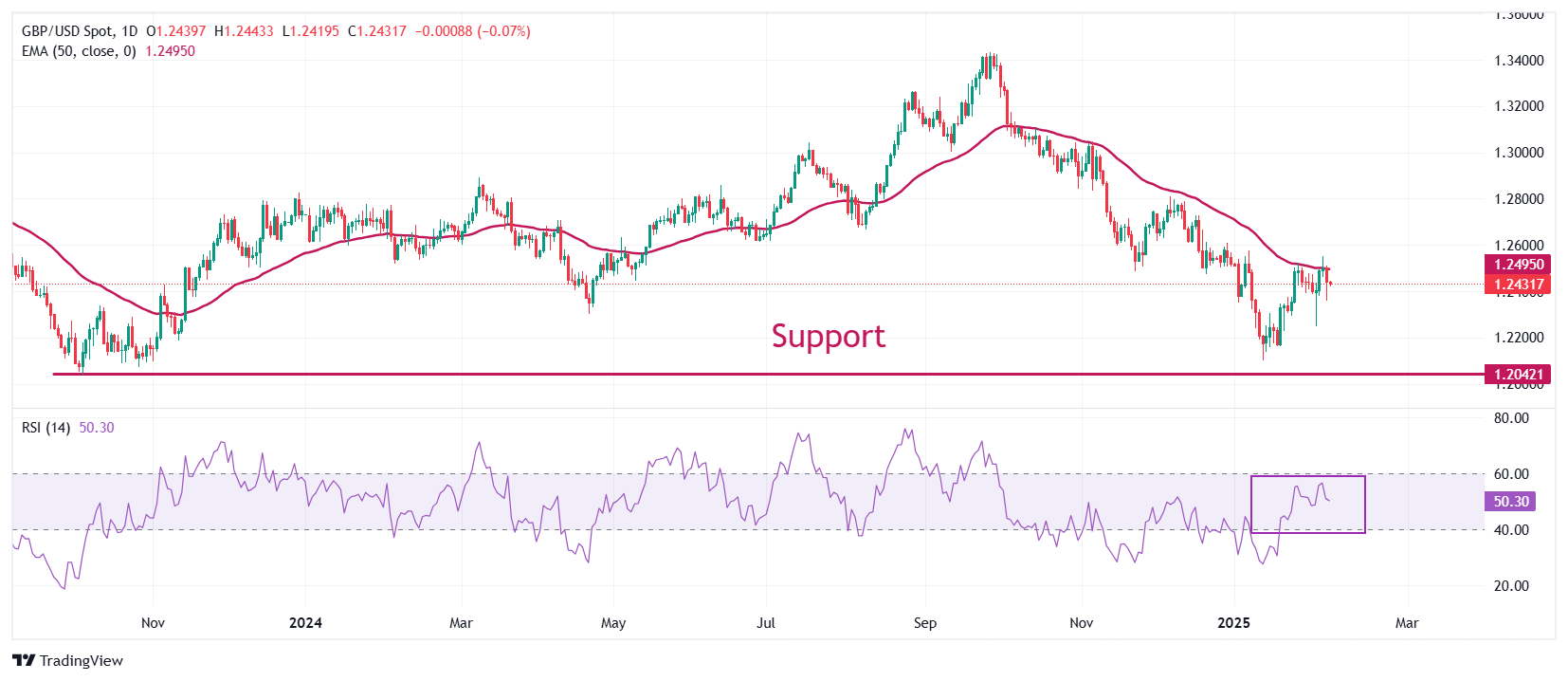
The Pound Sterling trades cautiously near 1.2400 against the US Dollar on Friday. The outlook of the GBP/USD pair remains weak as the 50-day Exponential Moving Average (EMA) continues to act as a resistance at around 1.2500.
The 14-day Relative Strength Index (RSI) oscillates inside the 40.00-60.00 range, suggesting a sideways trend.
Looking down, the January 13 low of 1.2100 and the October 2023 low of 1.2050 will be key support zones for the pair. On the upside, the December 30 high of 1.2607 will act as key resistance.
Nonfarm Payrolls FAQs
Nonfarm Payrolls (NFP) are part of the US Bureau of Labor Statistics monthly jobs report. The Nonfarm Payrolls component specifically measures the change in the number of people employed in the US during the previous month, excluding the farming industry.
The Nonfarm Payrolls figure can influence the decisions of the Federal Reserve by providing a measure of how successfully the Fed is meeting its mandate of fostering full employment and 2% inflation. A relatively high NFP figure means more people are in employment, earning more money and therefore probably spending more. A relatively low Nonfarm Payrolls’ result, on the either hand, could mean people are struggling to find work. The Fed will typically raise interest rates to combat high inflation triggered by low unemployment, and lower them to stimulate a stagnant labor market.
Nonfarm Payrolls generally have a positive correlation with the US Dollar. This means when payrolls’ figures come out higher-than-expected the USD tends to rally and vice versa when they are lower. NFPs influence the US Dollar by virtue of their impact on inflation, monetary policy expectations and interest rates. A higher NFP usually means the Federal Reserve will be more tight in its monetary policy, supporting the USD.
Nonfarm Payrolls are generally negatively-correlated with the price of Gold. This means a higher-than-expected payrolls’ figure will have a depressing effect on the Gold price and vice versa. Higher NFP generally has a positive effect on the value of the USD, and like most major commodities Gold is priced in US Dollars. If the USD gains in value, therefore, it requires less Dollars to buy an ounce of Gold. Also, higher interest rates (typically helped higher NFPs) also lessen the attractiveness of Gold as an investment compared to staying in cash, where the money will at least earn interest.
Nonfarm Payrolls is only one component within a bigger jobs report and it can be overshadowed by the other components. At times, when NFP come out higher-than-forecast, but the Average Weekly Earnings is lower than expected, the market has ignored the potentially inflationary effect of the headline result and interpreted the fall in earnings as deflationary. The Participation Rate and the Average Weekly Hours components can also influence the market reaction, but only in seldom events like the “Great Resignation” or the Global Financial Crisis.
Author

Sagar Dua
FXStreet
Sagar Dua is associated with the financial markets from his college days. Along with pursuing post-graduation in Commerce in 2014, he started his markets training with chart analysis.

















