Pound Sterling slumps against US Dollar as Greenback turns positive
- The Pound Sterling rebounds marginally as the UK OBR reported that the £30 billion fiscal gap has narrowed to £20 billion.
- Weak UK economic data has supported bets of another interest-rate cut by the BoE.
- The US Bureau of Labor Statistics said it will publish delayed economic data soon, but the exact timing isn't available yet.

The Pound Sterling (GBP) trades 0.4% lower to near 1.3130 against the US Dollar (USD) during the European trading session on Friday. The GBP/USD pair faces selling pressure as the Pound Sterling remains on the back foot, and the US Dollar has recovered strongly.
At the time of writing, the US Dollar Index (DXY), which tracks the Greenback’s value against six major currencies, trades 0.15% higher to near 99.35 after recovering early losses.
However, the US Dollar is expected to remain under pressure as investors turn cautious ahead of the publication of key United States (US) economic data releases that were halted due to the government shutdown.
The US Bureau of Labor Statistics (BLS) said that it will publish the updated schedule of delayed economic data on its website soon. The release of the US economic data would significantly influence market expectations for the Federal Reserve’s (Fed) monetary policy outlook.
On Thursday, White House Economic Council Director Kevin Hassett said in an appearance on Fox News that the upcoming labour data release won’t include the Unemployment Rate data.
Meanwhile, traders have trimmed Fed dovish bets for the December policy meeting as a slew of policymakers have warned of upside inflation risks. “The Fed needs to proceed with caution now, and continue to lean against inflation," St. Louis Fed President Alberto Musalem said on Thursday.
Pound Sterling recovers slightly as UK fiscal hole narrows to £20 billion
- The Pound Sterling recovers some of its earlier losses against its major peers during the European trading session on Friday, but it is still underperforming across the board. The British currency attracts slight bids as the United Kingdom (UK) Office for Budget Responsibility (OBR) has reported that stronger receipts and robust wage performance have narrowed the £30 billion fiscal gap to £20 billion.
- A modest improvement in the UK economy's fiscal position has led to a slight decline in surging gilt yields, some recovery in the Pound Sterling, and relief for policymakers. At the time of writing, 10-year UK gilt yields have dropped to 4.51% from THEIR intraday high of 4.56%. Still, they are 1.8% higher than their previous close.
- Earlier in the day, 10-year UK gilt yields soared, weighing on the British currency, following reports from the Financial Times (FT) signaling that Prime Minister Keir Starmer and Chancellor of the Exchequer Rachel Reeves might scrap their plans to raise basic and higher tax bands in the upcoming Autumn Budget on November 26.
- The FT reported that the UK government could avoid increasing the burden on individuals and might look for other non-direct revenues to cover the £30 billion fiscal gap.
- A few weeks ago, Reeves stated that the administration might need to reconsider its election manifesto’s promise not to hike households’ taxes to fund the stopgap bill.
- The absence of tax hikes could prompt fiscal debt risks by increasing interest obligations on the government's debt.
- In the UK, intensifying expectations of an interest rate cut by the Bank of England (BoE) for the December policy meeting are also being a drag on the Pound Sterling. BoE dovish bets have accelerated following weak employment data for three months ending September and the flash Q3 Gross Domestic Product (GDP) data. The ILO Unemployment Rate jumped to 5%, while the economy expanded by a marginal 0.1%.
- Next week, investors will focus on the UK Consumer Price Index (CPI) data for October, which will be released on Wednesday.
Pound Sterling Price Today
The table below shows the percentage change of British Pound (GBP) against listed major currencies today. British Pound was the weakest against the New Zealand Dollar.
| USD | EUR | GBP | JPY | CAD | AUD | NZD | CHF | |
|---|---|---|---|---|---|---|---|---|
| USD | 0.15% | 0.36% | 0.09% | 0.07% | 0.30% | -0.34% | -0.15% | |
| EUR | -0.15% | 0.22% | -0.05% | -0.07% | 0.15% | -0.48% | -0.29% | |
| GBP | -0.36% | -0.22% | -0.28% | -0.28% | -0.06% | -0.70% | -0.51% | |
| JPY | -0.09% | 0.05% | 0.28% | 0.01% | 0.22% | -0.43% | -0.23% | |
| CAD | -0.07% | 0.07% | 0.28% | -0.01% | 0.21% | -0.41% | -0.23% | |
| AUD | -0.30% | -0.15% | 0.06% | -0.22% | -0.21% | -0.63% | -0.44% | |
| NZD | 0.34% | 0.48% | 0.70% | 0.43% | 0.41% | 0.63% | 0.19% | |
| CHF | 0.15% | 0.29% | 0.51% | 0.23% | 0.23% | 0.44% | -0.19% |
The heat map shows percentage changes of major currencies against each other. The base currency is picked from the left column, while the quote currency is picked from the top row. For example, if you pick the British Pound from the left column and move along the horizontal line to the US Dollar, the percentage change displayed in the box will represent GBP (base)/USD (quote).
Technical Analysis: Pound Sterling stays below 200-day EMA
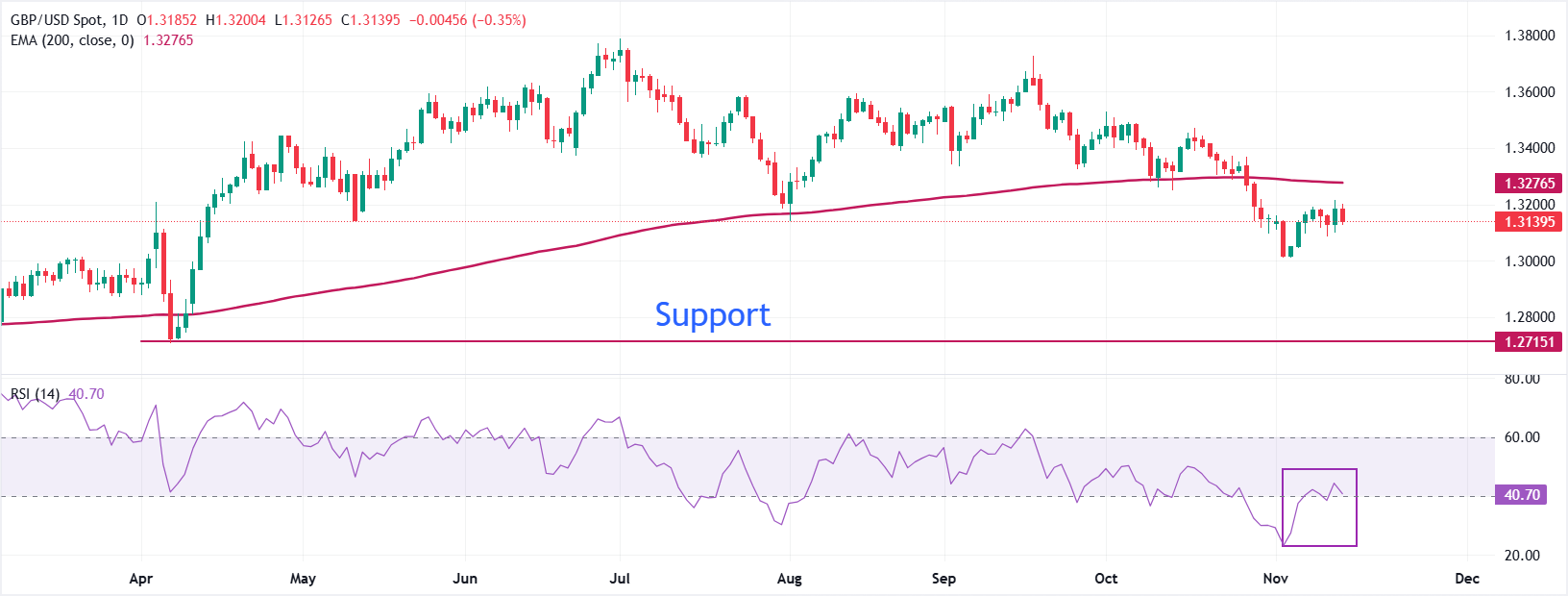
The Pound Sterling declines to near 1.3130 against the US Dollar on Friday. The overall trend of the pair remains bearish as it trades below the 200-day Exponential Moving Average (EMA), which is around 1.3276.
The 14-day Relative Strength Index (RSI) struggles to stay above 40.00. A fresh bearish momentum would emerge if the RSI resumes its downside journey.
Looking down, the April low near 1.2700 will act as a key support zone. On the upside, the October 28 high around 1.3370 will act as a key barrier.
(This story was corrected on November 14 at 08:30 GMT to say, in the second bullet, that weak economic data from the UK, not the US, has supported BoE dovish bets. It was also corrected to say that the next Federal Reserve meeting will be in December, not in October.)
UK gilt yields FAQs
UK Gilt Yields measure the annual return an investor can expect from holding UK government bonds, or Gilts. Like other bonds, Gilts pay interest to holders at regular intervals, the ‘coupon’, followed by the full value of the bond at maturity. The coupon is fixed but the Yield varies as it takes into account changes in the bond's price. For example, a Gilt worth 100 Pounds Sterling might have a coupon of 5.0%. If the Gilt's price were to fall to 98 Pounds, the coupon would still be 5.0%, but the Gilt Yield would rise to 5.102% to reflect the decline in price.
Many factors influence Gilt yields, but the main ones are interest rates, the strength of the British economy, the liquidity of the bond market and the value of the Pound Sterling. Rising inflation will generally weaken Gilt prices and lead to higher Gilt yields because Gilts are long-term investments susceptible to inflation, which erodes their value. Higher interest rates impact existing Gilt yields because newly-issued Gilts will carry a higher, more attractive coupon. Liquidity can be a risk when there is a lack of buyers or sellers due to panic or preference for riskier assets.
Probably the most important factor influencing the level of Gilt yields is interest rates. These are set by the Bank of England (BoE) to ensure price stability. Higher interest rates will raise yields and lower the price of Gilts because new Gilts issued will bear a higher, more attractive coupon, reducing demand for older Gilts, which will see a corresponding decline in price.
Inflation is a key factor affecting Gilt yields as it impacts the value of the principal received by the holder at the end of the term, as well as the relative value of the repayments. Higher inflation deteriorates the value of Gilts over time, reflected in a higher yield (lower price). The opposite is true of lower inflation. In rare cases of deflation, a Gilt may rise in price – represented by a negative yield.
Foreign holders of Gilts are exposed to exchange-rate risk since Gilts are denominated in Pound Sterling. If the currency strengthens investors will realize a higher return and vice versa if it weakens. In addition, Gilt yields are highly correlated to the Pound Sterling. This is because yields are a reflection of interest rates and interest rate expectations, a key driver of Pound Sterling. Higher interest rates, raise the coupon on newly-issued Gilts, attracting more global investors. Since they are priced in Pounds, this increases demand for Pound Sterling.
Author

Sagar Dua
FXStreet
Sagar Dua is associated with the financial markets from his college days. Along with pursuing post-graduation in Commerce in 2014, he started his markets training with chart analysis.

















