Pound Sterling drops as UK GDP growth remains stagnant in August
- The Pound Sterling drops against its major currency peers after weak UK GDP and factory data for July.
- UK GDP growth remained stagnant in August, as expected.
- US weekly Initial Jobless Claims ending September 5 came in significantly higher at 263K.

The Pound Sterling (GBP) faces selling pressure against its major currency peers on Friday after the release of the UK Gross Domestic Product (GDP) and factory data for July. The United Kingdom (UK) Office for National Statistics (ONS) reported that the economy remained stagnant in July, as expected, after rising by 0.4% in June.
Growing UK economic concerns are likely to force traders to raise bets supporting more interest rate cuts by the Bank of England (BoE) in the remainder of the year. Currently, there is a 33% chance that the BoE will reduce borrowing rates one more time this year, according to Reuters.
For fresh cues on the interest rate outlook, investors will pay close attention to the BoE’s monetary policy announcement on Thursday, in which the central bank is expected to keep borrowing rates steady at 4%. In its August monetary policy, the BoE lowered interest rates by 25 basis points (bps) and guided a “gradual and careful” monetary expansion guidance.
Meanwhile, month-on-month Manufacturing Production has declined by 1.3%, while it was expected to remain flat after rising by 0.5% in June. The Industrial Production has contracted by 0.9% MoM, which was also expected to remain flat.
The next key trigger for the Pound Sterling will be the employment data for the three months ending in July, which will be released on Tuesday.
Pound Sterling Price Today
The table below shows the percentage change of British Pound (GBP) against listed major currencies today. British Pound was the weakest against the US Dollar.
| USD | EUR | GBP | JPY | CAD | AUD | NZD | CHF | |
|---|---|---|---|---|---|---|---|---|
| USD | 0.13% | 0.27% | 0.50% | 0.06% | 0.14% | 0.38% | 0.25% | |
| EUR | -0.13% | 0.15% | 0.36% | -0.05% | 0.03% | 0.27% | 0.13% | |
| GBP | -0.27% | -0.15% | 0.22% | -0.22% | -0.16% | 0.12% | -0.02% | |
| JPY | -0.50% | -0.36% | -0.22% | -0.43% | -0.36% | -0.16% | -0.29% | |
| CAD | -0.06% | 0.05% | 0.22% | 0.43% | 0.12% | 0.34% | 0.19% | |
| AUD | -0.14% | -0.03% | 0.16% | 0.36% | -0.12% | 0.28% | 0.10% | |
| NZD | -0.38% | -0.27% | -0.12% | 0.16% | -0.34% | -0.28% | -0.14% | |
| CHF | -0.25% | -0.13% | 0.02% | 0.29% | -0.19% | -0.10% | 0.14% |
The heat map shows percentage changes of major currencies against each other. The base currency is picked from the left column, while the quote currency is picked from the top row. For example, if you pick the British Pound from the left column and move along the horizontal line to the US Dollar, the percentage change displayed in the box will represent GBP (base)/USD (quote).
US Initial Jobless Claims rose significantly in week ending September 5
- The Pound Sterling corrects to near 1.3550 against the US Dollar during European trading hours after the UK GDP data release. However, the outlook of the GBP/USD pair remains firm as the Federal Reserve (Fed) is certain to cut interest rates in the upcoming monetary policy meeting on Wednesday.
- According to the CME FedWatch tool, traders see a 7.5% chance that the Fed will cut interest rates by 50 basis points (bps) to 3.75%-4.00% on September 17, while the rest point a standard 25-bps interest rate reduction.
- Fed dovish speculation has intensified about escalating downside labor market risks. The United States (US) Department of Labor showed on Thursday that Initial Jobless Claims for the week ending in September 5 rose to 263K, the highest level seen in almost four years.
- This week, the Nonfarm Payrolls (NFP) benchmark revision report for 12 months ending on March 2025 also showed that the economy created 911K fewer jobs than had been anticipated earlier.
- Meanwhile, inflationary pressures in the US economy have accelerated further as business owners continue to pass on the impact of tariffs imposed by President Donald Trump to end consumers. The US headline Consumer Price Index (CPI) rose at an annual pace of 2.9% in August, as expected, faster than the prior reading of 2.7%.
- In Friday’s session, investors will focus on the University of Michigan's preliminary Consumer Sentiment Index and Consumer Inflation Expectations data for September, which will be published at 14:00 GMT.
Technical Analysis: Pound Sterling remains close to 20-day EMA
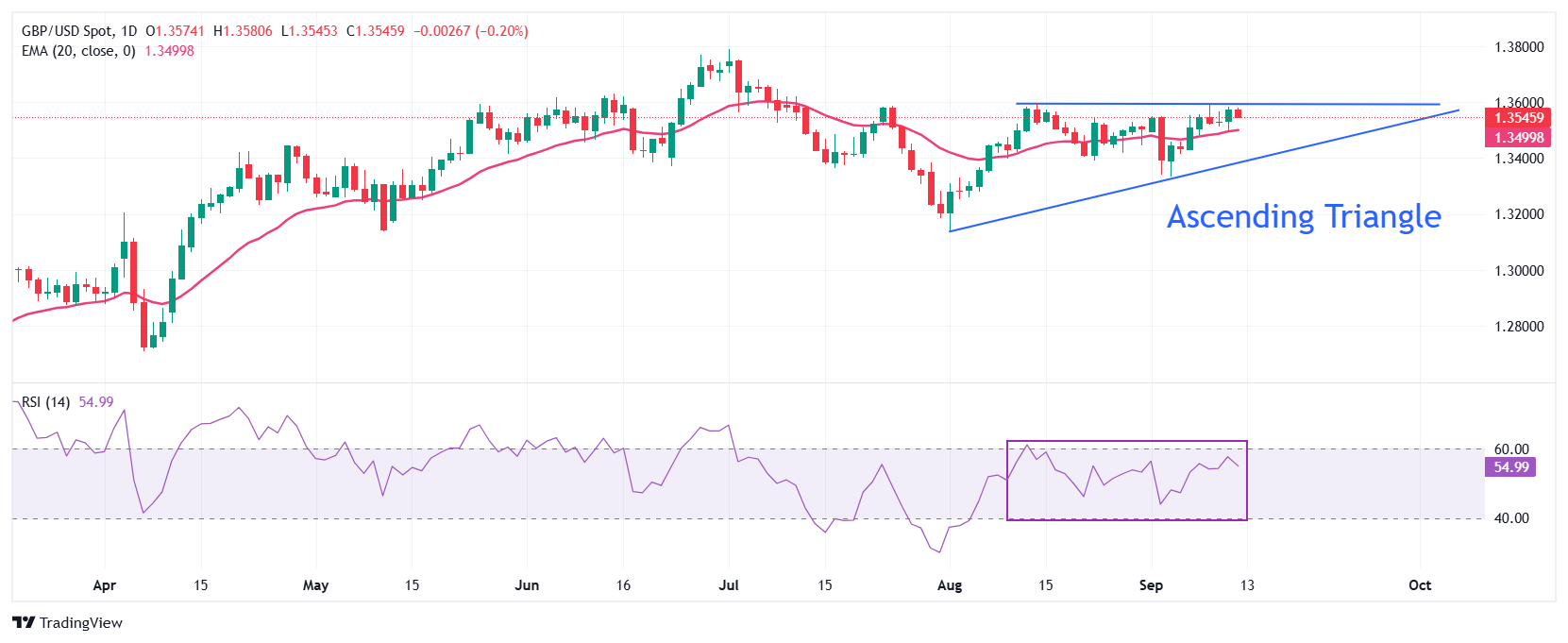
The Pound Sterling retraces to near 1.3550 against the US Dollar on Friday. The near-term trend of the Cable remains sideways as it trades close to the 20-day Exponential Moving Average (EMA), which is around 1.3487.
The GBP/USD pair trades inside the Ascending Triangle pattern, which indicates indecisiveness among investors. The horizontal resistance of the above-mentioned chart pattern is plotted from the July 23 high around 1.3585, while the upward-sloping border is placed from the August 1 low near 1.3140.
The 14-day Relative Strength Index (RSI) oscillates inside the 40.00-60.00 range, indicating a sideways trend.
Looking down, the August 1 low of 1.3140 will act as a key support zone. On the upside, the July 1 high near 1.3800 will act as a key barrier.
Economic Indicator
Michigan Consumer Sentiment Index
The Michigan Consumer Sentiment Index, released on a monthly basis by the University of Michigan, is a survey gauging sentiment among consumers in the United States. The questions cover three broad areas: personal finances, business conditions and buying conditions. The data shows a picture of whether or not consumers are willing to spend money, a key factor as consumer spending is a major driver of the US economy. The University of Michigan survey has proven to be an accurate indicator of the future course of the US economy. The survey publishes a preliminary, mid-month reading and a final print at the end of the month. Generally, a high reading is bullish for the US Dollar (USD), while a low reading is bearish.
Read more.Next release: Fri Sep 12, 2025 14:00 (Prel)
Frequency: Monthly
Consensus: 58
Previous: 58.2
Source: University of Michigan
Consumer exuberance can translate into greater spending and faster economic growth, implying a stronger labor market and a potential pick-up in inflation, helping turn the Fed hawkish. This survey’s popularity among analysts (mentioned more frequently than CB Consumer Confidence) is justified because the data here includes interviews conducted up to a day or two before the official release, making it a timely measure of consumer mood, but foremost because it gauges consumer attitudes on financial and income situations. Actual figures beating consensus tend to be USD bullish.
Author

Sagar Dua
FXStreet
Sagar Dua is associated with the financial markets from his college days. Along with pursuing post-graduation in Commerce in 2014, he started his markets training with chart analysis.
















