Pound Sterling declines on weak UK Q3 GDP, labour data
- The Pound Sterling has further weakened due to softer-than-projected flash UK Q3 GDP growth data.
- The UK economy expanded 0.1% in the third quarter, slower than estimates of 0.2%.
- The US government reopens after a 43-day shutdown, the longest in history.

The Pound Sterling (GBP) continues to underperform its major currency peers as weaker-than-projected United Kingdom (UK) preliminary Gross Domestic Product (GDP) data has prompted further economic concerns.
On Tuesday, the UK's economic uncertainty escalated after the release of the labour market data for the three months ending September, which showed that the Unemployment Rate accelerated to 5%, the highest level seen since February 2021.
During the European session, the UK Office for National Statistics (ONS) reported that the economy expanded 0.1% in the third quarter of the year, slower than estimates of 0.2% and the 0.3% growth seen in the second quarter. On an annualized basis, the UK economy grew at a moderate pace of 1.3%, against expectations and the prior release of 1.4%.
Month-on-month, the UK economy contracted by 0.1% in September, while it was expected to remain flat. Meanwhile, Manufacturing and Industrial Production have declined at a stronger-than-projected pace in September after rising in August. On month, the Manufacturing and Industrial Production dropped by 1.7% and 2%, respectively.
Signs of slowing UK economic growth and declining factory activity would further intensify market speculation that the Bank of England (BoE) will cut interest rates at the December monetary policy meeting, which accelerated after soft job market data.
On the political front, several British media outlets have stated that the allies of Prime Minister Kier Starmer are conspiring to oust him ahead of the Autumn Budget, which is scheduled to be unveiled later this month. Starmer’s ousting at times when the UK economy is facing higher fiscal debt risks would lead to political instability, an event that might boost gilt yields.
Pound Sterling Price Today
The table below shows the percentage change of British Pound (GBP) against listed major currencies today. British Pound was the weakest against the Australian Dollar.
| USD | EUR | GBP | JPY | CAD | AUD | NZD | CHF | |
|---|---|---|---|---|---|---|---|---|
| USD | -0.18% | -0.09% | -0.15% | -0.03% | -0.43% | -0.12% | -0.25% | |
| EUR | 0.18% | 0.09% | 0.02% | 0.15% | -0.26% | 0.06% | -0.07% | |
| GBP | 0.09% | -0.09% | -0.08% | 0.06% | -0.34% | -0.03% | -0.16% | |
| JPY | 0.15% | -0.02% | 0.08% | 0.10% | -0.30% | -0.02% | -0.11% | |
| CAD | 0.03% | -0.15% | -0.06% | -0.10% | -0.39% | -0.10% | -0.23% | |
| AUD | 0.43% | 0.26% | 0.34% | 0.30% | 0.39% | 0.32% | 0.20% | |
| NZD | 0.12% | -0.06% | 0.03% | 0.02% | 0.10% | -0.32% | -0.13% | |
| CHF | 0.25% | 0.07% | 0.16% | 0.11% | 0.23% | -0.20% | 0.13% |
The heat map shows percentage changes of major currencies against each other. The base currency is picked from the left column, while the quote currency is picked from the top row. For example, if you pick the British Pound from the left column and move along the horizontal line to the US Dollar, the percentage change displayed in the box will represent GBP (base)/USD (quote).
Daily digest market movers: US Dollar slides further amid firm Fed dovish bets
- The Pound Sterling rebounds to near 1.3165 against the US Dollar (USD) during the European trading session on Thursday after attracting bids near the intraday low of 1.3100. The GBP/USD pair ticks higher even as the Pound Sterling underperforms due to weak UK data, suggesting significant weakness in the US Dollar.
- During the press time, the US Dollar Index (DXY), which tracks the Greenback’s value against six major currencies, slides to near 99.15, the lowest level seen in almost two weeks.
- The US Dollar has come under pressure amid firm expectations that the Federal Reserve (Fed) will cut interest rates again this year.
- According to the CME FedWatch tool, the probability of the Fed cutting interest rates by 25 basis points (bps) to 3.50%-3.75% in the December meeting is 67%. This will be the third interest rate cut by the Fed in a row.
- The latest Reuters poll on the Fed’s interest rate decision for the December meeting shows that 80% of economists predicted a 25-bps interest rate reduction, citing weak job market conditions.
- On Wednesday, Boston Fed Bank President Susan Collins stressed the need to loosen monetary conditions further amid escalating job market risks. “It is prudent to normalize rates a bit further in 2025 as the downside risks to the labor market have likely risen,” Collins said at the Greater Boston Chamber of Commerce.
- On the political front, the US President Donald Trump signed the spending bill on Wednesday to reopen the government after what has been the longest shutdown ever, lasting 43 days, BBC News reported.
Technical Analysis: Pound Sterling stays below 200-day EMA
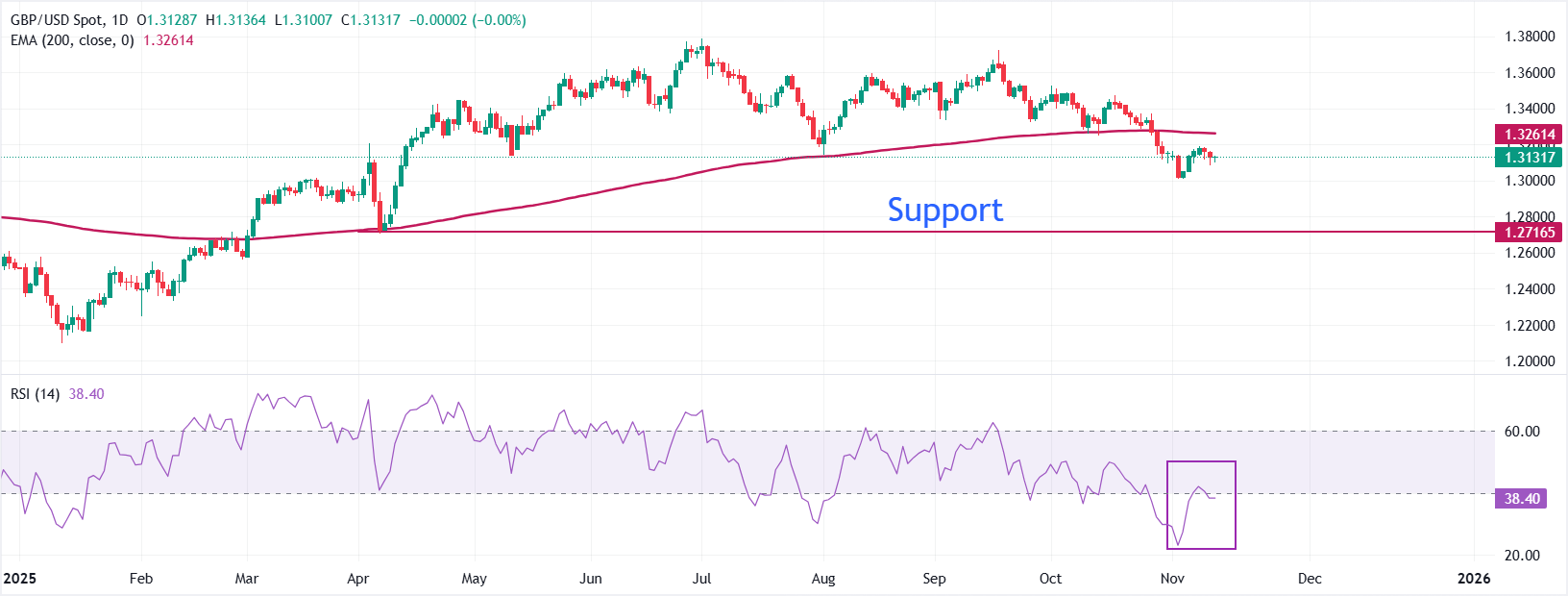
The Pound Sterling trades inside the previous day’s trading range around 1.3130 against the US Dollar on Thursday. The overall trend of the pair remains bearish as it trades below the 200-day Exponential Moving Average (EMA), which is around 1.3261.
The 14-day Relative Strength Index (RSI) struggles to return above 40.00. A fresh bearish momentum would emerge if the RSI resumes its downside journey.
Looking down, the April low near 1.2700 will act as a key support zone. On the upside, the October 28 high around 1.3370 will act as a key barrier.
GDP FAQs
A country’s Gross Domestic Product (GDP) measures the rate of growth of its economy over a given period of time, usually a quarter. The most reliable figures are those that compare GDP to the previous quarter e.g Q2 of 2023 vs Q1 of 2023, or to the same period in the previous year, e.g Q2 of 2023 vs Q2 of 2022. Annualized quarterly GDP figures extrapolate the growth rate of the quarter as if it were constant for the rest of the year. These can be misleading, however, if temporary shocks impact growth in one quarter but are unlikely to last all year – such as happened in the first quarter of 2020 at the outbreak of the covid pandemic, when growth plummeted.
A higher GDP result is generally positive for a nation’s currency as it reflects a growing economy, which is more likely to produce goods and services that can be exported, as well as attracting higher foreign investment. By the same token, when GDP falls it is usually negative for the currency. When an economy grows people tend to spend more, which leads to inflation. The country’s central bank then has to put up interest rates to combat the inflation with the side effect of attracting more capital inflows from global investors, thus helping the local currency appreciate.
When an economy grows and GDP is rising, people tend to spend more which leads to inflation. The country’s central bank then has to put up interest rates to combat the inflation. Higher interest rates are negative for Gold because they increase the opportunity-cost of holding Gold versus placing the money in a cash deposit account. Therefore, a higher GDP growth rate is usually a bearish factor for Gold price.
Author

Sagar Dua
FXStreet
Sagar Dua is associated with the financial markets from his college days. Along with pursuing post-graduation in Commerce in 2014, he started his markets training with chart analysis.