Pound Sterling slides below 1.3100 on Middle East risks, Fed large rate cut bets wane
- The Pound Sterling falls sharply below 1.3100 against the US Dollar as traders pare Fed large rate cut bets.
- US NFP report for September showed a sharp uptick in payrolls and wage growth.
- Growing Middle East tensions weigh heavily on risk-sensitive assets.

The Pound Sterling (GBP) weakens and slips below 1.3100 against the US Dollar (USD) in Monday’s North American session. The GBP/USD pair faces a sharp sell-off as the US Dollar holds gains to near an almost seven-week high, driven by robust growth in the United States (US) Nonfarm Payrolls (NFP) for September, released on Friday. The US Dollar Index (DXY), which tracks the Greenback’s value against six major currencies, extends its winning streak for the sixth trading day on Monday to near 102.50.
All components of the US labor market report for September pointed to a resilient economy. Fresh payrolls came in at 254K, the highest level seen since March, and the Unemployment Rate dropped to 4.1%. Average Hourly Earnings, a key measure of wage growth that drives consumer spending, rose at a robust pace of 4% year-over-year.
Surprisingly upbeat labor market data forced traders to unwind bets supporting a Federal Reserve’s (Fed) larger-than-usual rate cut of 50 basis points (bps) in November. According to the CME FedWatch tool, the Fed's probability of reducing interest rates by 50 bps has been entirely wiped out, and a quarter-to-a-percentage rate cut is now widely anticipated.
On Friday, Chicago Fed Bank President Austan Goolsbee called the latest US employment report "superb". He added, "If we get more reports like this, I'm going to feel a lot more confident that we are, in fact, settling in at full employment," Reuters reported.
Going forward, investors will focus on the US Consumer Price Index (CPI) data for September, which will be published on Thursday. The inflation data will provide more clarity about the Fed’s likely interest rate action in November.
Daily digest market movers: Pound Sterling declines on Bailey supports aggressive rate cuts if inflation eases further
- The Pound Sterling weakens against its major peers at the start of the week. The British currency faces pressure on dismal market sentiment due to growing tensions between Iran and Israel in the Middle East region. Israel intensified strikes across Beirut and its southern suburbs on Sunday after Israeli Prime Minister Benjamin Netanyahu vowed to win.
- Ongoing tensions in the Middle East region have deepened risks of Oil supply chain reduction, which have resulted in a sharp upside in energy prices. This could lead to a higher foreign outflow from Oil-importing economies.
- Apart from the cautious market mood, rising expectations of the Bank of England (BoE) to cut interest rates again in November have also weighed on the Pound Sterling. Last week, the comments from BoE’s Governor Andrew Bailey in an interview with the Guardian newspaper indicated that the central bank could be a bit more aggressive in its approach to lower interest rates if inflationary pressures continue to decline.
- On the contrary, BoE Chief Economist Huw Pill advised cutting interest rates gradually in his speech at the Institute of Chartered Accountants in England and Wales on Friday. Pill said, "While further cuts in Bank Rate remain in prospect should the economic and inflation outlook evolve broadly as expected, it will be important to guard against the risk of cutting rates either too far or too fast.”
- This week, the major trigger for the Pound Sterling will be the monthly Gross Domestic Product (GDP) and the factory data for August, which will be released on Friday.
Technical Analysis: Pound Sterling breaks below trendline support
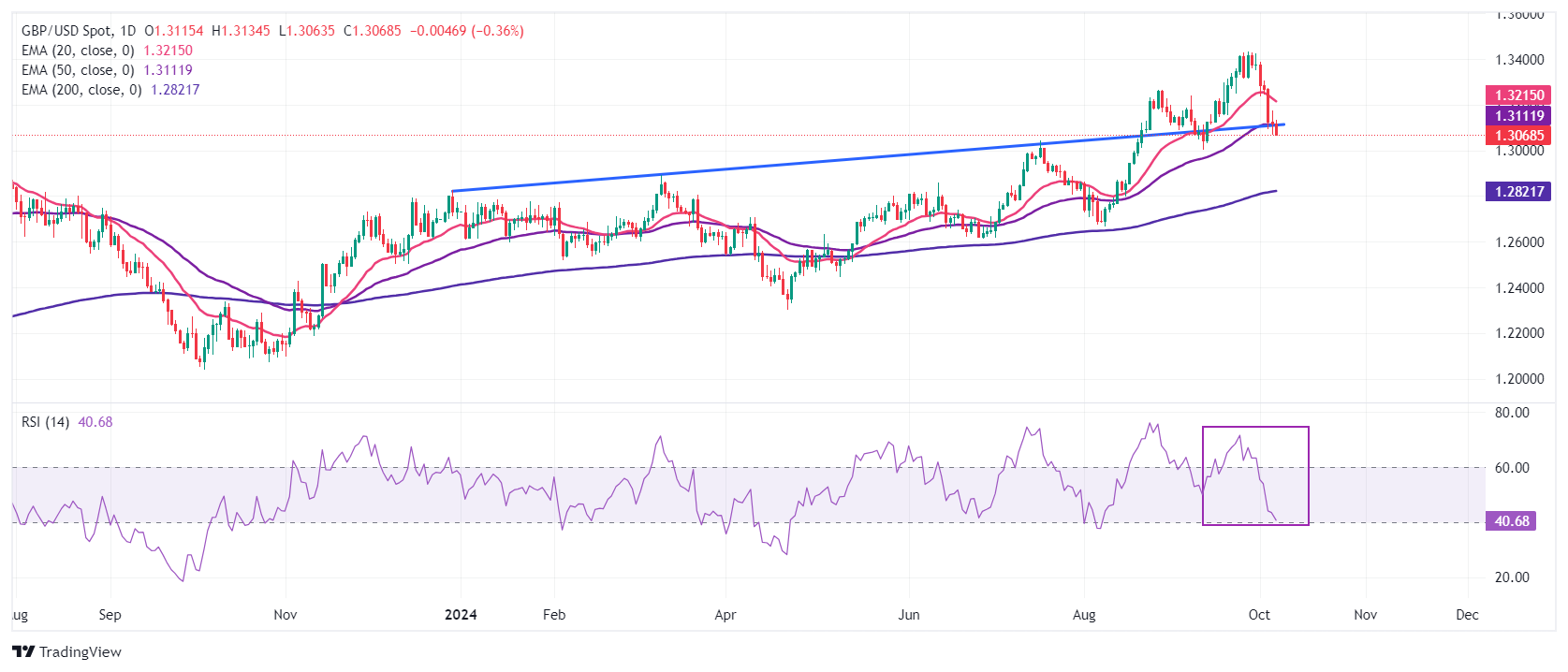
The Pound Sterling trades inside Friday’s trading range, with investors focusing on the US CPI data for September. The GBP/USD pair is expected to remain on the backfoot as it struggles to hold the 50-day Exponential Moving Average (EMA), which trades around 1.3110. The Cable is at make or a break near the upward-sloping trendline from the 28 December 2023 high of 1.2827.
The 14-day Relative Strength Index (RSI) declines inside the 40.00-60.00 range, suggesting a loss of bullish momentum. However, the upside trend remains intact.
Looking up, the 20-day EMA near 1.3234 will be a major barricade for the Pound Sterling bulls. On the downside, the pair would find support near the psychological figure of 1.3000.
Author

Sagar Dua
FXStreet
Sagar Dua is associated with the financial markets from his college days. Along with pursuing post-graduation in Commerce in 2014, he started his markets training with chart analysis.